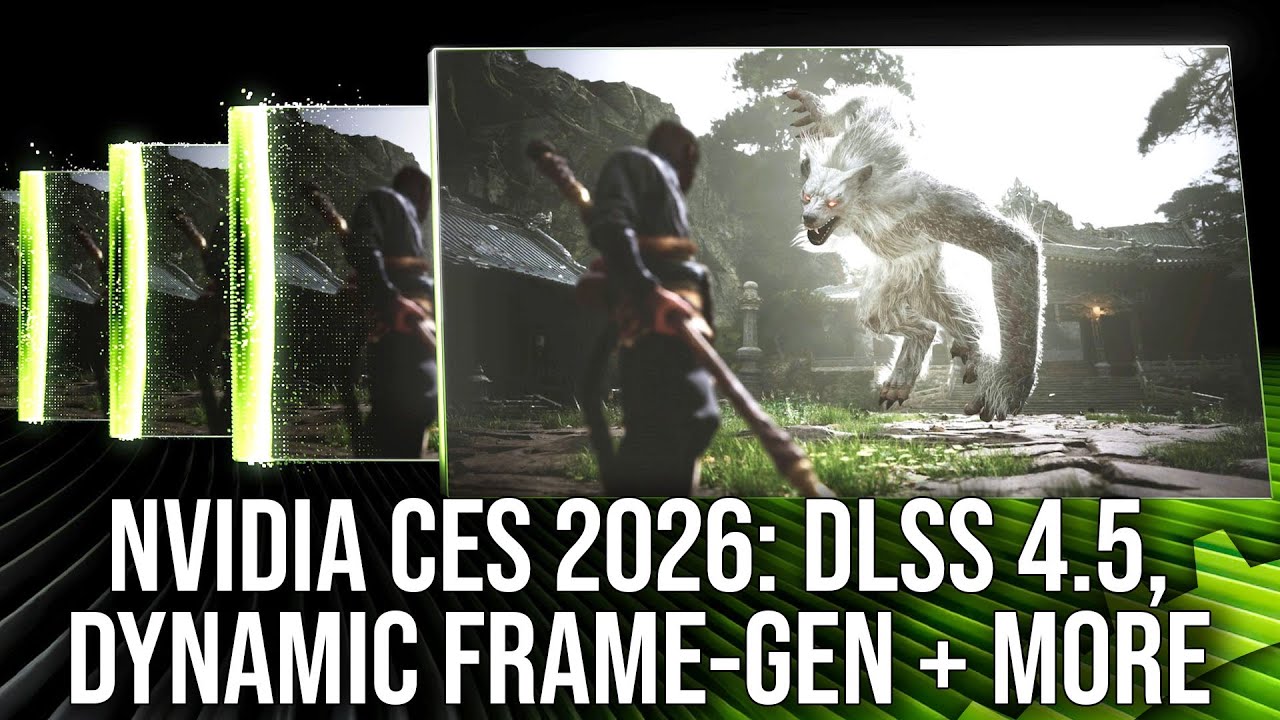
At CES 2026, Oliver and Alex provided an in-depth hands-on report from the Nvidia booth, highlighting several cutting-edge technologies. The centerpiece was DLSS 4.5, an iterative upgrade on Nvidia’s transformer-based upscaling model first introduced with DLSS 4.0. DLSS 4.5 was showcased running on an RTX 5090, demonstrating improved image quality with better handling of specular highlights, particles, and tone mapping, resulting in more accurate and stable visuals. Although the new model is slightly more computationally expensive (2-3% more), it offers noticeable enhancements in clarity and detail in games like Black Myth Wukong, with easy toggling between old and new models for comparison.
Alongside DLSS 4.5, Nvidia revealed dynamic frame generation technology capable of multiplying frame rates by up to six times with minimal latency increase. Demonstrated on Outer Worlds 2 running on an RTX 5060 Ti, this technology adapts frame generation dynamically based on GPU load, maintaining smooth gameplay and responsiveness. Improvements in how semi-transparent UI elements are handled were also noted, potentially reducing ghosting artifacts in future implementations. While the demo showed promising results, some limitations were acknowledged, especially in open-world scenarios where stuttering might become more apparent.
The discussion then shifted to the new Capcom title Pragmata, which utilizes Nvidia’s advanced ray tracing and path tracing technologies within the RE engine. The demo impressed with its highly precise and clean shadows, realistic reflections including dynamic strand-based hair rendering, and improved global illumination. Despite some noise and “firefly” artifacts during the demo, these are expected to be addressed before release. Pragmata’s implementation of path tracing marks a significant visual upgrade for the RE engine, enhancing the game’s sci-fi environments with detailed lighting and reflections.
Nvidia also showcased enhancements to RTX Remix, a modding technology that now supports dynamic, logic-based changes to game environments without needing source code access. This allows modders to create interactive and reactive game elements such as changing weather, time of day, or enemy effects based on player actions. The technology was demonstrated with various examples, including environmental effects and enemy visual cues, highlighting its potential to expand modding creativity and gameplay experiences. Additionally, Nvidia introduced G-Sync Pulsar, a novel strobing display technology that reduces perceived motion blur to near CRT levels while maintaining brightness and VRR compatibility, though it exhibits a flicker that is not noticeable to the human eye.
Finally, Nvidia presented exciting machine learning integrations in games, including local, on-device small language models for enhanced player interaction. A Total War: Pharaoh’s demo showed an AI-powered tutorial assistant providing contextual gameplay advice based on real-time game state, improving player onboarding. Another demo in PUBG featured a virtual NPC capable of understanding spoken commands and responding naturally using speech-to-text and text-to-speech models running locally on the GPU, offering a highly interactive experience without cloud dependency. Nvidia also addressed rumors about RTX 3060 availability and RTX 5090 pricing, confirming no major changes or new MSRP announcements, indicating stable product availability despite market fluctuations. Overall, the event highlighted Nvidia’s steady innovation in graphics, AI, and display technologies, with promising enhancements set to improve gaming experiences in the near future.