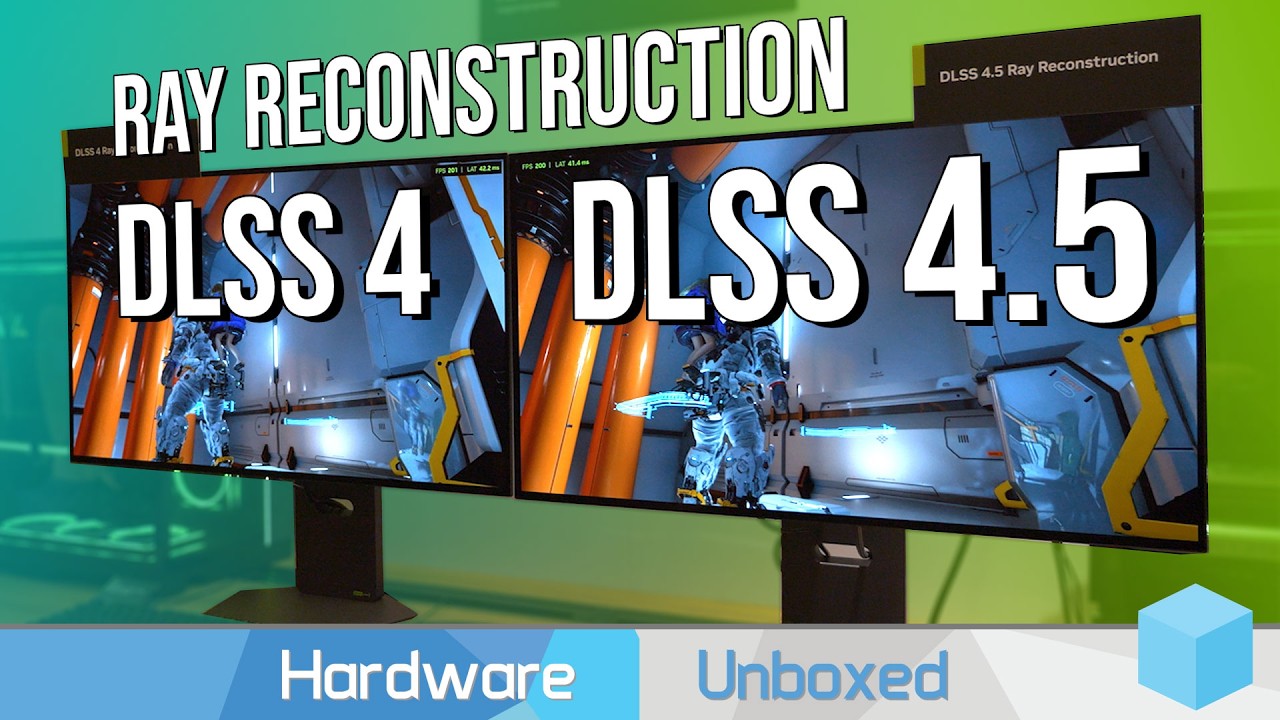
Hardware Unboxed showcased Nvidia’s upcoming DLSS 4.5 ray reconstruction technology, which combines advanced upscaling with improved denoising to enhance image quality, reduce ghosting and noise artifacts, and preserve texture details more effectively than DLSS 4. The technology promises better performance, seamless integration via app overrides, and significant visual improvements in ray-traced games, with an expected launch around August 2026.
Hardware Unboxed visited Nvidia at Computex 2026 to explore the highly anticipated DLSS 4.5 ray reconstruction technology, a significant upgrade aimed at gamers. Unlike previous versions where users had to choose between DLSS upscaling and ray reconstruction, DLSS 4.5 combines the benefits of advanced upscaling (using second-generation transformer models) with improved ray reconstruction denoising. Although this feature is not yet available, it is expected to launch around August 2026, promising enhanced image quality and better integration without requiring game-specific updates.
The demonstration using the game Pragmata highlighted noticeable improvements in image quality with DLSS 4.5 ray reconstruction compared to DLSS 4. Notably, DLSS 4.5 effectively eliminates ghosting artifacts, especially visible with moving laser effects, where previous versions showed distracting fading and retention. The text clarity and stability also improved significantly, reducing the “boiling” and “sizzling” artifacts often seen in ray-traced scenes. These enhancements contribute to a more stable and visually pleasing gaming experience, particularly in areas prone to ray tracing noise.
Another demo showcasing Indiana Jones revealed that DLSS 4.5 improves texture detail retention during denoising. The challenge with denoising is distinguishing between actual texture details and noise; DLSS 4.5 better preserves fine textures such as rocky surfaces and barrels, which were somewhat lost in DLSS 4. Additionally, DLSS 4.5 offers more responsive lighting effects, enhancing realism when new light sources appear. These improvements demonstrate the technology’s ability to maintain high fidelity in complex scenes while managing noise more effectively.
Performance-wise, DLSS 4.5 with 6x frame generation showed similar or slightly better performance compared to DLSS 4 with 4x frame generation in the demos, suggesting that the newer version remains efficient despite the enhanced image quality. Nvidia also introduced an app update override feature allowing existing games that support ray reconstruction to upgrade seamlessly to DLSS 4.5 without waiting for individual game patches, which should facilitate widespread adoption and usability.
Overall, the Hardware Unboxed team expressed enthusiasm about DLSS 4.5 ray reconstruction, emphasizing its potential to significantly improve visual fidelity and reduce common ray tracing artifacts like ghosting and noise. While the current demonstrations are promising, they look forward to testing DLSS 4.5 across a broader range of games to fully evaluate its performance and image quality benefits. The update is expected to be available soon, marking an important step forward for Nvidia’s ray tracing and AI upscaling technologies in gaming.