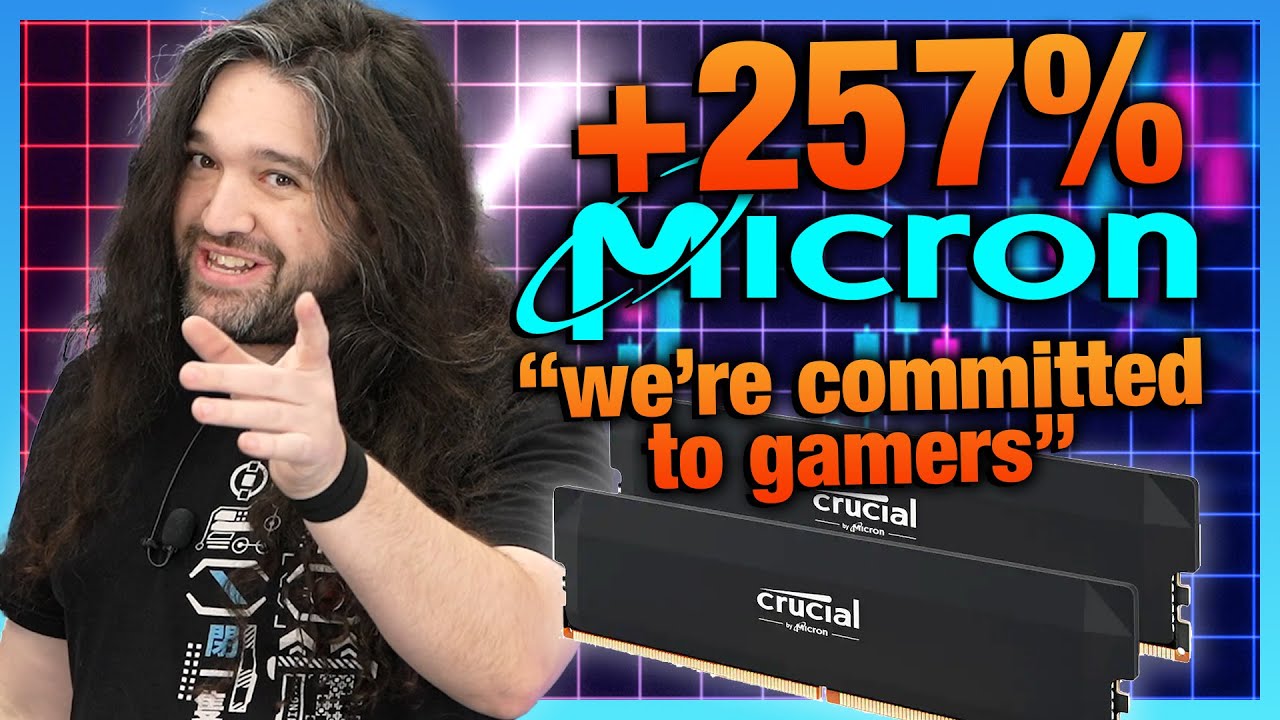
The video discusses Micron’s recent financial performance and strategic shift, highlighting its record growth in the data center memory segment, which increased by 257% year-over-year. This surge is driven primarily by demand from AI and cloud computing sectors, where Micron enjoys higher profit margins compared to its consumer memory business. Consequently, Micron is reallocating memory supply away from consumer markets to data centers, resulting in rising prices and reduced availability for gamers and general consumers. This shift is reflected in industry forecasts predicting an 8% increase in PC prices by 2026 and a contraction in PC market sales due to memory shortages.
Micron’s commitment to gamers, as stated in an October 2024 press release for its new Crucial DDR5 Pro overclocking memory, is called into question since the company discontinued the Crucial consumer brand just 43 days later. This move is seen as a deliberate deception, with Micron prioritizing AI and data center markets over consumer interests. The video underscores how Micron’s focus on AI infrastructure has led to a significant increase in revenue and market capitalization, while consumer memory products face neglect and price hikes. The broader industry trend includes system integrators offering RAMless PCs for users to reuse existing memory due to soaring RAM costs.
The video also covers market-wide impacts, noting that other companies like Lenovo and Dell are stockpiling memory chips, further tightening supply and driving prices up. G.Skill has warned consumers about rising prices, and scalpers continue to exploit the shortage with inflated prices on secondary markets. TrendForce projects that smartphones, laptops, and consoles will see price increases coupled with reduced specifications, a phenomenon described as “shrinkflation,” driven by the prioritization of memory supply for AI and data center applications over consumer products.
Micron’s financial reports reveal the stark contrast between its cloud memory business, which achieved a 48% operating margin and rapid revenue growth, and its mobile and client segment, which grew minimally and operates at a lower margin. The company is investing heavily in capital expenditures to expand HBM (high bandwidth memory) production for AI workloads, supported by government subsidies and tax incentives. Despite the consumer memory segment’s decline, Micron is focusing on maintaining its AI-driven growth trajectory, with no plans to alleviate memory shortages affecting consumers.
Finally, the video contextualizes Micron’s actions within the broader semiconductor industry, controlled largely by three major suppliers: Micron, Samsung, and SK Hynix. The AI boom, centered around Nvidia’s GPU demand, is reshaping memory supply priorities and pricing strategies. The video advises consumers, especially PC builders and gamers, to consider alternatives such as CPUs with cache-optimized architectures (e.g., AMD’s X3D) to mitigate memory performance issues. It also highlights the growing challenges for consumers facing escalating prices and reduced hardware specifications amid the ongoing AI-driven memory supply crisis.