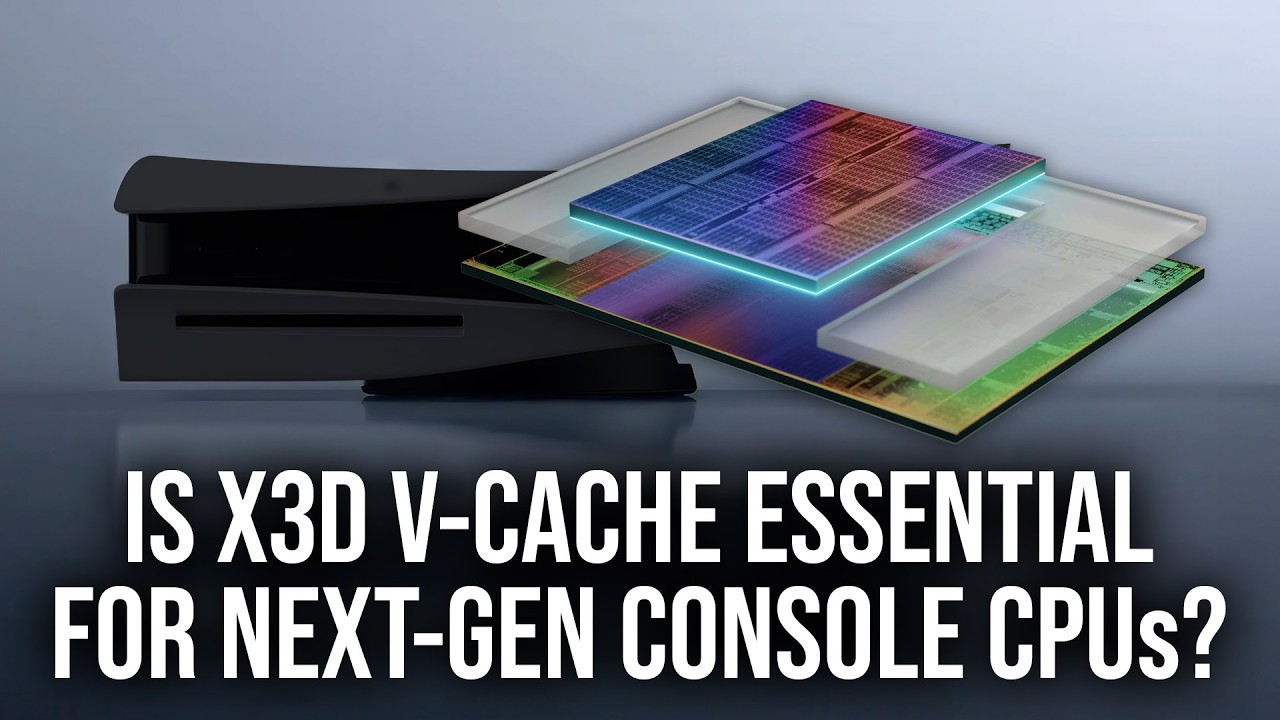
The discussion concludes that while AMD’s 3D V-Cache offers notable gaming performance benefits, its high cost, manufacturing challenges, and thermal issues make it impractical for inclusion in next-generation mass-market consoles. Instead, future consoles are more likely to focus on optimizing existing hardware and exploring alternative architectures like ARM rather than adopting expensive new cache technologies.
The discussion revolves around whether AMD’s 3D V-Cache technology should be included in next-generation console CPUs. While gamers appreciate the performance benefits of 3D V-Cache, especially as seen in the AMD 5800X3D, the panelists argue that its inclusion in consoles is not straightforward. The main challenge is the high cost associated with adding large amounts of extra cache memory to the CPU, which significantly increases silicon fabrication expenses. Consoles prioritize cost-effectiveness and broad accessibility, making such an expensive feature less practical for mass production.
Another critical point raised is the scalability and manufacturing challenges of 3D V-Cache for consoles. While it may be feasible for high-end PC gaming with limited production runs, scaling the technology to tens of millions of units annually, as required by console demand, is currently unrealistic. The packaging and fab processes needed for 3D V-Cache are not yet optimized for such volume, making it a non-starter for commodity consoles or even pro variants. Developers typically optimize games to run well within the existing CPU cache limits, reducing the necessity for such expensive hardware enhancements.
Thermal management and power consumption also pose significant obstacles. The 3D stacking involved in 3D V-Cache increases heat output, complicating cooling solutions in the confined spaces of console APUs. Maintaining predictable thermals and a compact form factor while keeping costs under a thousand dollars is a major engineering challenge. These factors further diminish the likelihood of 3D V-Cache becoming standard in consoles anytime soon, despite ongoing improvements in cache design and efficiency.
The conversation also touches on alternative CPU architectures for future consoles, such as ARM-based designs, inspired by successes like the Nintendo Switch and Apple Silicon. Although Sony and Microsoft currently rely on x86 architectures, ARM’s efficiency and performance gains make it an interesting possibility for future generations, albeit still uncertain given current industry trajectories. The panelists suggest that the next generation of consoles may instead focus on optimizing existing hardware and software rather than incorporating costly new technologies like 3D V-Cache.
Finally, the discussion briefly shifts to AMD’s upcoming Ryzen 9 9950X3D 2 CPU, which will feature 16 cores and substantial cache, targeting prosumer and professional workloads rather than gaming alone. This new chip is expected to compete with Intel’s Core Ultra Plus series but will likely come at a higher price point. While enthusiasts are curious about its performance, there is little urgency to upgrade from existing models. The conversation ends on a lighter note with a humorous reference to “3D Now,” a nod to older AMD technology.