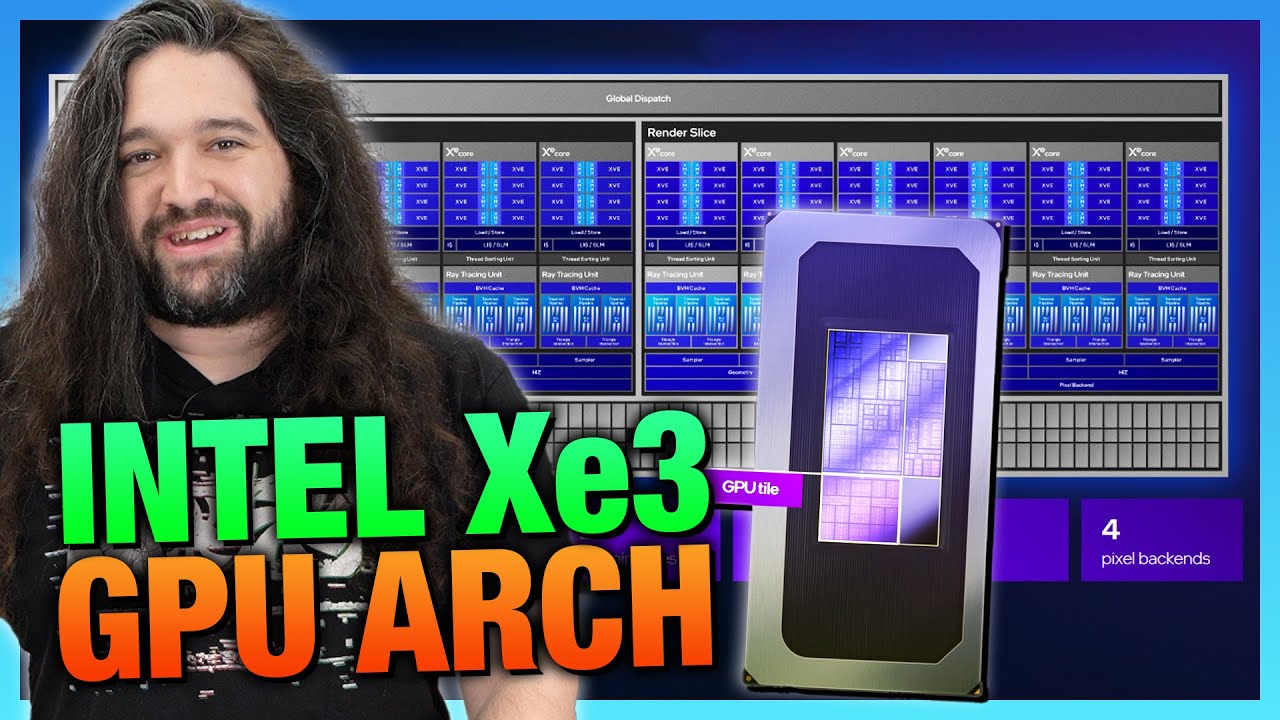
Intel has announced its new XE3 GPU architecture, debuting first in Panther Lake mobile and handheld devices, marking an evolution from the previous XC2 design. The key changes in XE3 include larger render slices with more XE cores per slice, increased L1 and L2 cache sizes, and better register utilization. These hardware improvements aim to address previous limitations in resource utilization and pipeline efficiency seen in Intel’s earlier GPUs like Battle Mage and Alchemist. Microbenchmarks reveal significant performance uplifts in areas such as occluded primitive handling, isotropic filtering, mesh rendering, and ray-triangle intersection, indicating better rendering efficiency and potential gaming performance gains.
A major focus of the XE3 architecture is improved cache hierarchy and register allocation. The L2 cache size doubles from 8MB to 16MB, reducing memory traffic by up to 36% in certain applications, which enhances performance and power efficiency. The L1 cache also increases by 33%, from 192KB to 256KB. Additionally, Intel has introduced variable register allocation and increased thread counts by up to 25%, which helps prevent pipeline starvation when shaders demand many registers. These changes are expected to improve compute unit occupancy and overall GPU utilization, addressing one of Intel’s longstanding challenges with its GPU hardware.
Intel also highlighted improvements to its ray tracing units, including asynchronous dispatch and out-of-order triangle testing, as well as a new URB (Unified Return Buffer) manager that allows partial updates instead of full flushes, reducing serialization bottlenecks. Power management has been enhanced through the introduction of Intelligent Bias Control V3, which prioritizes scheduling on low-power efficiency cores (E-cores) during gaming workloads to better allocate power budgets between CPU and GPU. This approach aims to reduce stuttering and improve frame pacing by dynamically balancing power distribution, particularly benefiting laptops and handheld devices with constrained power envelopes.
Alongside hardware updates, Intel introduced Xe Super Sampling 3 (XeSS3) with a new multi-frame generation (MFG) technique similar to Nvidia’s approach. XeSS3 uses optical flow and depth buffers to generate multiple interpolated frames between real frames, potentially improving perceived frame rates. However, Intel’s claims about image quality parity with native frames are met with skepticism, as frame generation typically involves some quality trade-offs. Intel commits to reporting performance metrics both with and without frame generation to maintain transparency, a contrast to some controversies surrounding Nvidia’s frame generation marketing.
Overall, Intel’s XE3 architecture represents a significant step forward in GPU design focusing on efficiency, utilization, and power management, setting the stage for future discrete GPU launches under the Celestial architecture. While the current rollout is primarily for mobile and handheld devices, the architectural enhancements suggest promising improvements for upcoming DGPU products. Intel’s continued driver and software improvements, combined with hardware advances, aim to close the gap with competitors in gaming and compute performance. Further independent testing and benchmarks, especially in handheld gaming devices like the MSI Claw, will be needed to validate these claims and assess real-world impact.