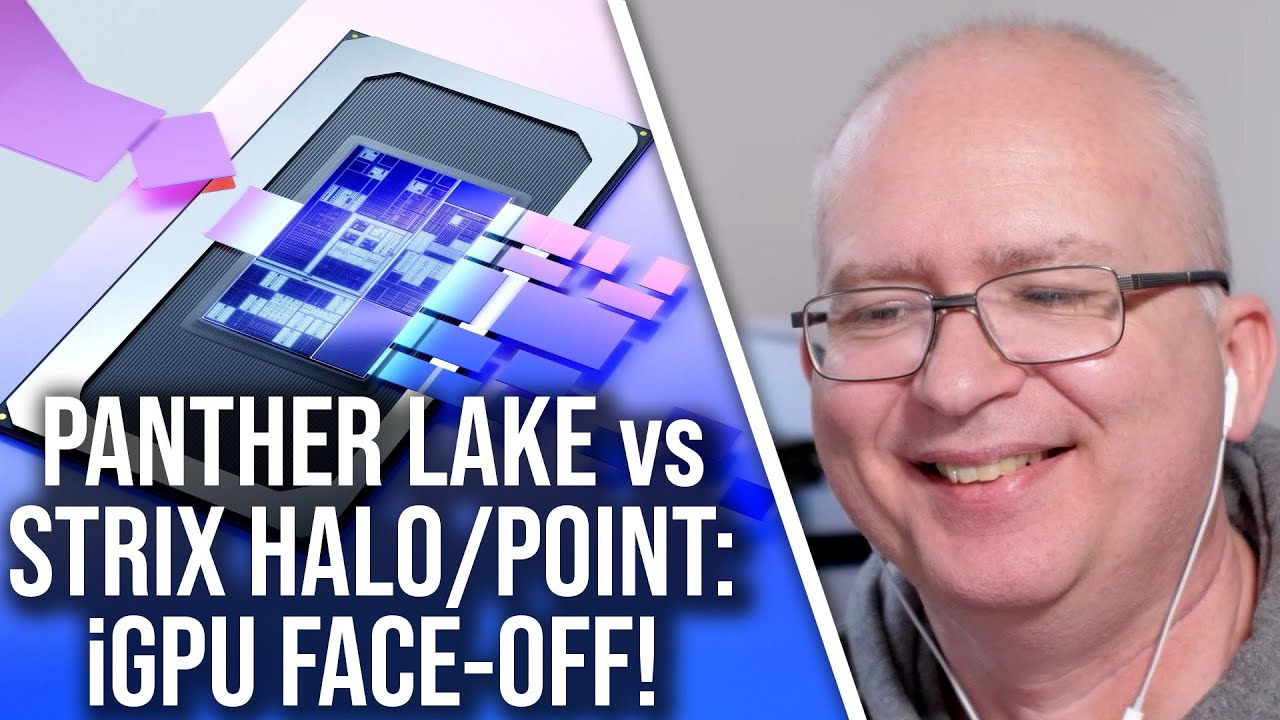
The video presents an in-depth benchmark comparison between Intel’s Panther Lake integrated graphics and AMD’s Strix Point and Strix Halo GPUs, focusing on gaming performance under demanding conditions. Unlike typical PC tech reviews, the benchmarks emphasize stress testing with ray tracing enabled and ultra settings at native 1080p resolution. The games tested include Cyberpunk 2077, Doom: The Dark Ages, and Shadow of the Tomb Raider, chosen for their varying demands and ray tracing integration. The tests aim to push integrated GPUs beyond standard expectations, highlighting Panther Lake’s impressive capabilities in delivering playable frame rates even with heavy graphical loads.
In Cyberpunk 2077, Panther Lake achieves an average of nearly 30 FPS at native 1080p with ray tracing enabled, outperforming Strix Point by a significant margin and trailing Strix Halo by about 24%. When upscaling techniques such as 2x super sampling and frame generation are applied, Panther Lake’s performance nearly doubles, reaching around 96 FPS, showcasing the efficiency of Intel’s machine learning-enhanced super resolution and frame generation technologies. These enhancements provide a substantial boost without heavily compromising visual quality, making Panther Lake stand out as a strong contender in integrated graphics performance.
Doom: The Dark Ages, a highly optimized ray tracing title, further demonstrates Panther Lake’s strength by delivering an average frame rate of 33 FPS at ultra settings and native resolution, significantly outperforming Strix Point and even surpassing Strix Halo by a considerable margin. This result is particularly notable given the game’s handheld-focused design, illustrating Panther Lake’s potential for future handheld gaming devices. The inclusion of ray tracing as a core benchmark element underscores Intel’s focus on future-proofing their integrated graphics solutions for upcoming game titles heavily reliant on ray tracing technology.
Shadow of the Tomb Raider tests reveal Panther Lake’s consistent advantage over Strix Point, often nearly doubling its frame rates across different game segments, while Strix Halo maintains a lead over Panther Lake but at a higher power and die size cost. The discussion highlights the complexities of comparing these GPUs due to differences in power consumption, die area, and manufacturing processes. Additionally, Intel’s use of advanced AI-driven super sampling and frame generation (XCSS) offers superior image quality and performance scaling compared to AMD’s current solutions, positioning Panther Lake as a more efficient and visually appealing option for mobile gaming.
The video concludes with considerations about power efficiency and real-world usage scenarios, noting that Panther Lake’s performance is expected to be fully available even on battery power within a sub-100 watt system envelope, unlike many discrete GPU laptops that suffer performance drops on battery. This power profile, combined with strong integrated graphics performance and advanced upscaling technologies, makes Panther Lake a compelling choice for ultra-portable laptops and upcoming handheld gaming devices. Intel’s plans to standardize Panther Lake for handheld platforms, with industry partners including Microsoft, hint at a promising future for integrated gaming performance in compact form factors.