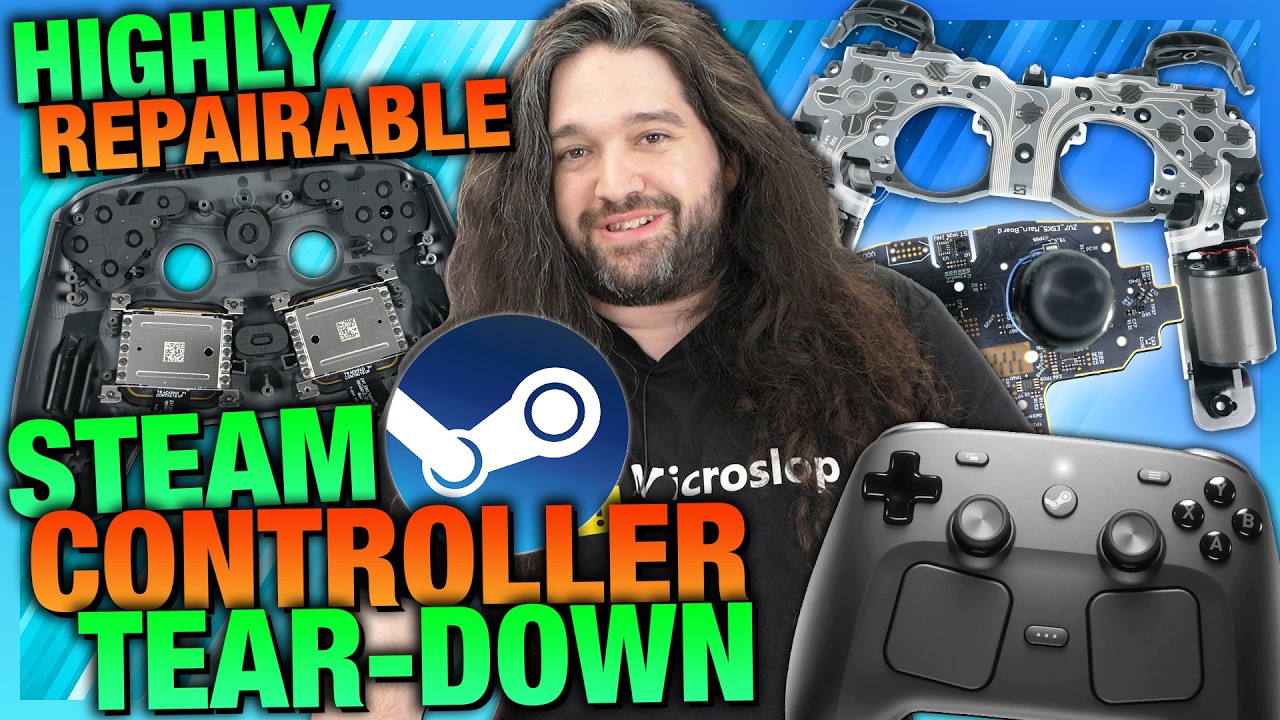
The video thoroughly examines Valve’s Steam Controller, praising its excellent repairability due to clear labeling, modular design, easy-to-remove components, and thoughtful engineering that avoids glue or complex fasteners. This user-friendly approach highlights Valve’s commitment to durability and maintainability, making the controller accessible for repairs and modifications without specialized tools.
The video provides a detailed tear-down and disassembly of Valve’s new Steam Controller, focusing specifically on its repairability and mechanical design. The host praises Valve for the controller’s clear and human-readable labeling on internal components, including cables and circuit boards, which greatly simplifies the repair and maintenance process. The presence of QR codes on nearly every part suggests that Valve is preparing to support repair efforts by providing accessible information and possibly replacement parts, making the controller very user-friendly for repairs and modifications.
Starting the disassembly, the host notes the use of Torx screws and the absence of glue or complicated fasteners, which contrasts favorably with other controllers that often require destructive methods like cutting or grinding to open. The battery is particularly easy to remove, secured only by screws and connected via simple gold contact pads rather than cables, allowing for straightforward replacement. The internal plastic mechanisms for buttons and triggers are simple and robust, using plastic springs and rubber contact pads, which are common and reliable designs in controllers.
Internally, the controller features advanced components such as Valve’s proprietary TMR sticks, a six-axis gyro, grip sensors, and an IR LED for tracking with Valve’s upcoming Steam Frame. The antenna placement is cleverly designed to minimize interference and maximize wireless performance by situating it near the top edge of the controller, away from the user’s hands. The modular design extends to the circuit boards, with easily removable battery cages and clearly labeled connectors, making the internal layout intuitive and accessible.
The host also highlights the thoughtful engineering of the controller’s frame and button contacts, noting the use of carbon contact pads and a well-organized cable routing system. The FSC board and other internal parts are held together with a minimal variety of screws, simplifying reassembly and reducing the risk of damage during repairs. The overall design reflects Valve’s commitment to creating a durable, maintainable product that can be serviced without specialized tools or extensive technical knowledge.
In conclusion, the Steam Controller’s repairability is rated as excellent, with the host commending Valve for prioritizing ease of maintenance and user-friendly assembly. This approach is especially valuable given the fleeting nature of peripheral devices and the importance of longevity for users who invest in quality hardware. The video ends with encouragement to support the channel through their store and Patreon, promising further coverage on the controller’s performance and usability in future videos.