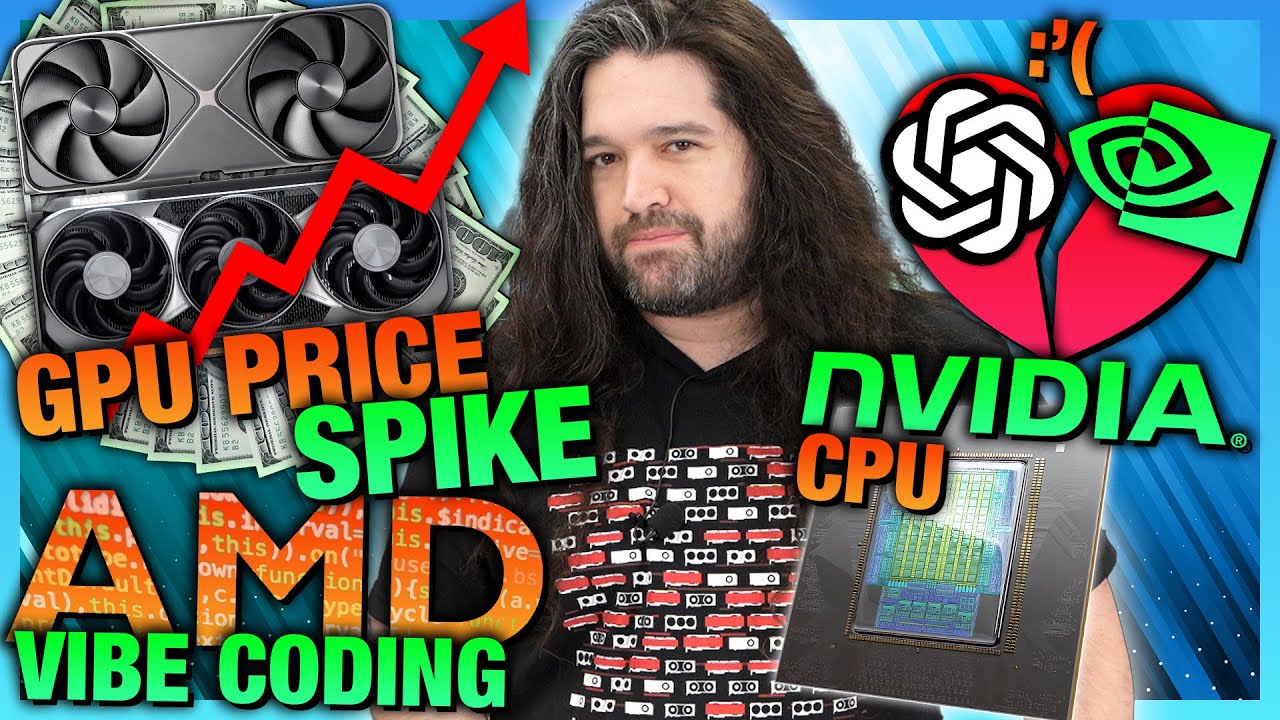
The video begins by discussing the uncertain future of the massive $100 billion deal between OpenAI and Nvidia. Originally, Nvidia pledged this investment to OpenAI under complex conditions involving leasing GPUs and building data centers that are not yet operational. However, recent reports reveal that the agreement was non-binding and not finalized, with Nvidia CEO Jensen Huang expressing skepticism about OpenAI’s business strategy. The competitive pressure from Google’s Gemini AI has also raised concerns at OpenAI. Nvidia’s increasing focus on government and military contracts suggests a shift away from purely commercial AI investments, highlighting challenges like power supply and rare earth mineral availability for data centers.
Next, the video covers a controversy involving AMD and the open-source multimedia project FFmpeg. FFmpeg developers criticized AMD for submitting verbose and poorly documented code patches, suspected to be AI-generated. Although AMD denied explicitly using AI, the incident underscores the growing tension in software development communities around the use of AI tools for coding. This situation reflects broader concerns about AI’s impact on code quality and collaboration, especially in open-source projects where transparency and thorough review are critical.
The discussion then shifts to rumors about Nvidia’s GPU supply strategy for early 2026, suggesting a major focus on lower VRAM models like the RTX 5060 Ti 8GB and RTX 5070 12GB, which could account for 75% of GPU supply. This shift is attributed to increased memory costs and supply constraints. Industry insiders have mixed views, with some system integrators seeing no change while others confirm the trend. Concurrently, GPU prices, which had improved over the past year, are now climbing sharply again. For example, the RTX 5070 Ti and RTX 5090 models are significantly above their original MSRPs, signaling a tough market for consumers.
In another important Nvidia update, CEO Jensen Huang announced plans to sell the Vera CPU as a standalone product, expanding Nvidia’s reach beyond GPUs into ARM-based CPUs. This move positions Nvidia to compete more directly with AMD’s EPYC server processors, although the architectures differ (ARM vs. x86). Nvidia’s increasing stake in Intel and partnerships in mobile chiplets further illustrate its strategy to dominate multiple aspects of computing infrastructure, potentially squeezing AMD’s market share in various sectors.
Finally, the video touches on leaked details about AMD’s upcoming Zen 6 CPU architecture, revealing a shift from 8-core to 12-core CCDs with increased cache and improved silicon density. This could lead to higher core counts in mainstream desktop CPUs and alter AMD’s product lineup, potentially making 24-core CPUs the new high-end standard. AMD plans to support the AM5 socket through at least 2027, with Zen 6 expected to launch before the platform’s end-of-life. The video wraps up by promoting upcoming content, including a documentary on Chinese memory manufacturers and encouraging viewers to support the channel through merchandise and crowdfunding.