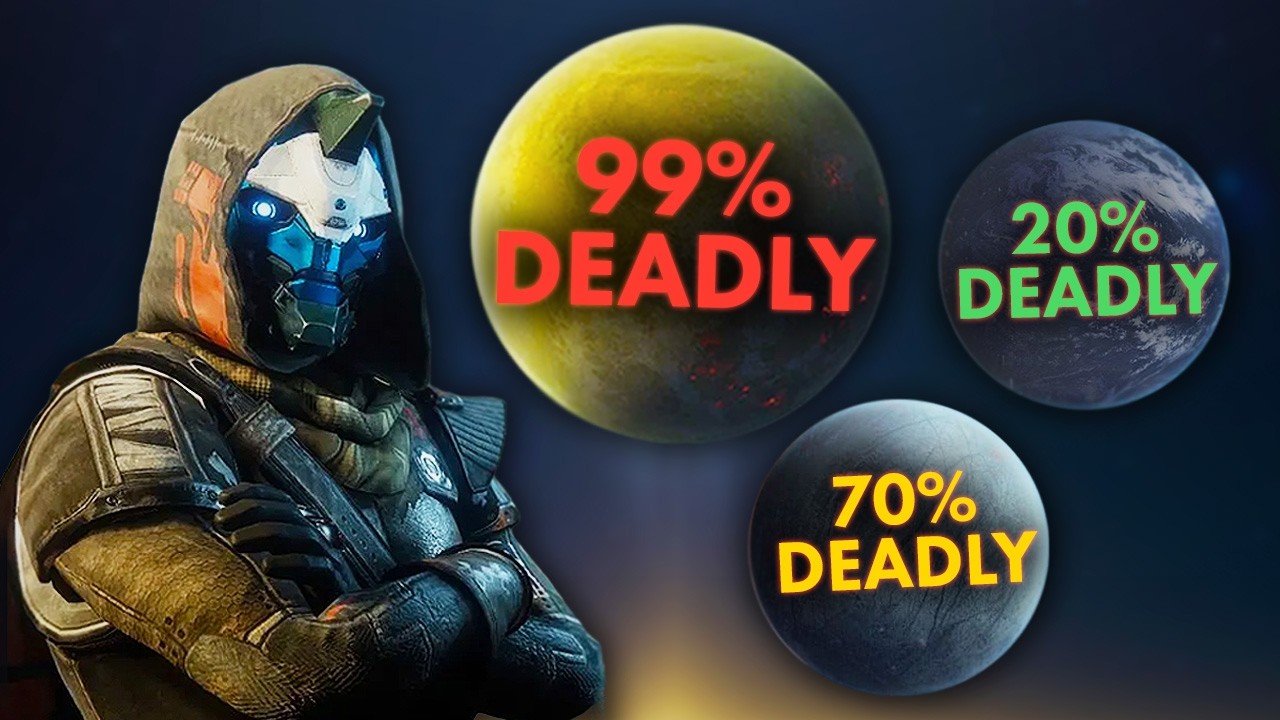
The video explores the question of how long a normal human could survive on various playable planets and locations within the Destiny video game universe. These destinations include real planets and moons from our solar system, such as Venus and Mars, as well as fictional places like the Dreadnot and Sabathun’s Throne World. The creator uses two different perspectives to evaluate survivability: one based on real-world science, considering factors like atmosphere, temperature, surface stability, and resource availability; and another based on Destiny’s in-game lore, which assesses environmental conditions, infrastructure, enemy presence, and political stability. Each factor is scored to produce a survival rating from zero (safe) to 100 (certain death).
Scientifically, most of the planets and locations would result in almost immediate death for a human due to hostile environments like vacuum, extreme temperatures, toxic atmospheres, or crushing pressures. For example, the Dreadnot, a massive spacecraft in deep space, and Sabathun’s Throne World, an extradimensional space, are both instantly lethal. The only two places where humans might survive scientifically are Earth and Kepler — a fictional representation of one of the many exoplanets discovered by NASA’s Kepler Space Telescope. Kepler 186F, in particular, is highlighted as potentially habitable due to its atmosphere and temperature, though it would still be a challenging environment.
When considering Destiny’s lore and the Traveler’s terraforming influence, the survival outlook changes somewhat. Some places that are scientifically deadly become more survivable due to lore-based factors like advanced technology, terraforming, or existing human infrastructure. For instance, the Reef and Neomuna on Neptune are considered relatively safe due to their organized societies and technology. Meanwhile, hostile locations like Mercury, the Moon, and Phobos remain extremely dangerous due to active conflict zones and enemy presence, making survival there less than a day in many cases.
Several other locations fall into intermediate survival categories. Europa, Venus, Io, and the Dreaming City offer survival chances ranging from a day to a week, primarily due to environmental hazards and ongoing conflicts. Mars and the Tangled Shore might allow survival for a week or two, benefiting from some infrastructure and defensive presence but still fraught with danger. Nessus and Titan offer a few months of survivability, with some shelter and less immediate threat, but still pose risks from environmental dangers and enemy factions.
Ultimately, Earth remains the safest place for humans within the Destiny universe, despite being a frequent target for attacks due to the Traveler’s presence. Kepler is noted as a close contender, given its relative isolation from major enemy factions and stable environment. The video concludes by inviting viewers to share their own rankings and opinions, acknowledging that the assessments are subjective and meant for fun. The creator expresses enjoyment in mixing different types of content and hopes the video provided a positive distraction for the Destiny community amid ongoing concerns about the game’s content.