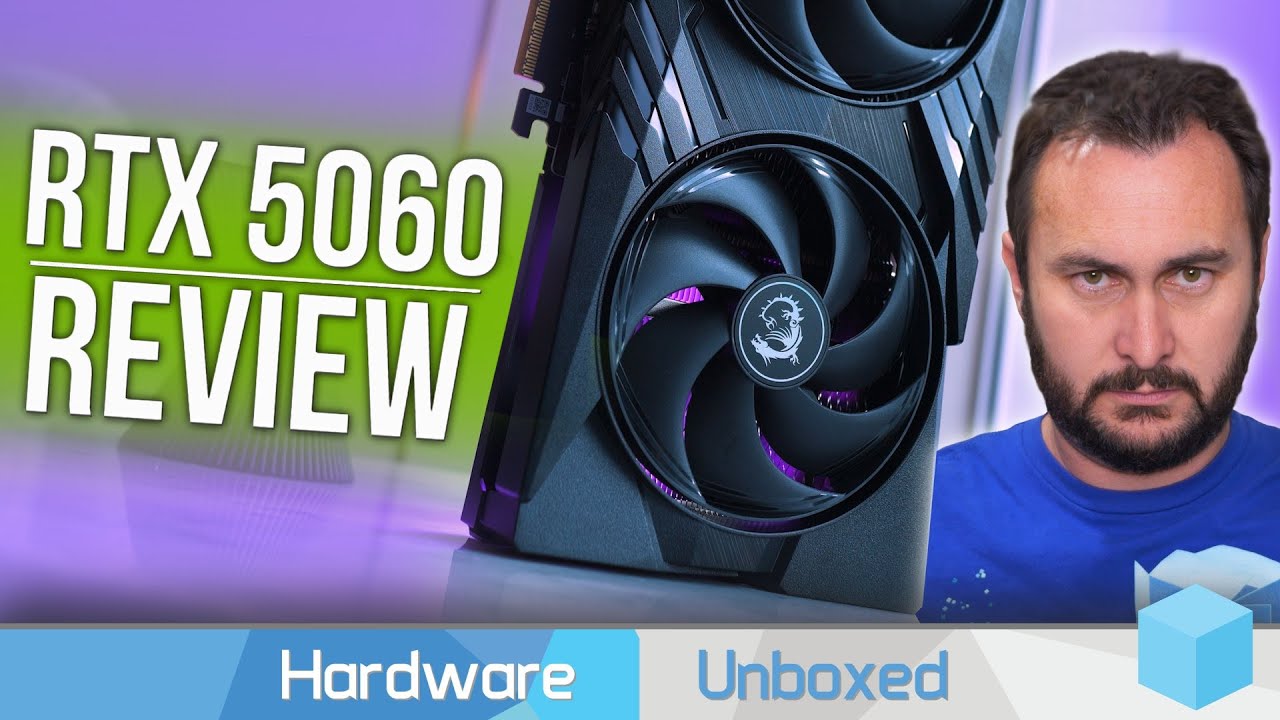
The video is a detailed review of the Nvidia GeForce RTX 5060, highlighting the challenges and limitations faced during its testing. The reviewer, Steve, emphasizes that Nvidia likely did not want this GPU to be widely scrutinized, but he went to great lengths to evaluate it thoroughly. The RTX 5060 is based on the same GB 206 silicon as the 5060 Ti, with a reduced core count and 8 GB of VRAM, which the reviewer criticizes as a significant drawback. Despite improvements in bandwidth and core count over older models, the VRAM limitation and the use of PCIe 5.0 x8 interface are major issues, especially for users with older hardware or at higher resolutions.
Throughout the testing, the RTX 5060 demonstrates performance comparable to older or lower-tier GPUs like the RTX 4060 and 3060 Ti, with some titles showing performance similar to the RTX 3070 and 4060 Ti. In many games, especially at 1080p, it performs well in esports titles and well-optimized games, delivering high frame rates. However, at higher resolutions like 1440p, VRAM limitations cause significant issues, leading to stuttering, missing textures, and unplayable frame rates in several titles. The card’s performance in ray tracing is also underwhelming due to its limited power and VRAM, making it unsuitable for demanding RT features.
The reviewer discusses the value proposition of the RTX 5060, noting that at its current market price of around $330 USD, it offers decent value compared to other GPUs, particularly the RTX 4060 and AMD Radeon options. However, he criticizes Nvidia for releasing a product that essentially is a rebranded or slightly improved version of older GPUs, with the same 8 GB VRAM, which he argues is insufficient for modern gaming and will age poorly. He suggests that with more VRAM, such as 12 or 16 GB, the GPU could have been a more compelling choice, especially for future-proofing.
Overall, the review is quite critical of Nvidia’s strategy and marketing surrounding the RTX 5060. Steve describes the GPU as an “onsale RTX 4060 Ti” or a discounted RTX 3070, which is underwhelming given the time elapsed since those models’ releases. He predicts that upcoming AMD Radeon RX 9060 XT series will further overshadow the 5060, making it an even less attractive option. The review concludes with a note on Nvidia’s poor handling of the release, calling it a PR disaster, and hints at upcoming comparisons with new AMD GPUs, emphasizing that the RTX 5060 is not a product worth considering for most gamers today.