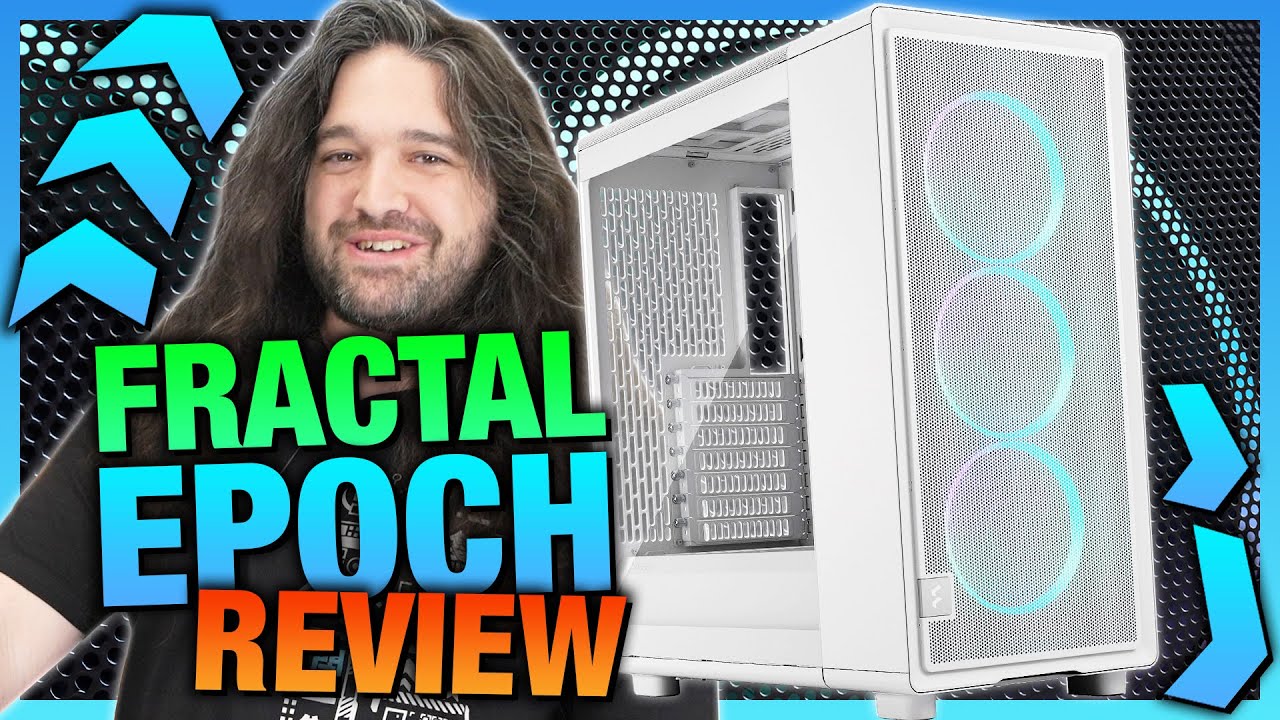
The Fractal Epoch is essentially a more affordable variant of the Fractal North case, featuring a different front panel design and priced at $110 MSRP, with an RGB version at $130. The case reuses much of the North’s internal tooling to keep costs down, while increasing GPU clearance from 355mm to 372mm by pushing the front fans further into the front panel. It also includes three stock fans compared to the North’s two, and the front panel serves as the dust filter using a finer mesh, improving thermal performance and acoustics by eliminating an additional filter layer.
Build experience and internal design of the Epoch closely mirror the North, with easy access through removable side and top panels. However, cable management remains a weak point due to a shallow 3cm deep channel at the front, which can cause side panel bulging with poor cable routing. The case lacks the North’s mesh side panel and side fan mounting rails, opting instead for solid panels, which limits airflow options. Additionally, the Epoch removes features like a built-in fan hub but compensates with fan daisy chaining.
Thermal testing revealed that the Epoch performs well for its price class, often outperforming the original North and some competitors like the Fantex XT Pro Ultra, while matching others such as the Corsair Frame 4000D RS. The RGB and non-RGB fan variants showed minimal differences in thermal performance, with noise-normalized testing indicating slightly better CPU temperatures with the Epoch. GPU thermals were competitive, though some budget cases like the Lean Lee Lancool 207 and 217 still outperformed it in certain metrics.
At full fan speed, the Epoch’s noise levels differ between variants, with the non-RGB version being louder but moving more air, while the RGB variant is quieter but with slightly reduced airflow. Overall, the Epoch offers solid thermal performance, but its noise levels and cooling capabilities are roughly on par with similarly priced cases. Compared to higher-end models like the Fractal Torrent or Flux Pro, the Epoch is more modest but also significantly less expensive.
In conclusion, the Fractal Epoch fills a budget slot in Fractal’s lineup by stripping away premium features found in the North, such as the wood front panel and mesh side panel, resulting in a reliable but unremarkable mid-tower case. While build quality and assembly remain strong, the case faces stiff competition from other budget options like Corsair, Fantex, and Lean Lee, often priced lower or offering better features. For $110, the Epoch is a decent choice but lacks standout qualities that would make it the top pick in its price range.