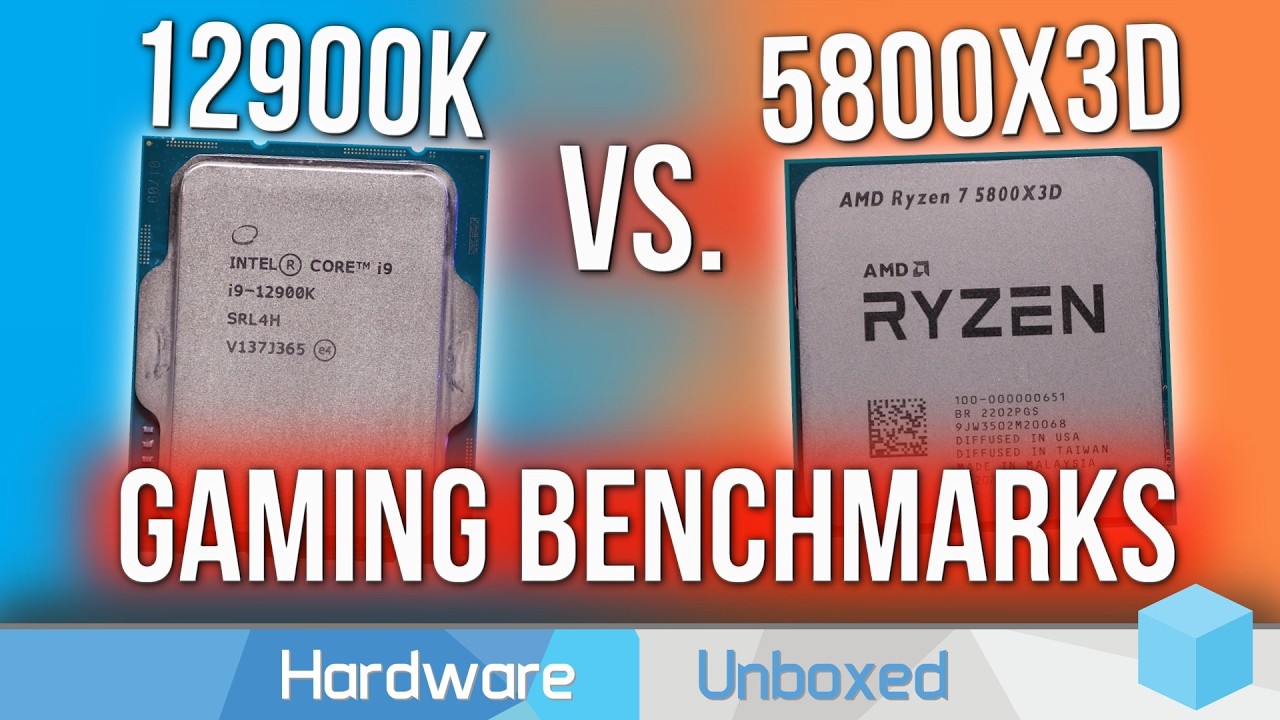
The video revisits the comparison between the AMD Ryzen 7 5800X3D and Intel Core i9-12900K processors, focusing on gaming performance with both DDR4 and DDR5 memory configurations. The creator acknowledges the demand from viewers for an updated benchmark, especially testing the Core i9-12900K with DDR4 3600 and DDR5 7200 memory to directly compare with the 5800X3D, which uses DDR4 3600. The video also includes a brief sponsor mention for the UG Fine Cam Pro 4K AIO webcam before diving into the benchmark results.
Testing across various games reveals that the Core i9-12900K generally performs better with DDR5 memory, often outpacing the 5800X3D by a small margin. However, when paired with DDR4 memory, the 5800X3D frequently outperforms the Core i9, sometimes by significant percentages, highlighting the importance of memory type in gaming performance. Titles like Rainbow Six Siege, Battlefield 6, Arc Raiders, and Cyberpunk 2077 showcase these trends, with the 5800X3D excelling particularly when the Core i9 is limited to DDR4.
Some games, such as Borderlands 4 and Counterstrike 2, are more GPU-bound or less sensitive to memory bandwidth, resulting in comparable performance between the two CPUs regardless of memory type. Meanwhile, CPU-intensive games like Space Marine 2 and Assassin’s Creed Codename (ACC) show the Core i9 benefiting from DDR5 memory, sometimes matching or slightly exceeding the 5800X3D. The 3D V-Cache technology in the 5800X3D continues to provide notable advantages in certain titles, especially those optimized for it.
Overall, the average performance across 14 games indicates that the 5800X3D edges out the Core i9-12900K by a small margin when the latter uses DDR5 memory and leads by a more substantial margin when the Core i9 is paired with DDR4. The video reflects on historical data from four years ago, confirming that while the two CPUs were closely matched then, modern games better utilize DDR5 memory, giving the Core i9 a more pronounced advantage with DDR5 but also highlighting the 5800X3D’s ability to mitigate DDR4 limitations through its large L3 cache.
In conclusion, the video recommends the Ryzen 7 5800X3D as an excellent gaming CPU for those using DDR4 platforms, offering strong performance without the need for expensive DDR5 upgrades. The Core i9-12900K remains competitive, especially with DDR5 memory, but pairing it with DDR4 can significantly hinder performance. Both CPUs have aged well, maintaining relevance in modern gaming, and the 5800X3D is praised as a “GOAT” for AM4 users seeking a cost-effective, high-performance gaming solution. The creator encourages viewers to subscribe for more content and thanks them for watching.