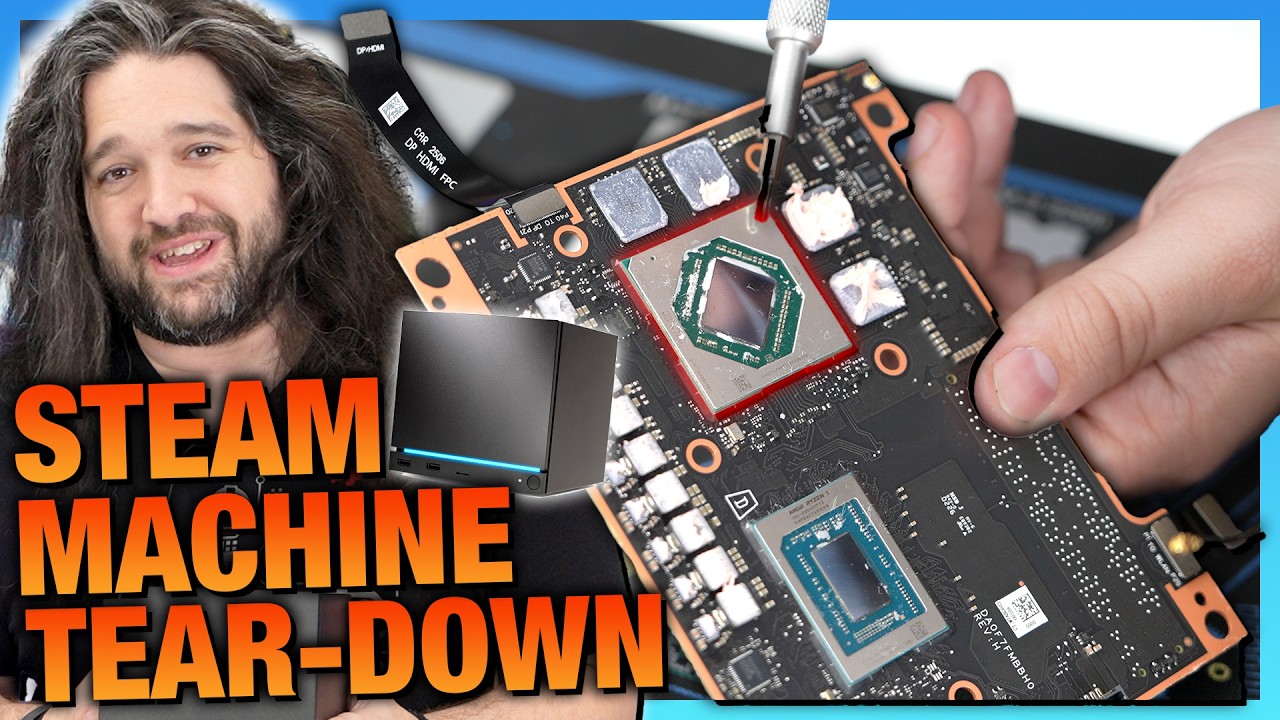
The video provides an in-depth tear-down and review of the Steam Machine, focusing on its repairability, internal components, and upgrade options. The host begins by carefully removing the front panel and accessing the internal parts, noting the ease of disassembly compared to other consoles. Valve’s emphasis on repairability is highlighted, with clear labeling of cables, screws, and components, as well as plans to sell replacement parts through partners like iFixit. The Steam Machine comes with either a single 16 GB RAM stick or two 8 GB sticks, with Valve confirming that current units have a single 16 GB stick, which may impact performance in certain workloads but allows for future upgrades.
The video also discusses the custom cooling solution, featuring a vertically oriented heat sink with server-style fins and a high-pressure fan designed to pull air efficiently through the system. The fan is unique, with seven large blades optimized for pressure rather than airflow volume, necessary to navigate the dense fin stack. The host explains the airflow design, including intake paths and exhaust management to prevent recirculation, demonstrating Valve’s thoughtful engineering despite the compact form factor. Additionally, the host showcases custom 3D-printed front plates with dust filters that improve thermals and aesthetics, available for purchase to support the channel.
Inside, the Steam Machine’s SSD is easily accessible via a couple of screws, allowing straightforward upgrades. The M.2 NVMe SSD connects through a labeled and glued cable, which the host notes as a minor inconvenience but appreciates the clear labeling. The wireless module and antennas are integrated neatly at the top of the chassis, contributing to better range. The power supply is compact but not user-serviceable, and the host advises caution when handling it. Overall, the internal layout is compact but well-organized, with a focus on repairability rather than extensive upgradeability.
The host carefully removes the heat sink, revealing the AMD Ryzen CPU and accompanying GPU with GDDR6 VRAM. The thermal interface materials include thermal putty and paste, with the putty used for components like inductors and MOSFETs to ensure effective heat transfer and tolerance for mounting pressure variations. The use of thermal putty is less common but advantageous, though the host advises caution when handling it to avoid contamination. The modular design allows access to the RAM without removing the heat sink, making memory upgrades relatively simple compared to other consoles.
In conclusion, the Steam Machine is praised for its thoughtful design prioritizing repairability, clear labeling, and ease of disassembly, making it accessible for enthusiasts who want to upgrade or repair components like RAM and SSD. While its proprietary elements limit broader upgrade options, Valve’s approach is a significant improvement over many consoles. The host encourages viewers to check out the full review and consider supporting the channel by purchasing custom front plates that enhance cooling and dust protection. Overall, the Steam Machine offers a well-engineered, serviceable device with a compact, efficient internal design.