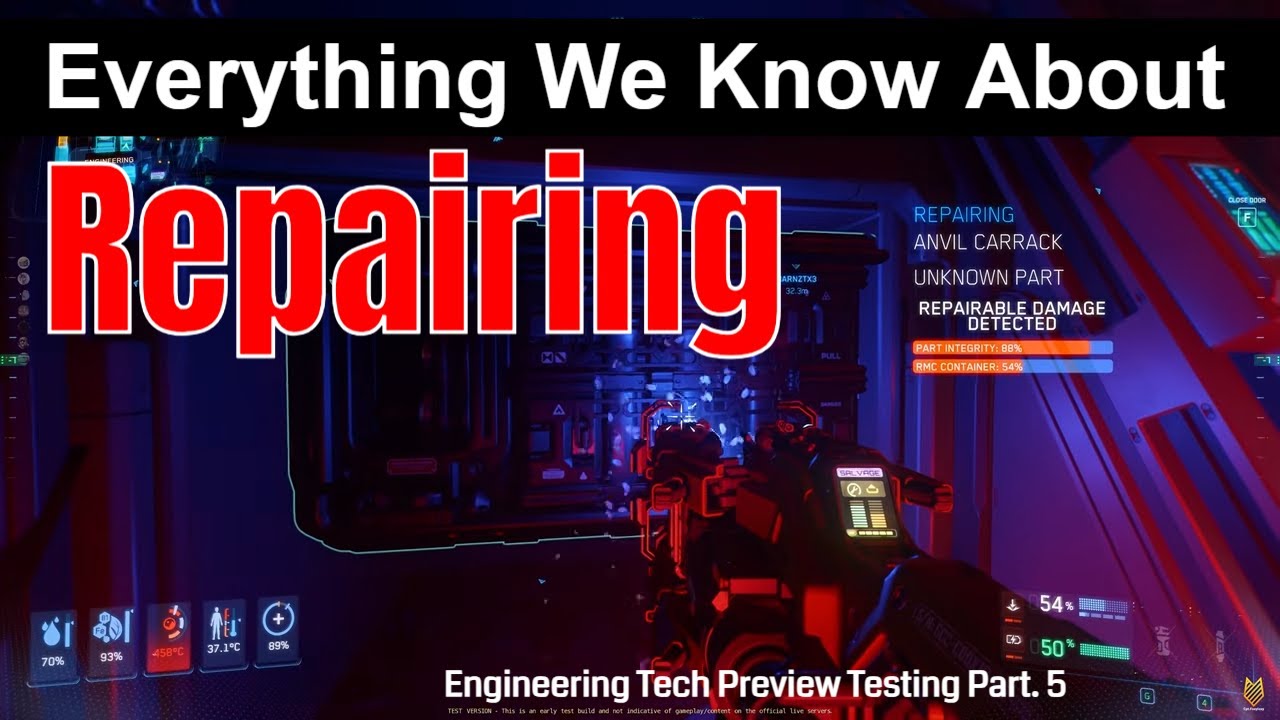
In this video, the creator explores the mechanics of repairing ships and components within the Star Citizen engineering gameplay, focusing on the essential aspect of ship repair. They outline four main methods for repairing damaged ships and components: using station landing pads where repairs can be paid for, handheld repair tools like the small multi-tool and the larger Cambio SRT, the new diagnostic repair feature accessible via the ship’s MFD, and the upcoming ship-based repair capabilities on capital and dedicated repair ships, which are not yet implemented. The diagnostic repair has notable limitations, such as only being usable on completely destroyed components, restoring health only up to 20%, and being a one-time use until the ship is repaired at a station.
The video emphasizes that only physicalized ship components can be repaired, covering everything from small to capital-sized parts, including weapons, turrets, missiles, thrusters, and ship hull sections. The ship hull can be repaired up to 90%, but the creator was unable to test whether a fully destroyed ship (a “soft death” ship) can be restored completely, a feature expected to be introduced as the game moves away from hard death mechanics. Repairing extends even to ship ramps and doors, provided they can be targeted, although some doors remain inaccessible due to bugs or their placement inside the ship.
Regarding the use of repair tools, the video explains the necessity of equipping RMC canisters as ammunition for repairs, with the bigger Cambio SRT tool offering faster repair speeds compared to the smaller multi-tool. Repair speed depends on the size of the component, with larger parts taking longer, and teamwork significantly improves repair efficiency. The ship hull repairs are nearly instant, but larger ships like the Carrick, Polaris, or Idris require multiple engineers to maintain and repair components efficiently, especially during combat situations where prioritizing critical systems is vital.
The creator also highlights some gameplay limitations and challenges, such as the inability to perform repairs within armistice zones using handheld tools, which can leave players vulnerable if their one-time diagnostic repair has been used. Fires are frequently associated with damaged components, requiring engineers to be prepared not only to repair but also to extinguish fires, as these can spread and exacerbate damage. This adds a layer of complexity and realism to the engineering role, emphasizing the importance of multitasking and readiness during repairs.
Finally, the video concludes with a practical demonstration of ship fires causing power and life support failures, illustrating some current bugs and challenges in the system, such as inconsistent oxygen levels and fire detection in unusual locations like bathrooms. Despite these issues, the engineering gameplay is praised for its depth and potential to make multi-crew ships truly collaborative, requiring coordinated efforts to keep ships operational during intense combat and damage scenarios. The creator expresses hope for improvements and further development to enhance the repair mechanics and overall engineering experience in Star Citizen.