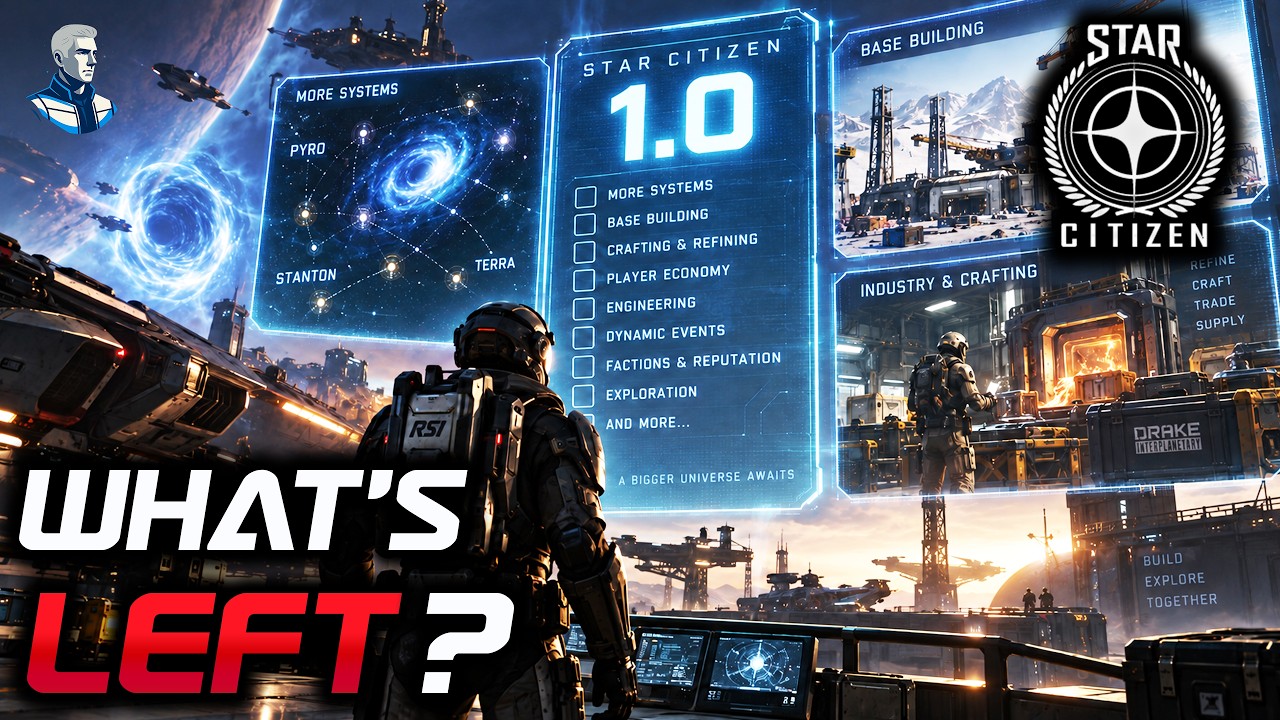
The recent release of Star Citizen 4.10 introduced instancing, a major technical hurdle, and it performed better than expected, delivering over 100 FPS and improving gameplay experience significantly. With this milestone achieved, the focus now shifts to completing several key features before the game’s 1.0 launch. The developers have committed to including five star systems—Stanton, Pyro, Nyx, Castra, and Terra—with three already in the game and the upcoming 4.11 patch adding Genesis Planetary Tech to populate empty planets with content, greatly enhancing the game world.
A critical area still needing development is the progression backbone, including a main questline to guide new players through the game’s systems and gameplay, addressing the current reliance on external resources like YouTube and Reddit for guidance. Additionally, professions in the game require full development to become complete gameplay loops. While some, like mining, are close to completion, others such as medical gameplay, repair, and exploration need significant expansion. These systems are generally seen as lower technical risk but essential for player engagement and retention.
The in-game economy also needs substantial upgrades to become a driving force in the universe. This includes implementing player trading systems akin to auction houses, introducing meaningful credit sinks like insurance and taxes, and enabling player-run shops and markets. Crafting and base building represent some of the most complex remaining features, involving detailed mechanics such as blueprint progression, item decay, and integration with planetary terrain and other gameplay systems. These are expected to be delivered around 2027, given their technical challenges.
Social tools in Star Citizen are currently very basic, and an overhaul is planned to improve in-game communication, organization management, and group-finding systems. These improvements are vital for fostering player cooperation, especially as organizations will play a major role in building player cities and space stations, competing for control in PvP zones. While technically less risky than other features, social tool enhancements are crucial for long-term player engagement and community building.
Finally, several major simulation systems remain under development, including Star Cloth, Star Wear, dynamic weather, and the highly anticipated dynamic server meshing, which is the biggest technical challenge left. While instancing’s smooth delivery offers hope for progress, these systems are complex and may take years to fully implement. Despite the extensive list of remaining features, the video argues that with Star Citizen’s monthly patch cadence and accelerated development pace since 2024, a 1.0 release within three years is plausible, supported by the momentum of recent fundamental tech advancements.