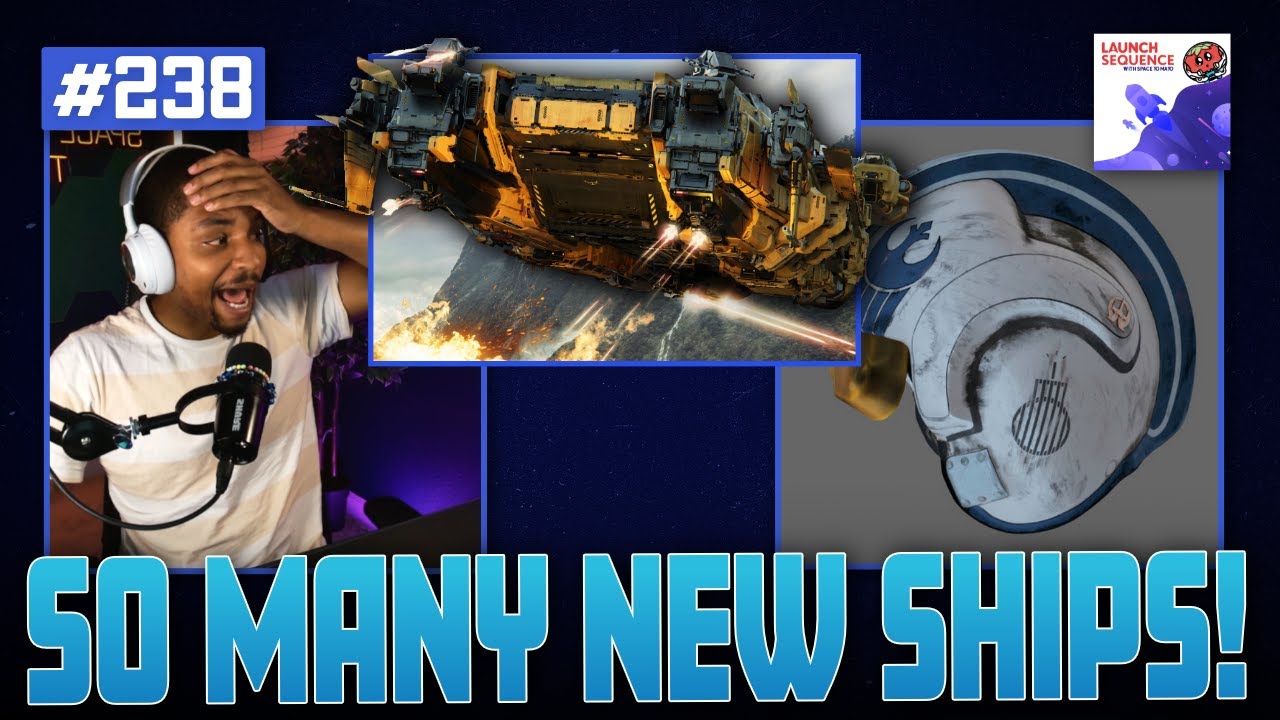
The podcast episode begins with a discussion about the recent Star Citizen Intergalactic Aerospace Expo (IAE) and the new ships revealed there, highlighting a record-setting year for funding but focusing mainly on the ships themselves. The hosts are joined by Trist Pone, known for his detailed modeling work and insightful analysis of ship silhouettes. They reflect on the community-driven nature of Star Citizen, emphasizing how players contribute significantly to tutorials, guides, and artistic content, which enriches the game’s ecosystem. Both hosts share their personal backgrounds and connections to space simulation games, such as Wing Commander and X-Wing, underscoring the diverse origins of Star Citizen’s player base.
The conversation then shifts to specific ships introduced or updated recently, starting with the Perseus, a large multi-crew ship that showcases significant advancements in interior design compared to older ships like the Polaris. They discuss the upcoming engineering gameplay feature, which will require players to repair and manage ships actively, potentially making solo operation of large ships like the Perseus more challenging. This leads to a broader discussion about the balance between solo and multiplayer gameplay in Star Citizen, with the hosts agreeing that large ships are best operated by crews, though solo players might still find ways to enjoy them.
Attention moves to the Drake Clipper, a ship that generated much speculation and has become popular despite its unconventional and “ugly” design. Both hosts appreciate its generalist role, which includes features like a crafting bench and medical bed, making it versatile for various gameplay styles. They note that the Clipper’s success might influence the design of future generalist ships but express hope that it won’t render other ships obsolete. The discussion touches on the trend of modular ship variants, exemplified by the new Wolf variants with swappable weapons, which are seen as a positive evolution in ship design and monetization.
Looking ahead, the hosts explore upcoming ships and features expected in 2025 and 2026, including crafting-focused ground vehicles, the ambitious Ironclad capital ship, and the highly anticipated alien Gata’c Rail. They discuss the challenges and delays in implementing crafting and base building, noting that some planned ships may not arrive as soon as initially hoped. The conversation also covers significant changes to existing ships like the Hull series, with cargo capacities being adjusted to more realistic levels, reflecting the ongoing balancing act between concept and playable reality. The hosts express excitement about the growing variety of ships and the evolving gameplay systems.
In closing, the hosts share personal hopes and predictions for Star Citizen’s future, emphasizing engineering as a key focus for the upcoming year and anticipating new story content. They debate the idea of Mark 2 versions of iconic ships like the Aurora and the implications for ship variety and player expectations. The episode ends with a call to the community to engage with the podcast and the broader Star Citizen content creators, highlighting the vibrant and creative community that supports the game’s ongoing development. Trist Pone invites listeners to follow his work on YouTube, where he streams his modeling projects and discusses the artistic side of Star Citizen.