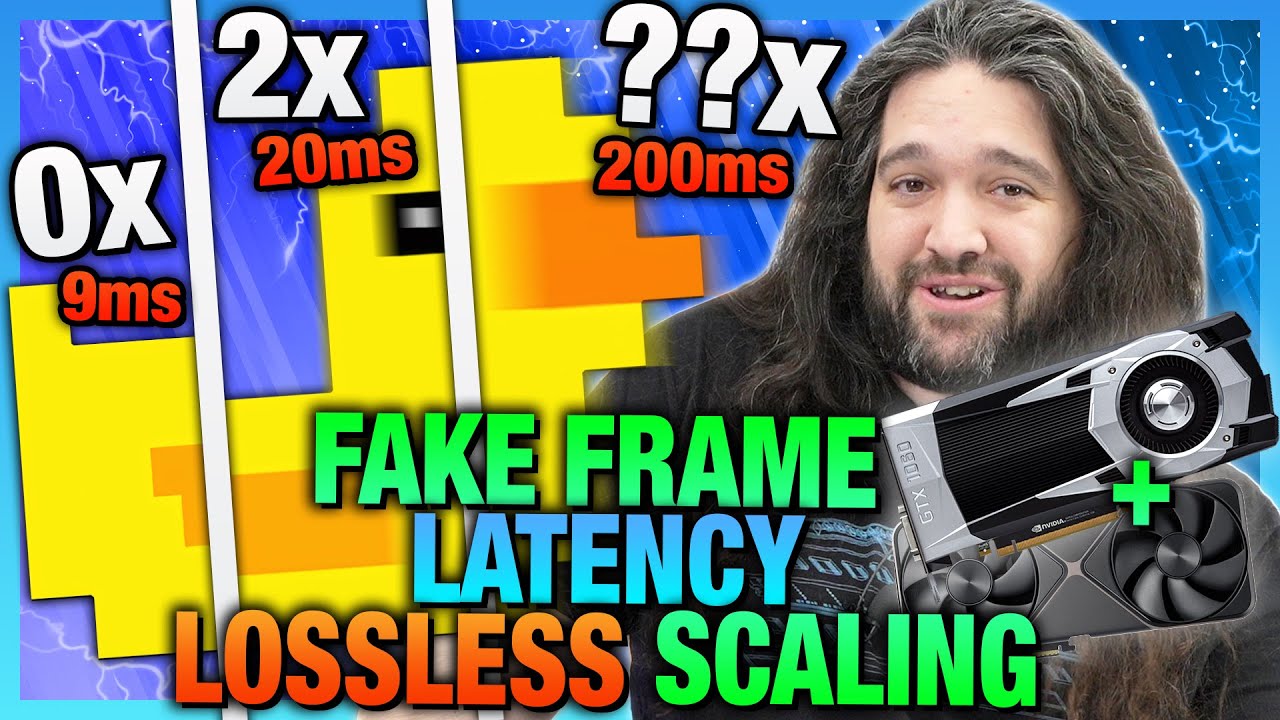
The video revisits lossless scaling frame generation (LSFG) with a focus on latency, using a physical hardware tester developed by Tech Team GB to measure end-to-end click-to-photon latency. Unlike previous image quality tests, this analysis investigates how frame generation impacts the responsiveness of gameplay across multiple GPUs, including setups with older secondary cards. The testing spans various scaling multipliers from 2x to 20x and includes scenarios with and without frame rate caps, aiming to provide a comprehensive view of latency effects that go beyond simple FPS metrics. The presenter emphasizes that latency is a critical experiential factor for gamers, often more telling than frame rate alone, and introduces a new metric called “5% highs” to highlight worst-case latency spikes.
The methodology involves using an open-source latency tester that employs an Arduino microcontroller and a silicon photodiode to detect changes on the screen with high precision, bypassing proprietary tools from GPU vendors. Tests were conducted on several GPUs, including the Nvidia RTX 560 Ti, RTX 3060, RTX 2060 KO, and GTX 1060, across four games: Cyberpunk 2077, Rainbow Six Siege, Marvel Rivals, and Warhammer 40k Space Marine 2. The video explains the latency pipeline from input to display, noting that frame generation adds delay because generated frames are interpolated and don’t represent actual game state updates, thus increasing the time before the newest real frame is shown.
Results show that enabling LSFG frame generation significantly increases latency, with the largest jump occurring when turning frame generation on at 2x multiplier. For example, in Cyberpunk 2077 without frame caps, latency increased by 77% from 25.3 ms to 44.8 ms, while frame rates rose by 39%. Higher multipliers further increased latency, with 20x reaching an unplayable 139 ms. Using a secondary GPU to handle frame generation helped reduce latency compared to a single GPU setup, but the effectiveness depended on the secondary card’s capability. Older GPUs like the GTX 1060 struggled to keep up, sometimes resulting in worse latency than single GPU setups.
The video also highlights the impact of frame rate caps, which help mitigate latency increases by reducing GPU workload. For instance, capping Cyberpunk 2077 at 60 FPS lowered latency compared to uncapped tests, although LSFG still added noticeable delay. Competitive and latency-sensitive games like Rainbow Six Siege showed the most pronounced latency penalties, where even small increases can affect gameplay performance. Conversely, single-player or less latency-critical games might tolerate the extra delay for the visual smoothness benefits that frame generation provides. The presenter stresses that frame generation cannot “fix” low frame rates and that the added latency is an inherent trade-off.
In conclusion, the video advises caution when using frame generation, recommending keeping multipliers low (2x or 3x) to balance latency and smoothness. LSFG’s dual GPU mode is interesting and can reduce the main GPU’s load, but it may introduce frame pacing issues. The latency cost of frame generation is not unique to LSFG and applies to other technologies like Nvidia DLSS and AMD FSR. Ultimately, the decision to use frame generation depends on the individual’s tolerance for latency versus their desire for smoother visuals, with the video providing valuable independent data to help consumers make informed choices. The presenter appreciates LSFG’s honest approach compared to GPU vendors’ marketing and encourages viewers to consider their own needs before adopting such technologies.