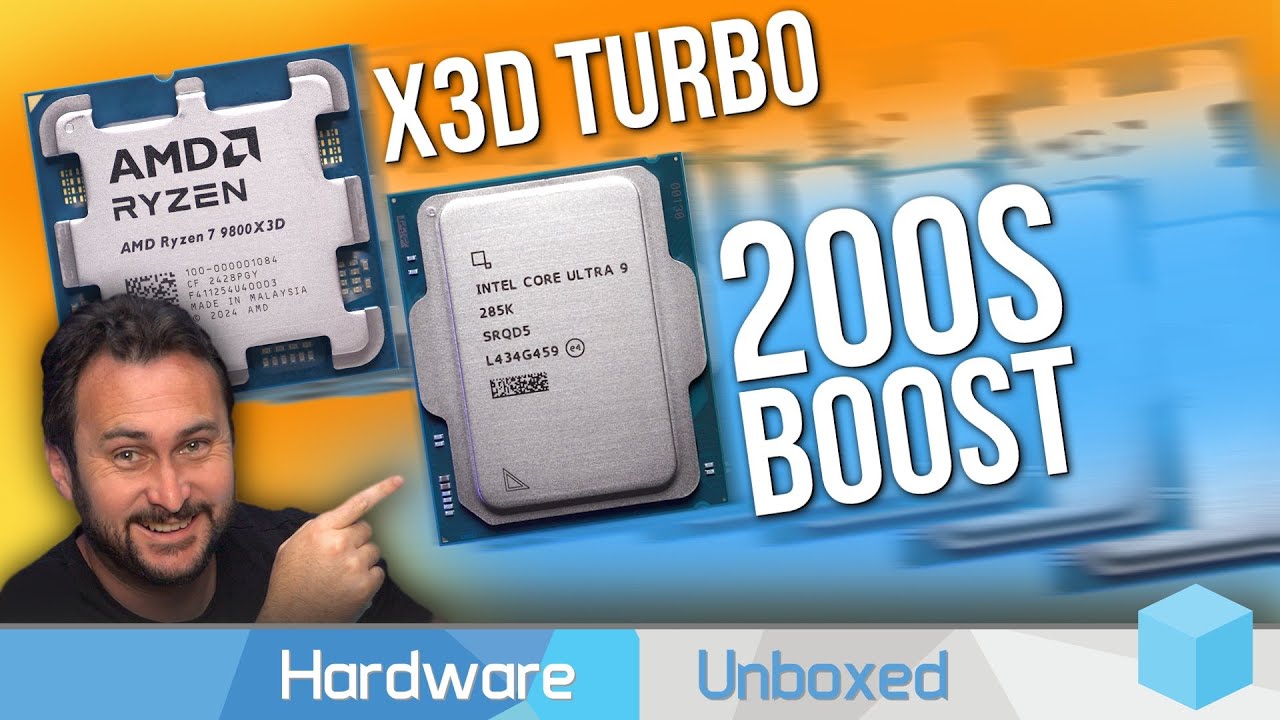
The video finds that Intel’s 200S Boost feature provides only a modest performance increase and does not close the significant gaming performance gap against the AMD Ryzen 7 9800X3D, which remains substantially faster across various games. While the Intel Core Ultra 9 285K excels in productivity tasks, the Ryzen 7 9800X3D is the superior choice for gaming, and the presenter recommends waiting for future Intel releases or opting for AMD’s AM5 platform for better longevity and performance.
The video revisits a year-old comparison between the AMD Ryzen 7 9800X3D and Intel Core Ultra 9 285K processors across gaming performance, focusing on whether Intel’s new 200S Boost feature has closed the performance gap. Previously, the Ryzen 7 9800X3D was found to be on average 24% faster across 45 games. The presenter tests a dozen mostly recent games using medium and ultra presets, comparing the 285K in both stock and 200S Boost configurations against the 9800X3D with and without AMD’s X3D Turbo overclocking feature. The tests use an Asus ROG Maximus Z890 Hero motherboard for Intel and a Gigabyte X870 Aorus Master for AMD, paired with an RTX 5090 GPU to minimize bottlenecks and focus on CPU performance.
Results show that the Ryzen 7 9800X3D consistently outperforms the Intel 285K in gaming, often by a significant margin. On average, the 9800X3D was found to be 35% faster at medium settings and 26% faster at higher quality presets. The 200S Boost feature on the Intel side provides only a modest 3% performance uplift on average, which is comparable to the 3-4% gain seen with AMD’s X3D Turbo. Many games demonstrated the Ryzen 7’s dominance, especially in CPU-bound scenarios, with some titles showing performance leads as high as 81% to 94%. However, in GPU-limited scenarios or games less dependent on CPU performance, the margins narrow considerably.
The video also highlights that while Intel’s 200S Boost is a convenient one-click overclocking feature, it is not guaranteed to work on all chips and can cause instability. Similarly, AMD’s X3D Turbo, although unofficial, can boost gaming performance but may also affect system stability depending on the silicon quality. High-speed memory like DDR5 8200 or DDR5 9600 was tested but showed limited benefits due to increased latency impacting gaming performance negatively, especially on the Intel platform.
Beyond gaming, the Intel 285K holds an advantage in multi-core performance and shader compilation times, where it was 28-32% faster than the 9800X3D, making it a better choice for productivity workloads. However, overclocking results for gaming on the 285K remain underwhelming despite guides like Scatterbencher’s, who recommends enabling 200S Boost and adjusting core ratios for best results. Overall, the 285K is positioned as a strong all-rounder with excellent productivity performance but falls short of matching the 9800X3D in gaming.
In conclusion, the video advises that Intel’s 200S Boost does not close the gaming performance gap against the Ryzen 7 9800X3D. The Core Ultra 285K remains significantly slower for gaming despite updates and overclocking attempts. Considering platform longevity concerns with Intel’s LGA 1851 socket, the presenter suggests waiting for future Intel generations or opting for AMD’s AM5 platform with upcoming Zen 6 and Zen 7 architectures. The video wraps up by encouraging viewers to subscribe for more content and check out additional resources for overclocking information.