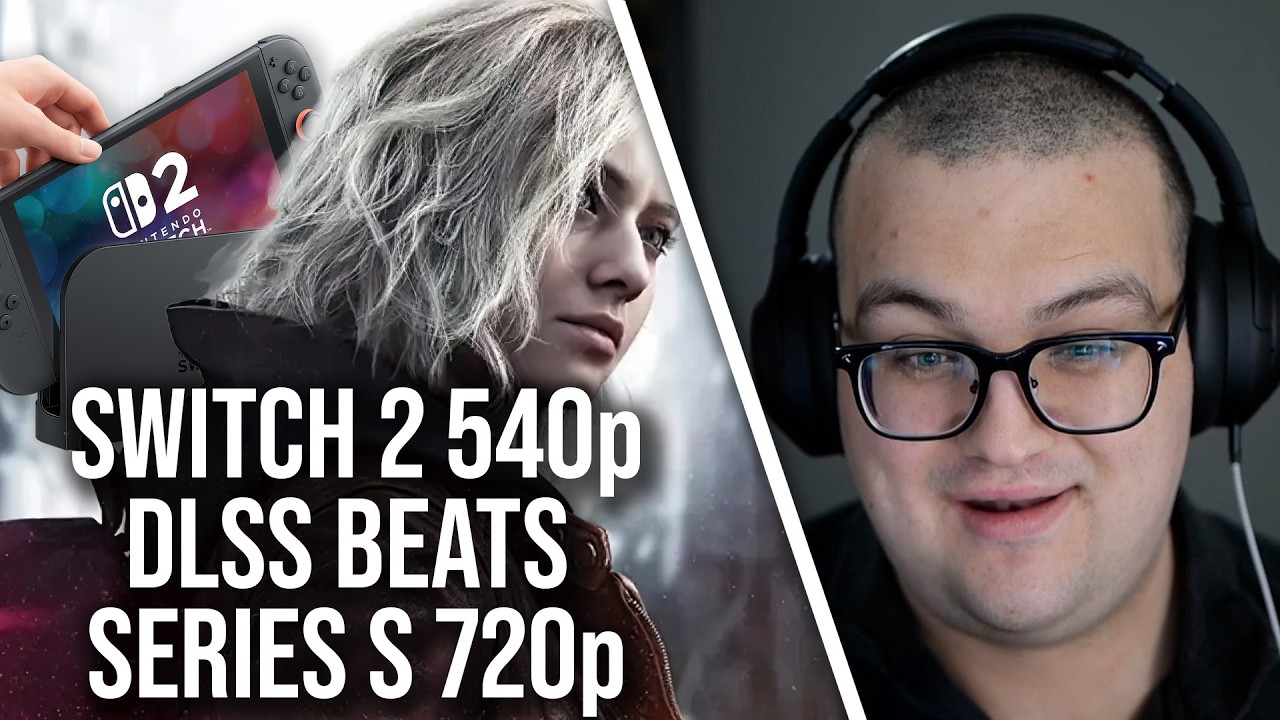
The video discusses the image quality and performance comparisons of Resident Evil Requiem across Switch 2, PS5, and Series S consoles. A key highlight is that Switch 2 operates at a relatively low internal resolution of about 540p but uses DLSS (Deep Learning Super Sampling) to upscale the image to roughly 1080p, resulting in surprisingly competitive visuals compared to the PS5, which runs at around 1080p internally. While Switch 2’s image is softer, it appears more stable due to the advanced DLSS upscaling, whereas PS5 seems to rely on spatial upscaling techniques like FSR1, which are less effective. However, PS5 has a film grain effect enabled that Switch 2 lacks, making direct comparisons somewhat complicated.
Performance-wise, PS5 delivers a very stable and mostly locked 60fps experience, with only rare dips, providing smooth gameplay throughout. Switch 2 ambitiously targets 60fps as well but fluctuates more, ranging between 30fps in demanding scenes up to 60fps in smaller areas. The unlocked frame rate on Switch 2 leads to inconsistent performance, which the commentators suggest could be improved by implementing a frame rate cap or dynamic resolution scaling. Despite these fluctuations, loading times on Switch 2 are impressively quick, with level loads taking around 9-10 seconds and death reloads only a few seconds, enhancing the overall user experience.
Series S presents an interesting middle ground, running at a mostly stable 60fps but at a lower resolution than both PS5 and Switch 2. Its internal resolution hovers around 576p to 720p, utilizing spatial upscaling without temporal techniques, resulting in noticeably worse image quality compared to Switch 2’s DLSS-enhanced visuals. Series S also lacks certain graphical features like the detailed hair strands found on PS5 and Series X, instead using a simpler hair system similar to Switch 2. Despite its lower image quality, Series S offers superior performance stability, making it a clear choice for players prioritizing smooth gameplay over visual fidelity.
The video also reflects on the broader context of Capcom’s performance choices, noting that the unlocked frame rate approach seen on Switch 2 is reminiscent of previous generation consoles like PS4 Pro, where frame rates fluctuated widely between 30 and 60fps. The absence of ray tracing on all current-gen versions is attributed to the heavy performance cost, which would likely push frame rates below acceptable levels. The commentators suggest that a locked frame rate mode or dynamic resolution adjustments could benefit Switch 2’s performance profile, improving consistency without sacrificing too much visual quality.
Finally, the discussion touches on how display size affects perceived image quality, especially for the Series S version. While the game looks decent on smaller monitors or handheld screens, it becomes noticeably blurrier on larger displays like a 77-inch OLED TV. This highlights the importance of considering the viewing environment when evaluating console performance and image quality. Overall, the video presents a nuanced comparison that balances resolution, upscaling technology, performance stability, and user experience across the three consoles, offering valuable insights for potential buyers and enthusiasts.