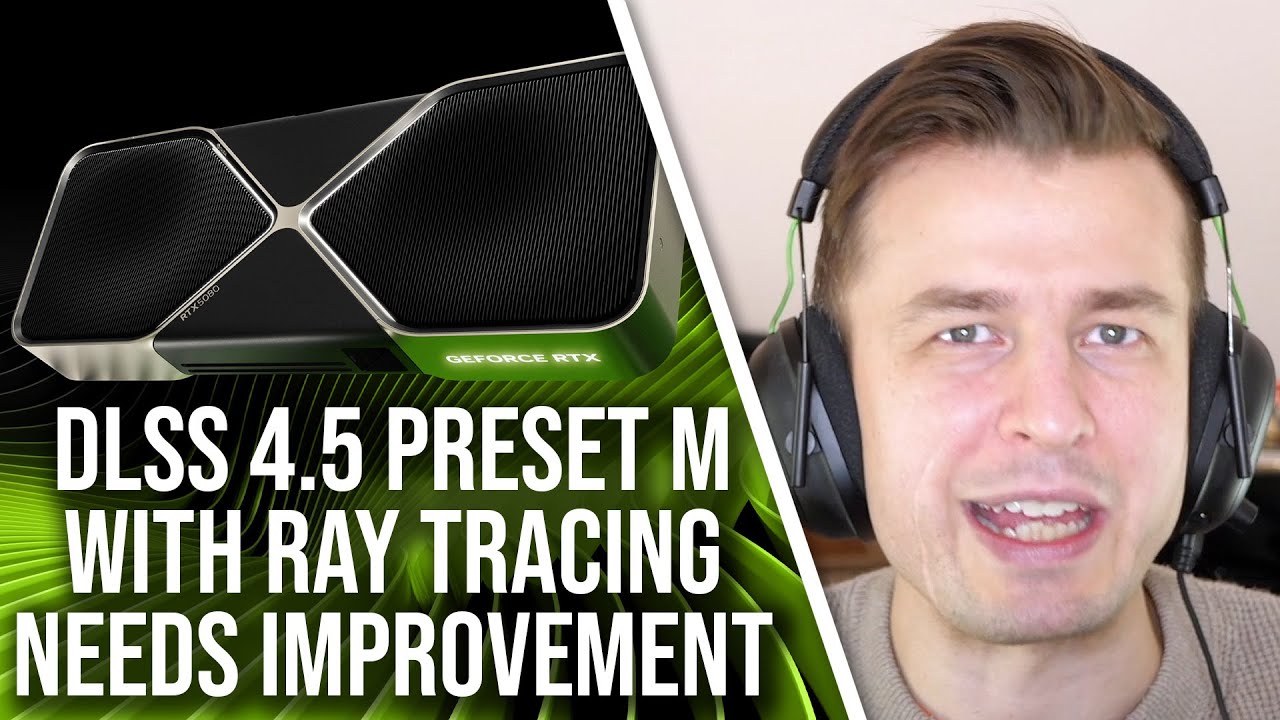
The video discusses the performance and image quality differences between DLSS 4.5 Preset M and the earlier Preset K, focusing especially on ray tracing effects in various games. Preset M shows several regressions in handling ray traced lighting details compared to Preset K, particularly in games that rely on their own denoisers rather than ray reconstruction. Examples include noisy reflections and ambient occlusion flickering in titles like Outer Worlds 2, Control, Jedi Survivor, Silent Hill 2, and Ratchet and Clank. While some games show improvements with Preset M, such as more stable water reflections in Jedi Survivor, the overall trend indicates more noise and instability in ray traced effects, making Preset M less elegant in this regard.
The video also highlights differences in brightness and tone mapping between the two presets. Preset M enables auto exposure by default, which affects image brightness and saturation in some titles, leading to subtle but noticeable changes in lighting appearance. For instance, Horizon Forbidden West appears slightly less saturated with Preset M, and stars in Outer Worlds 2 have a different color tone. These changes are not universal but can be perceptible depending on the game, adding another layer of complexity when choosing between presets.
A significant point of discussion is the sharpening behavior in Preset M. The video notes a return of artificial oversharpening that had been mostly cleaned up in earlier DLSS versions but now reappears in 4.5. This effect varies by title and can sometimes lead to ringing artifacts and an unnatural look, especially in games with default sharpening enabled, such as Spider-Man and Horizon Forbidden West. The sharper image does not always mean better quality, as increased aliasing can occur, particularly with thin details like foliage, where Preset M may show more aliasing compared to Preset K.
Performance-wise, Preset M is more demanding than Preset K, with the impact varying significantly depending on the GPU generation. Older RTX cards like the 3070 experience a notable performance hit of around 18%, whereas newer Ada Lovelace and Blackwell cards such as the 4060 Ti and 5060 see much smaller penalties, sometimes under 5%. This means that the viability of using Preset M heavily depends on the hardware, with newer GPUs better equipped to handle the increased load. Users are advised to test both presets on a per-title basis to balance image quality and performance.
In conclusion, while DLSS 4.5 Preset M introduces some improvements in certain areas, it also brings regressions in ray tracing noise handling, brightness consistency, and sharpening artifacts. The choice between Preset M and K is not straightforward and depends on individual game implementation, personal preference, and hardware capabilities. Fortunately, NVIDIA allows users to select presets on a per-game basis or globally, enabling flexibility. The video emphasizes the need for further refinement of DLSS 4.5 to address these issues and improve the overall experience.