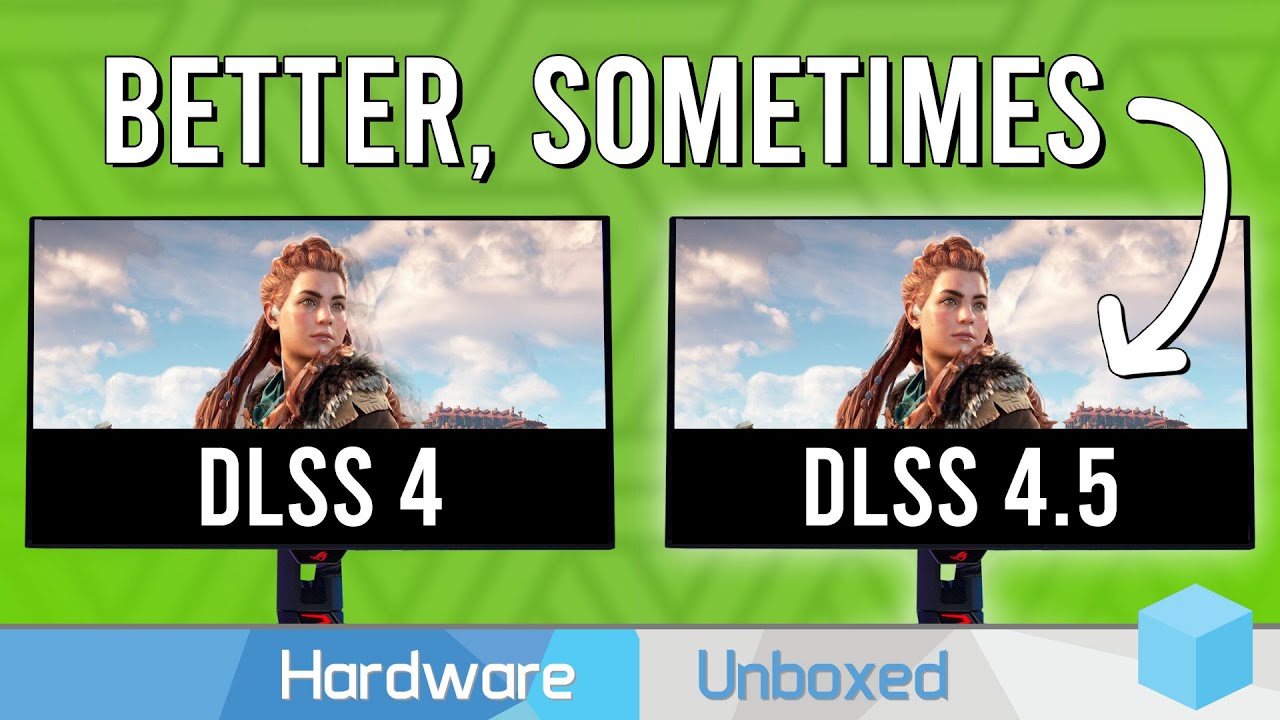
The video provides an in-depth comparison between Nvidia’s DLSS 4.5 and DLSS 4 upscaling technologies, focusing on improvements in image quality and performance across various games and hardware configurations. DLSS 4.5 introduces a second-generation transformer model accelerated by FP8 instructions, promising better temporal stability, reduced ghosting, smoother edges, improved lighting, and particularly enhanced performance mode image quality. Enabling DLSS 4.5 is straightforward via the Nvidia app, with two main presets: Preset M optimized for performance mode (and recommended for other modes) and Preset L optimized for ultraformance mode. However, the performance hit varies depending on GPU generation, with newer RTX 40 and 50 series GPUs experiencing minor slowdowns, while older RTX 20 and 30 series GPUs see a more significant impact.
Performance testing across titles like Cyberpunk 2077, Mafia: The Old Country, and Horizon Zero Dawn reveals that on RTX 50 and 40 series GPUs, DLSS 4.5 generally runs slightly slower than DLSS 4 but remains within a comparable performance tier. In contrast, older GPUs without native FP8 support suffer larger performance drops, sometimes exceeding one or two quality tiers, making DLSS 4.5 less practical on these architectures. The video recommends that owners of older GPUs stick with DLSS 4’s first-generation model (preset K) to avoid excessive performance penalties. Overall, DLSS 4.5 is more suitable for newer hardware, where the trade-offs between performance and visual quality are more balanced.
Image quality improvements with DLSS 4.5 are notable but not universally superior to DLSS 4. The new model delivers sharper images, especially in foliage, hair, and textures, and significantly reduces discclusion artifacts—where foreground objects reveal background scenes—making it particularly beneficial in third-person games with complex environments. Ghosting is also reduced in many scenarios, although some instances still show comparable or worse ghosting than DLSS 4. Fine detail and edge stability present a mixed picture, with DLSS 4.5 sometimes outperforming DLSS 4 and other times falling short, especially with delicate elements like ropes or fences.
Lighting quality benefits from DLSS 4.5’s approach of performing upscaling calculations in linear light space before tone mapping, resulting in brighter and more vibrant highlights. However, this method can introduce flicker in bright areas during motion, which was less prominent in DLSS 4’s logarithmic space processing. Particle quality sees minor improvements, with sharper particles and less ghosting, though some scenes show increased grain or pixelation. Transparency handling remains largely unchanged from DLSS 4, maintaining good quality for effects like fire and holograms.
In summary, DLSS 4.5 represents a meaningful evolution of Nvidia’s upscaling technology, offering clear benefits in sharpness, discclusion, ghosting, and foliage stability, especially on newer GPUs. However, it is not a flawless upgrade; certain visual trade-offs and performance impacts, particularly on older hardware, mean that DLSS 4’s first-generation model remains relevant. The video recommends DLSS 4.5 preset M for most users on modern GPUs and suggests that lower upscaling modes are now more viable than ever due to improved image quality. Compatibility issues with ray reconstruction and the need for future updates are also noted, with a follow-up comparison to AMD’s FSR4 promised.