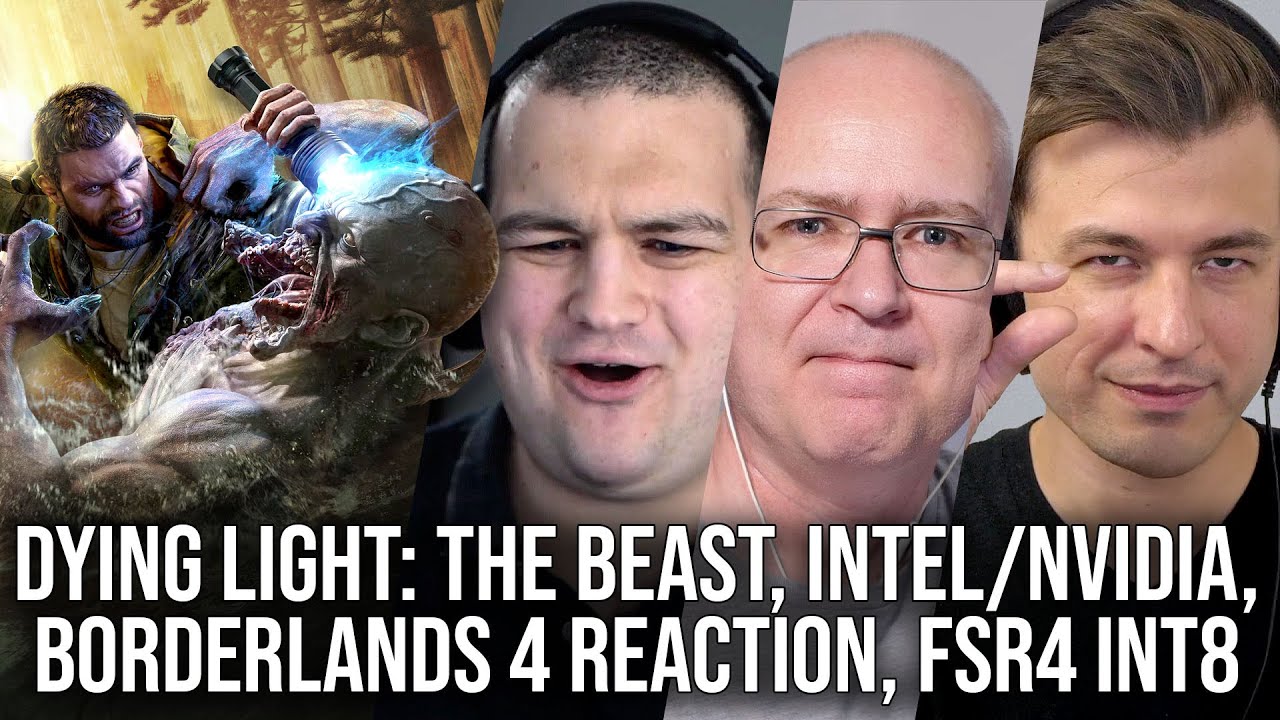
In this edition of DF Direct Weekly #232, the Digital Foundry team dives into several significant gaming and tech topics. They begin with an in-depth discussion on the launch of “Dying Light: The Beast,” highlighting the absence of ray tracing features on the PC version at launch, which Techland plans to add post-release. Alex Battalia shares his hands-on experience, praising the game’s fluid performance and impressive lighting effects despite missing ray tracing, while also noting some issues with reflections and Nvidia Reflex causing frame time problems. Oliver McKenzie adds insights on the PlayStation 5 version, noting good performance and visuals but confirming the lack of ray tracing features on both PS5 and PS5 Pro, emphasizing that the game is a cross-generation title with solid but not groundbreaking graphics.
The conversation then shifts to a surprising semiconductor industry collaboration between Nvidia and Intel. Nvidia has acquired a roughly 4% stake in Intel, marking a historic partnership aimed at developing products combining Intel’s x86 CPU chiplets with Nvidia’s RTX graphics chiplets. This alliance is seen as a potential game-changer, especially for enterprise and data center markets, but also hints at future consumer products like laptops and handheld devices with integrated high-performance CPU and GPU technology. The team discusses the implications for gaming technology, competition in the chip market, and the challenges and opportunities this partnership presents for both companies.
Next, the team explores a leaked version of AMD’s FSR4 upscaling technology that can run on older GPU architectures, including Nvidia’s. This unofficial implementation uses INT8 machine learning instructions and shows promising performance improvements on RDNA3 GPUs, though with some performance trade-offs compared to native FSR4 on newer hardware. They analyze benchmarks from games like Cyberpunk 2077 and Miles Morales, noting that while image quality appears improved over FSR3, the technology is still a work in progress. The discussion also touches on the potential for this technology to be backported officially, especially for handheld devices that cannot support RDNA4 GPUs.
The panel then addresses the controversy surrounding Borderlands 4’s problematic PC performance and Gearbox CEO Randy Pitchford’s contentious social media responses. The game suffers from severe performance issues, including shader cache bloat and stuttering, which have frustrated players and reviewers alike. Oliver criticizes Pitchford’s approach to customer service, emphasizing that acknowledging and working on fixes would be more productive than dismissing complaints or suggesting players develop their own engines. Alex adds that shader compilation issues in Unreal Engine games are complex and often stem from engine design and development practices rather than laziness, highlighting the challenges developers face with shader pre-compilation.
Finally, the show covers various supporter questions, including explanations of virtual shadow maps and their advantages over traditional shadow techniques, discussions on upscaling and motion clarity, and thoughts on future console memory requirements in light of AI advancements. The team also debates the potential impact of the Nvidia-Intel partnership on the handheld and console markets, expressing skepticism about new console ecosystems but optimism about powerful, integrated handheld devices. They conclude with a look at the upcoming GPD Win 5 handheld featuring AMD’s Strix Halo APU, noting its high price but impressive performance potential, and emphasize the evolving landscape of gaming hardware and upscaling technologies.