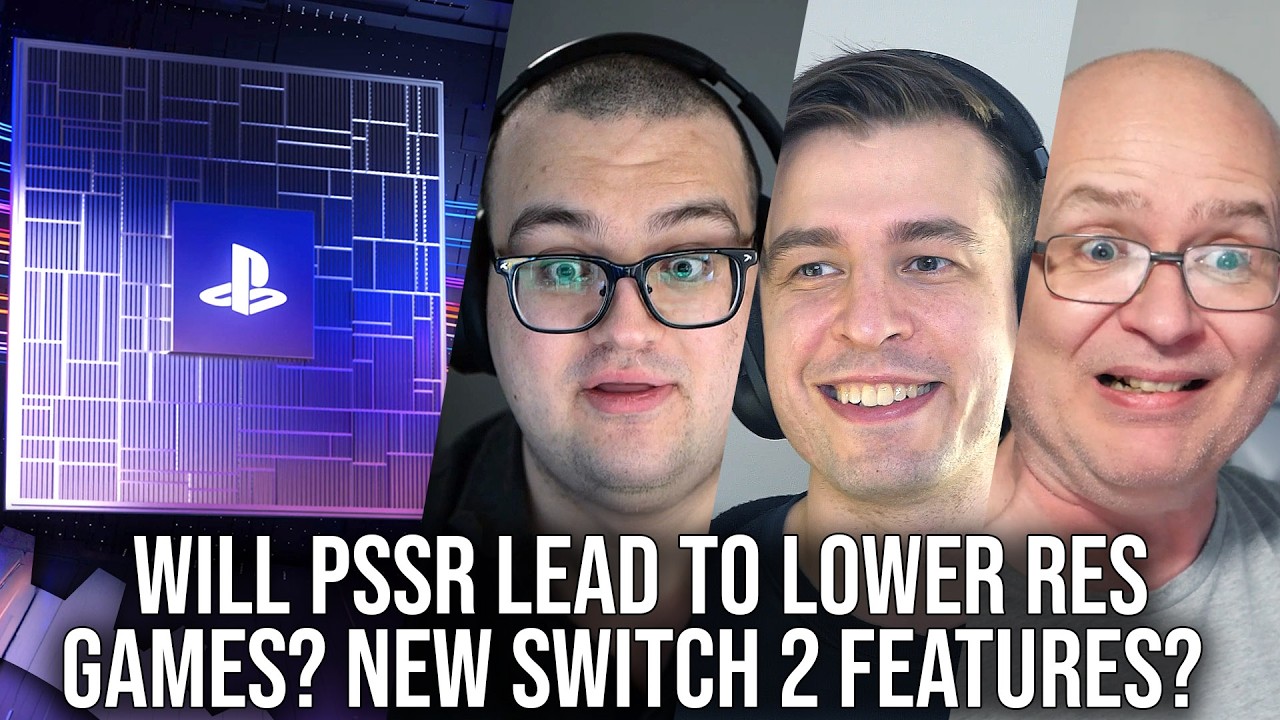
In this episode of the DF Direct Q&A show, the hosts discuss a variety of gaming technology topics, starting with the use of PSSR (PlayStation Super Resolution) on PS5 Pro. They explore why some developers continue to increase internal resolutions despite the presence of advanced upscalers like PSSR, FSR, and DLSS. The consensus is that while aggressive upscaling can free GPU resources for enhanced effects like ray tracing, some developers prefer to boost internal resolution simply because it’s an easy way to utilize extra GPU power. However, overly low internal resolutions can negatively impact visual quality, especially with ray-traced elements.
The conversation then shifts to Nintendo’s Switch 2 and the potential for features like forcing older games into 120 Hz modes or adding VRR (Variable Refresh Rate) support. The hosts agree that while handheld boost mode is a welcome and somewhat unexpected feature from Nintendo, implementing 120 Hz or VRR on older titles could be complex due to hardware and software limitations. They note that many Nintendo games use double buffering and fixed frame rates, complicating efforts to introduce smoother or more adaptive refresh rates without impacting game speed or latency.
Next, the discussion focuses on Guerilla’s in-house upscaling solution, Pico, used in games like Death Stranding 2 and Horizon Forbidden West. While Pico delivers impressive results, the panelists caution against most developers attempting to create bespoke upscalers due to the significant engineering effort involved. Instead, they advocate for more universal, vendor-agnostic upscaling solutions integrated into platforms, which would allow developers to leverage high-quality upscaling without reinventing the wheel or relying on proprietary technologies that may have bugs or limitations.
The hosts also address Capcom’s reluctance to offer frame rate caps on Switch 2 ports like Pragmata, debating whether limiting frame rates at the display level could improve gameplay experience. They conclude that capping frame rates can introduce input latency and that Nintendo’s current hardware and software don’t fully support low refresh rate modes like 30 Hz. The recommendation is that developers should ideally implement explicit frame rate caps and VRR support to balance smoothness and latency, but practical and technical hurdles remain.
Finally, the episode covers rumors about Starfield on Switch 2, the viability of Nvidia’s RTX 5080 GPU for path tracing, and the concept of a cloud-based “Series S version” of PlayStation 6. The panelists express skepticism about cloud gaming as a primary console strategy due to latency and reliability concerns, favoring traditional hardware solutions or handheld microconsoles for affordable access. They recommend trying cloud services like GeForce Now to experience path tracing before investing in high-end GPUs. Regarding Starfield, they caution that CPU bottlenecks in certain cities may hamper performance on Switch 2, suggesting a 30 FPS cap and DLSS usage to make the port feasible, though compromises will be necessary.