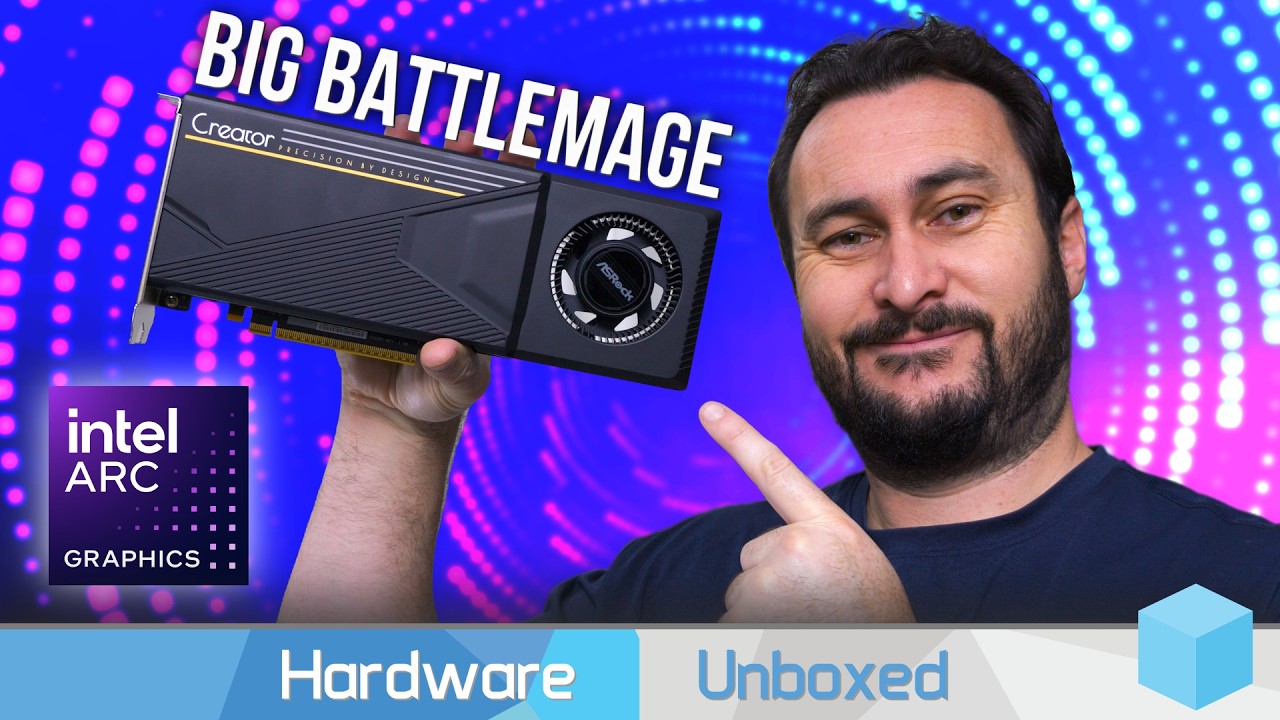
The video discusses Intel’s long-anticipated Battle Mage gaming GPU, specifically the rumored B770 model, which has yet to be released. Instead, Intel launched the B580 in late 2024 and the cut-down B570 in early 2025 but never expanded the lineup as expected. Recently, Intel released the Ark Pro B70, a larger variant with 32 GB of GDDR6 memory, aimed not at gamers but at AI and workstation markets. Priced at $1,000 USD, this GPU is not particularly appealing for gaming despite having full driver support and the potential to perform well in games. The video explores the possibility that if the AI hype fades, Intel might eventually release a gamer-friendly B770 with less VRAM.
The Ark Pro B70 is essentially an upgraded, larger version of the B580, featuring 32 XE2 cores (a 60% increase), a 5% higher core clock speed at 2.8 GHz, 33% more L2 cache, and a wider 256-bit memory bus increasing bandwidth by 33% to 608 GB/s. Manufactured using TSMC’s older N5 process, the B70 also supports PCIe 5.0 with a full 16-lane interface, a significant upgrade from the B580’s PCIe 4.0 x8. These improvements suggest the B70 should perform considerably better than the B580 in gaming, though the B580 itself was already behind AMD and Nvidia’s current generation GPUs.
Gaming benchmarks across twelve popular titles reveal that the B70 consistently outperforms the B580 by roughly 30-40% at both 1080p and 1440p resolutions. However, when compared to competing mid-range GPUs like the RTX 5060 Ti and RX 960 XT, the B70 only matches or slightly trails these cards, offering mid-range performance rather than a breakthrough. The B70 shows good scaling and handles VRAM-heavy games better than some competitors, but its overall gaming performance and power consumption are less impressive, consuming more power than similarly performing Nvidia and AMD GPUs.
The video highlights that a hypothetical B770, which would likely be a B70 with less VRAM and possibly higher clocks, would have to be priced around $300-$350 USD to compete with AMD and Nvidia’s mid-range offerings. However, due to rising memory costs and Intel’s reliance on TSMC for manufacturing, producing a competitively priced B770 is not economically viable. This explains why Intel has not released such a product, as it would neither be sufficiently competitive in performance nor price to attract gamers, especially when compared to existing AMD and Nvidia options.
In conclusion, while Intel’s Battle Mage architecture scales well and the Ark Pro B70 shows promising gaming performance improvements over the B580, Intel’s strategic focus on AI and the economics of GPU production have prevented the release of a true gaming-focused B770. Gamers hoping for Intel to disrupt the mid-range GPU market with a competitively priced, high-performance card will likely be disappointed for now. The video ends by encouraging viewers to subscribe for more hardware content and thanks them for watching.