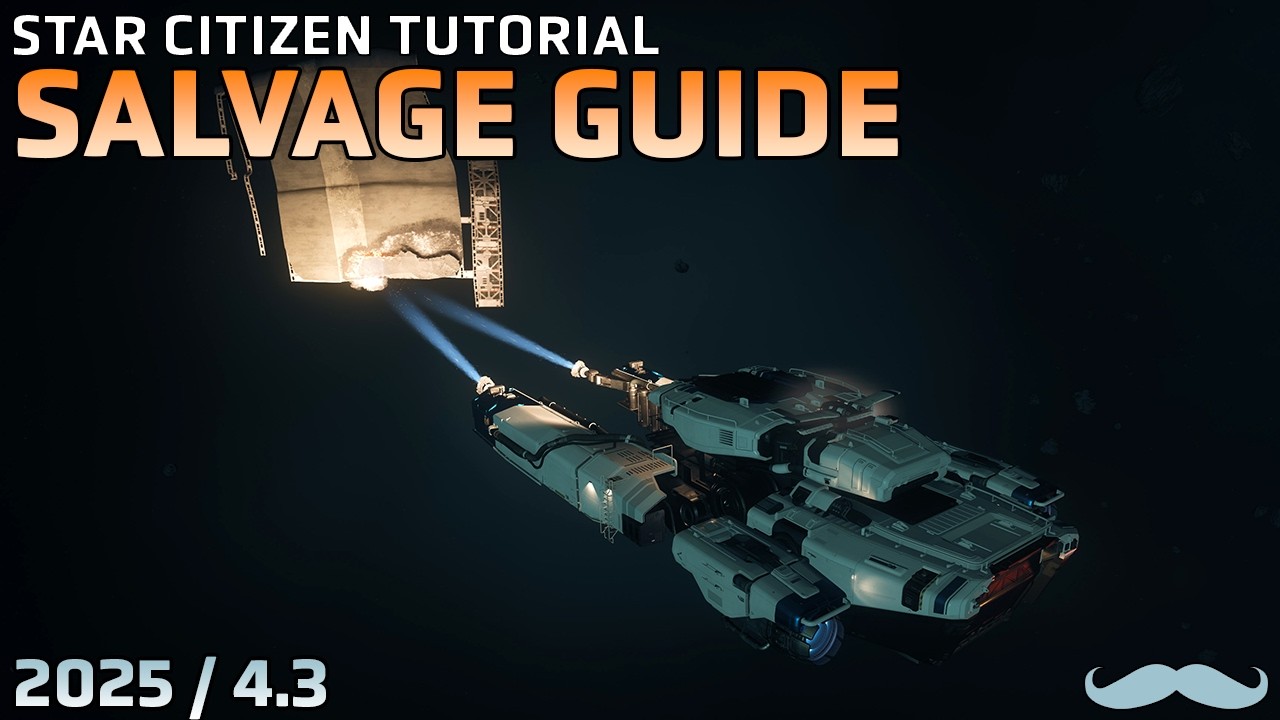
This video provides a comprehensive guide to salvaging in Star Citizen as of Alpha 4.3, covering everything from the necessary tools to the different types of salvage and ships involved. Salvaging can be done either by hand or using specialized ships. For hand salvaging, players need a multi-tool with a Cambolite SRT attachment or a larger hand salvage tool, along with canisters to store recycled material composite (RMC). For ship-based salvaging, players can use the Drake Vulture, Misfortune Fortune, or the multi-crew Aegis Reclaimer. Each ship varies in price, capacity, and complexity, with the Reclaimer being the most expensive and suited for large-scale salvage operations.
To find salvage targets, players can either locate derelict ships and salvage panels in the verse, destroy ships themselves, or accept salvage contracts. Contracts are categorized by size and reputation requirements, with smaller contracts often needed before tackling larger wrecks. Salvage panels, commonly found in asteroid fields like the Aaron Halo belt, offer a convenient source of RMC without the need for contracts. Players use a multi-tool with a tractor beam to strip components and cargo from wrecks, which can be sold to appropriate vendors or other players, though this method is less lucrative than full hull scraping.
The core of salvaging lies in hull scraping, where players use a salvage beam to strip materials from wrecks and collect RMC. The video explains the mechanics of the salvage beam, including indicators for material remaining, beam efficiency, and storage capacity. Players can customize salvage heads based on diameter, speed, and efficiency to balance between thoroughness and time spent. Larger wrecks, such as whalefall from capital ships, provide significant returns. Salvage panels also offer quick RMC collection but do not yield construction materials.
Structural salvage is a more advanced process involving fracturing and disintegrating wrecks into smaller chunks to extract construction materials. This requires switching between modes and using tractor beams for positioning. The process is limited by ship size, with the Reclaimer being the only ship capable of handling the largest targets. Salvage materials are stored in internal hoppers and ejected as crates for transport and sale. Each salvage ship has a unique setup for managing these materials, with the Vulture and Fortune designed for solo use and the Reclaimer optimized for multi-crew operations.
Lastly, the video covers hand salvaging, which is rare and limited in scale but useful for patching hulls or extracting small amounts of RMC. This method uses a multi-tool with a Cambolite SRT attachment and canisters for storage, functioning similarly to ship-based scraping but on a smaller scale. The video concludes by encouraging viewers to share their experiences and subscribe for more Star Citizen content, emphasizing the satisfying and profitable nature of salvaging gameplay within the game.