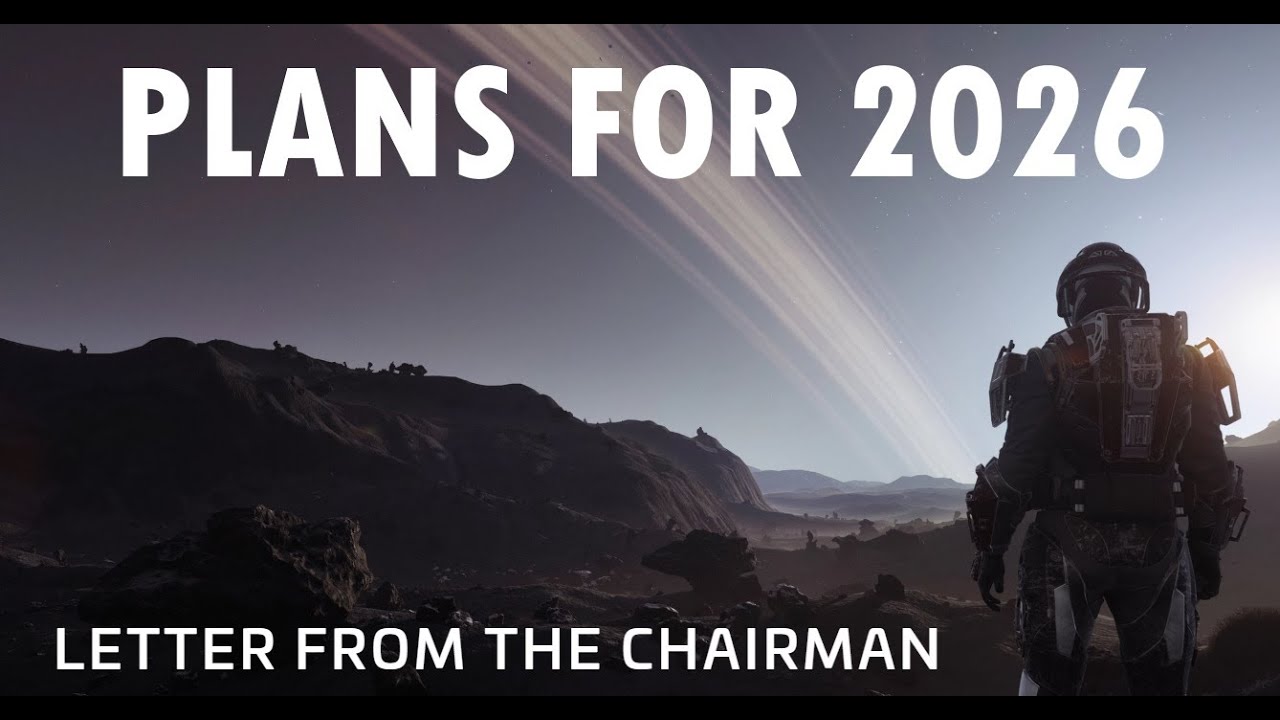
In his end-of-year “Letter from the Chairman,” Chris Roberts reflects on 2025 as a pivotal year for Star Citizen, marked by significant advancements such as the release of new star systems Pyro and Nyx, the return of Lefki, and extensive expansions in locations and mission content. Central to these achievements was the implementation of server meshing, which allowed hundreds of players to share the same game instance, greatly enhancing performance, stability, and overall playability despite some lingering legacy issues. The year also saw improvements in AI, new vehicles, and major gameplay features like engineering introduced in alpha 4.5, alongside experimental VR modes and ongoing engine optimizations, all contributing to record player engagement and a focus on quality of life.
Looking ahead to 2026, Roberts outlines a year of consolidation rather than radical change, emphasizing the maturation and interlocking of Star Citizen’s core systems into a cohesive MMO framework. The highlight is the transition to dynamic server meshing, which will enable real-time scaling of player encounters, events, and hotspots based on activity and density, facilitating truly massive multiplayer operations such as large fleet battles and dynamic social hubs. This approach aims to fulfill Star Citizen’s original vision of a unified universe rather than fragmented servers, while also allowing designers to introduce curated content without breaking immersion.
Another major focus for 2026 is the introduction of Planet Tech V5, or Genesis planets, which represent a qualitative leap in environmental design. These planets will be governed by systemic rules involving climate, terrain, and ecological relationships, making them feel more alive and logically consistent rather than static backdrops. The integration of AI population management will ensure that NPCs are context-aware and relevant to their environments, enhancing immersion and potentially improving traffic and NPC behavior based on location-specific conditions.
Core system improvements are also planned to enhance player trust and long-term engagement, with upgrades to inventory management, insurance, item recovery, and cross-patch persistence. These foundational features, though less glamorous, are essential for an MMO where player investment of time and resources matters. By improving reliability and clarity around ownership and recovery, the game aims to reduce player frustration and prepare for deeper economic systems and more challenging gameplay loops, such as survival mechanics and higher-stakes scenarios.
Regarding Squadron 42, Roberts signals that the project is entering its final refinement phase, focusing on polish, performance stabilization, AI consistency, and cinematic quality. The game is now benefiting from the same technological advancements proven in Star Citizen’s live universe, suggesting it is moving through beta rather than still in development uncertainty. With an internal beta phase underway and a restrained marketing approach, the release window appears targeted for 2026, with potential delays to 2027 possibly aligning well with other major game releases. Overall, Chris Roberts’ letter paints a picture of Star Citizen moving from proving its technology to fully leveraging it at scale, setting the stage for a deeper, more immersive MMO experience in the coming year.