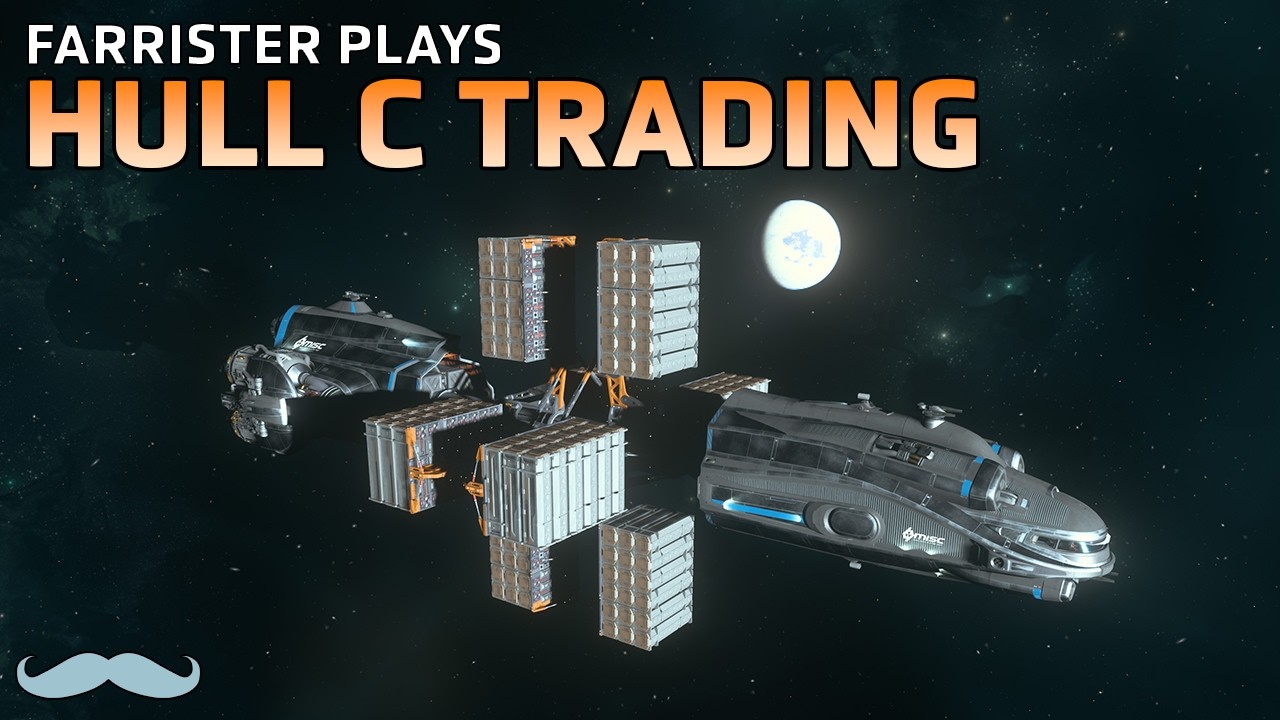
The video showcases cargo trading gameplay in Star Citizen using the Hull C, the largest cargo hauler in the game with a capacity of 4,608 SCUs, equivalent to 144 crates of 32 SCUs each. The Hull C requires spaceborne operation for cargo hauling, so the journey begins in orbit at Port Tressler after launching from New Babbage. Due to the current patch (4.9), auto-loading is not functional, necessitating manual loading of cargo using tractor beams operated by the player and two crewmates. The loading process is laborious and time-consuming, taking 10 to 15 minutes per full load despite having three people involved.
The cargo trading route involves buying and selling various commodities such as waste, carbon, and hydrogen between key locations in the Stanton system—MicroTech, Everest, and Terra Gateway. Each commodity is purchased in maximum quantities to fully utilize the Hull C’s capacity. The unloading process is similarly manual and slightly more challenging due to alignment issues with external freight elevators. Despite the difficulty, the team manages to efficiently load and unload cargo, although the Hull C flies sluggishly when fully laden, requiring careful piloting.
Throughout the trading runs, the player emphasizes the risk involved in manual cargo trading compared to hauling contracts, where AI bears the risk. However, sticking to the Stanton system and having a crew helps mitigate some of this risk. The player also highlights the importance of checking the status of auto-loading functionality before embarking on trading runs, as it significantly reduces loading time and effort. The Hull C’s large cargo capacity makes it ideal for commodity trading, but without auto-loading, the manual work can be tedious and inefficient.
The video further explores strategic decisions such as route planning, timing of purchases, and efficient use of freight elevators to optimize loading and unloading. The player also discusses the sluggish handling of the Hull C when heavily loaded and the benefits of slower, controlled speeds during docking approaches. Despite the challenges, the player enjoys the process and finds satisfaction in seeing the cargo grids fully loaded, sharing a sense of accomplishment with the crew.
After approximately two hours of gameplay, the trading run concludes with a total profit of around 2.3 million alpha UEC, split among the three participants. While the profit margin is modest given the time investment and manual labor required, the experience is described as a fun experiment rather than a recommended method for efficient trading. The player advises that smaller haulers with functional auto-loading are better suited for profitable cargo trading, but appreciates the social and gameplay aspects of the Hull C run. The video ends with an invitation for viewers to like and subscribe for more content.