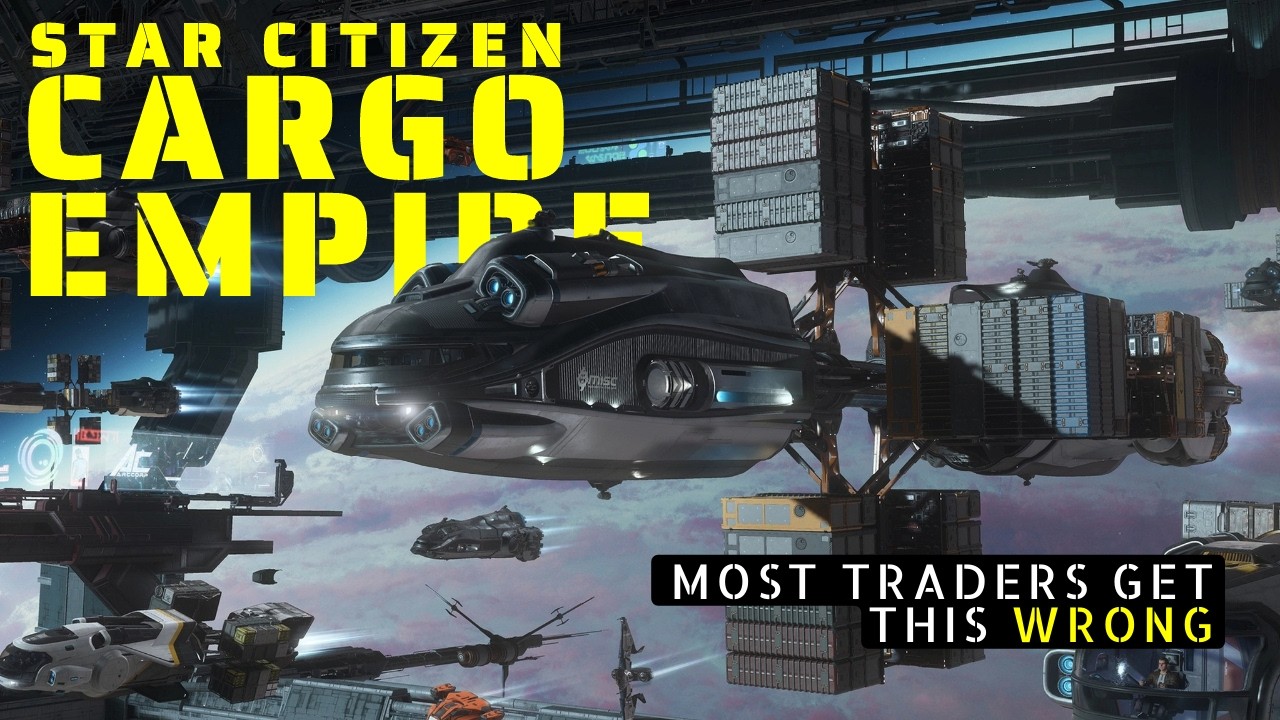
The largest cargo ship in Star Citizen can hold over 12,288 cargo units, but most traders rarely fly such massive vessels. Instead, smaller ships often provide better profitability due to their speed, maneuverability, and ability to access smaller landing pads that larger ships cannot. Many new players mistakenly focus solely on cargo capacity, overlooking factors like loading efficiency, quantum travel time, and piracy risk. Ships like the Nomad, 315P, and Avenger Titan offer excellent entry points for traders, combining manageable cargo space with agility and lower costs, making them ideal for quick, profitable runs with less risk.
Mid-sized haulers strike a balance between cargo capacity, defense, and versatility. The Constellation Taurus stands out in this category with 174 SCU of cargo, substantial firepower, and a hidden smuggling compartment that adds 52 SCU not visible to scans. This makes it a favorite for traders who want both safety and decent cargo space. Other versatile ships like the Freelancer Max and Cutlass Black provide multi-role capabilities, allowing players to switch between trading, combat, and exploration missions. Their adaptability is valuable in Star Citizen’s dynamic environment, where market conditions and gameplay demands frequently change.
Large haulers like the C2 Hercules and Caterpillar offer massive cargo capacities but come with significant drawbacks. The C2 Hercules can carry nearly 700 SCU and generate huge profits but requires large landing pads, limiting route options and increasing exposure to piracy. It also handles poorly and is vulnerable during interdictions. The Caterpillar, while popular for its toughness and modular design, suffers from inefficient cargo loading and a confusing interior layout. Both ships demand substantial capital investment and careful risk management, making them suitable only for experienced traders with enough resources to absorb potential losses.
Specialized ships like the Hull series and the Argo RAF introduce new trading mechanics and efficiencies. Hull ships are designed for station-to-station bulk trading, eliminating atmospheric flight time and improving profit margins, though they are limited to space stations. The RAF features advanced cargo tractor beams for easy loading and unloading, representing a significant quality-of-life improvement. These ships cater to late-game traders who prioritize optimization and large-scale operations, often requiring organized crews and precise market strategies to maximize returns.
Ultimately, successful trading in Star Citizen depends on matching ship choice to your playstyle, capital, and risk tolerance. New players benefit from nimble, affordable ships that minimize losses and allow learning the market, while seasoned traders invest in larger vessels for higher profits but greater risk. Component selection, cargo grid design, and ship handling also critically impact efficiency and survivability. Flexibility and adaptability to changing market conditions and dynamic events are key, as no single ship remains optimal indefinitely. Trading is as much about strategy and enjoyment as it is about raw cargo capacity.