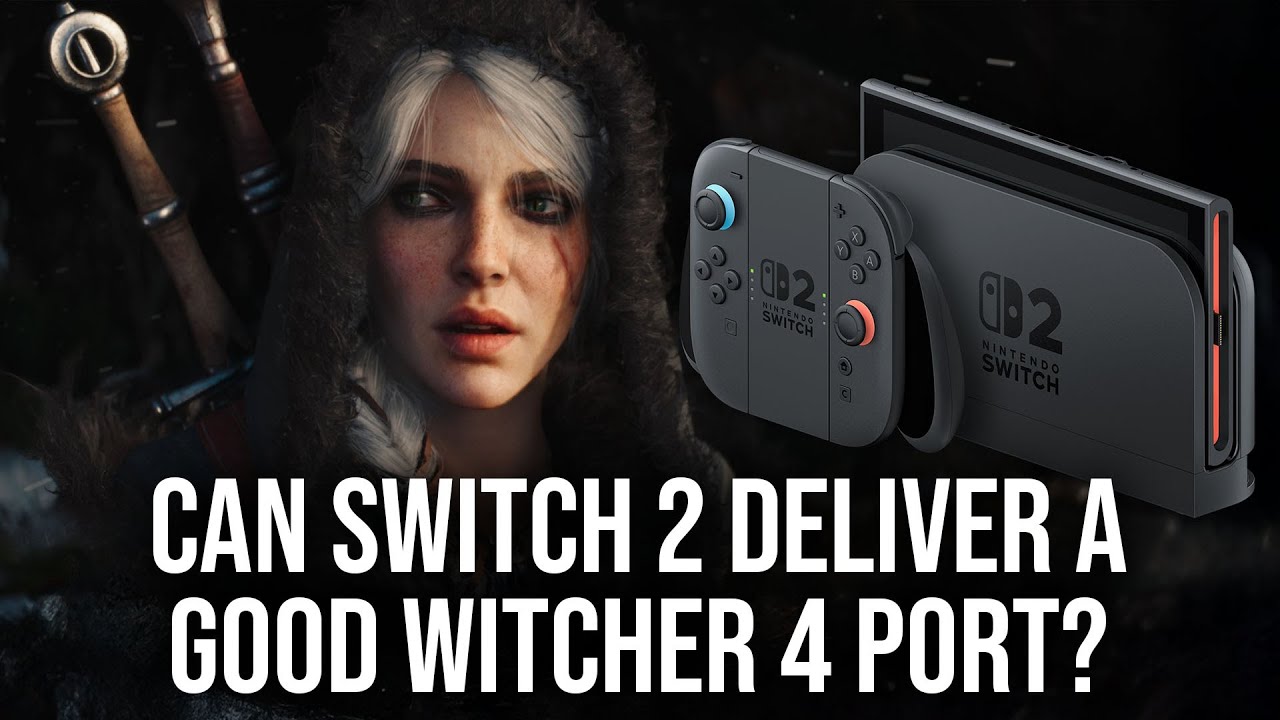
The panel expresses doubt that The Witcher 4 will run well on the upcoming Switch 2 due to its heavy use of demanding Unreal Engine features, despite the promising ray tracing capabilities demonstrated by Star Wars Outlaws. They highlight Nintendo’s cautious but steady approach to adopting new technologies like ray tracing and DLSS, suggesting these features will gradually appear in future titles as development cycles progress and technology stabilizes.
The discussion centers around whether The Witcher 4 can run on the upcoming Switch 2 console, especially in light of the promising port of Star Wars Outlaws, which showcases ray tracing (RT) capabilities on the platform. The panelists express skepticism about The Witcher 4 being ported to Switch 2 due to the game’s heavy reliance on advanced Unreal Engine features like Nanite and Lumen, which have high performance costs. They note that the demo shown was already a massive undertaking to run at 60fps, and the full game might not even maintain that frame rate, indicating that a full port to Switch 2 is unlikely.
The conversation then shifts to Nintendo’s general approach to adopting new technologies like ray tracing and DLSS (Deep Learning Super Sampling). While initial Switch 2 titles don’t seem to leverage these next-generation features extensively, this is attributed to long development cycles that began on the original Switch hardware. Historically, Nintendo has embraced new hardware capabilities once they become stable and accessible, so there is cautious optimism that future titles might take advantage of ray tracing and DLSS to improve visual quality and performance.
Nintendo’s track record with anti-aliasing is discussed, with some panelists noting that the company has been somewhat resistant to implementing advanced anti-aliasing techniques in the past. DLSS, which provides high-quality anti-aliasing and performance boosts, is seen as a feature Nintendo is likely to adopt eventually, as it would significantly enhance the visual fidelity of their games. The example of Luigi’s Mansion 4 is brought up as a potential candidate for utilizing ray tracing, given the technical prowess demonstrated in its predecessor on the original Switch.
The panel also touches on the development culture within Nintendo, highlighting a conservative approach where games often undergo long development periods and may delay adopting cutting-edge features until they are confident in the technology. This conservative mindset contrasts with other publishers like EA, which tend to push out games more rapidly. The discussion suggests that while Nintendo may not immediately embrace all the advanced features of Switch 2, they are likely to incorporate them gradually over time.
Finally, an interesting point is made about Game Freak, the studio behind Pokémon, which despite being considered less technically advanced, managed to add DLSS support to the Pokémon Scarlet and Violet games post-launch. This example shows that even studios with limited technical resources can adopt advanced features, possibly indicating that Nintendo’s hesitation is more about strategic pacing and risk management rather than technical incapability. Overall, the panel remains cautiously optimistic about the future integration of ray tracing and other next-gen features in Nintendo’s lineup.