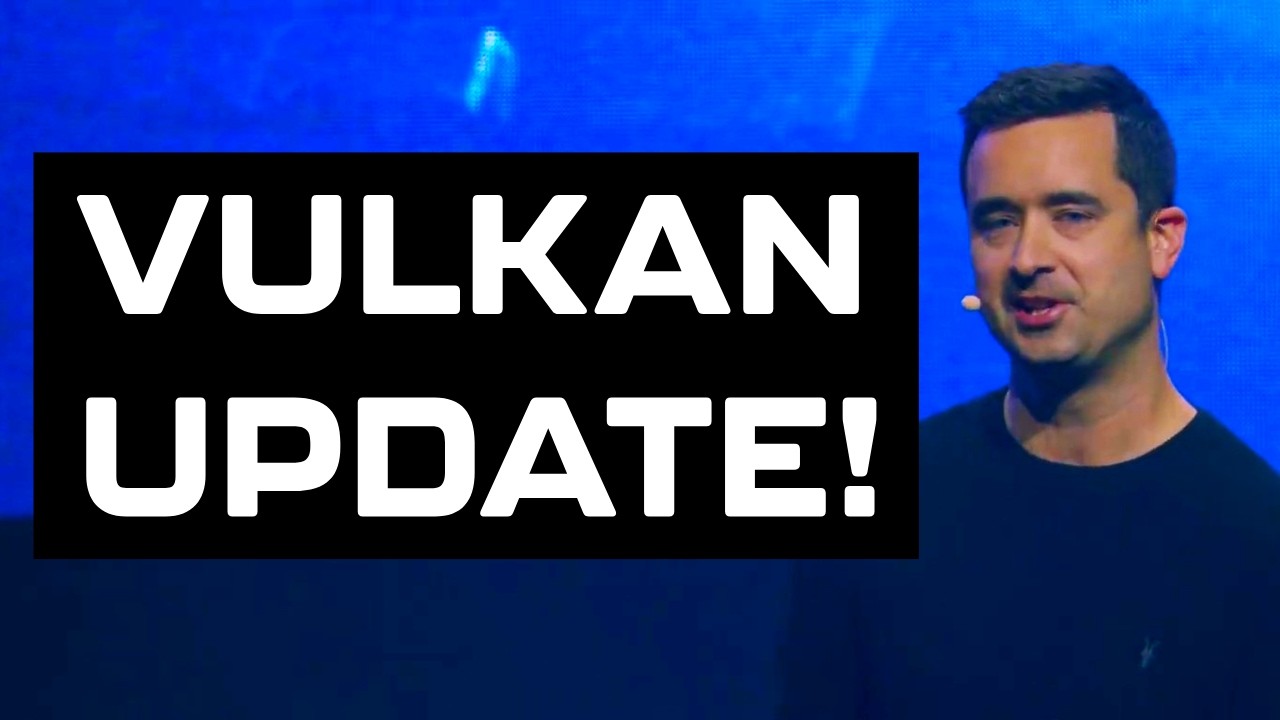
The video provides an update on Star Citizen’s upcoming Vulkan renderer integration, explaining that while it won’t drastically boost performance, it will enable new graphical features and improved stability, with a public release expected after extensive testing. Additionally, the video covers planned CPU and GPU optimizations, the upcoming DLSS 4 upscaling for Nvidia users, and ongoing work on global illumination technology, though these enhancements may arrive later in the year rather than immediately.
The video provides an update on the much-anticipated Vulkan renderer integration in Star Citizen, shared by Ali Brown, the game’s graphics lead. While Vulkan has been in use by Squadron 42 for some time, its transition to Star Citizen’s main branch has been slow due to stability issues and the complexity of moving code between projects. Ali Brown explains that the work done on Vulkan and other graphics technologies in Squadron 42 is now being integrated into Star Citizen’s main development branch, but extensive testing and bug fixing remain before a public release can happen. This process could take several weeks, so while progress is being made, the update is not imminent.
One of the key points highlighted is that Vulkan itself may not dramatically improve performance as many had hoped. The main bottleneck in Star Citizen’s performance lies in the game’s main thread and logic processing rather than the rendering thread. Vulkan’s primary benefit will be enabling new graphical features and stability improvements rather than providing a massive performance boost. For now, DirectX 11 remains the more stable option for most players, but Vulkan is expected to eventually become the default renderer once fully stable.
The video also discusses upcoming changes to upscaling technology in the game. Ali Brown mentioned that DLSS 4 upscaling is implemented internally but has not yet been tested or released publicly. There is no current support for DLSS frame generation, and AMD’s FSR remains unchanged for now, with no immediate plans to upgrade to FSR 4. This is somewhat disappointing for AMD users, as the existing FSR version in Star Citizen is outdated compared to the latest versions available elsewhere. However, the inclusion of DLSS 4 could provide significant improvements for Nvidia users once it is released.
In addition to Vulkan and upscaling, Ali Brown confirmed that both CPU and GPU optimizations are underway, although major optimizations may arrive later than the initial Vulkan update. These optimizations are expected to improve overall game performance, which has been underwhelming in recent updates. The video suggests that these improvements might not arrive as early as the 4.3 patch but could come later in the year, potentially around August or September. The hope is that these combined efforts will make Star Citizen run more smoothly across a range of hardware, from lower-end to high-end systems.
Finally, the video touches on global illumination (GI) technology, which will not be included in the upcoming update due to the need for further optimization and missing features specific to Star Citizen. Although GI is not arriving yet, progress is being made toward integrating it, which is important for realistic lighting across the game world. The developers are exploring both software and hardware ray tracing solutions for this feature. Overall, the video conveys cautious optimism about the future of Star Citizen’s graphics, emphasizing that while big changes are coming, there is still work to be done before these improvements are fully realized.