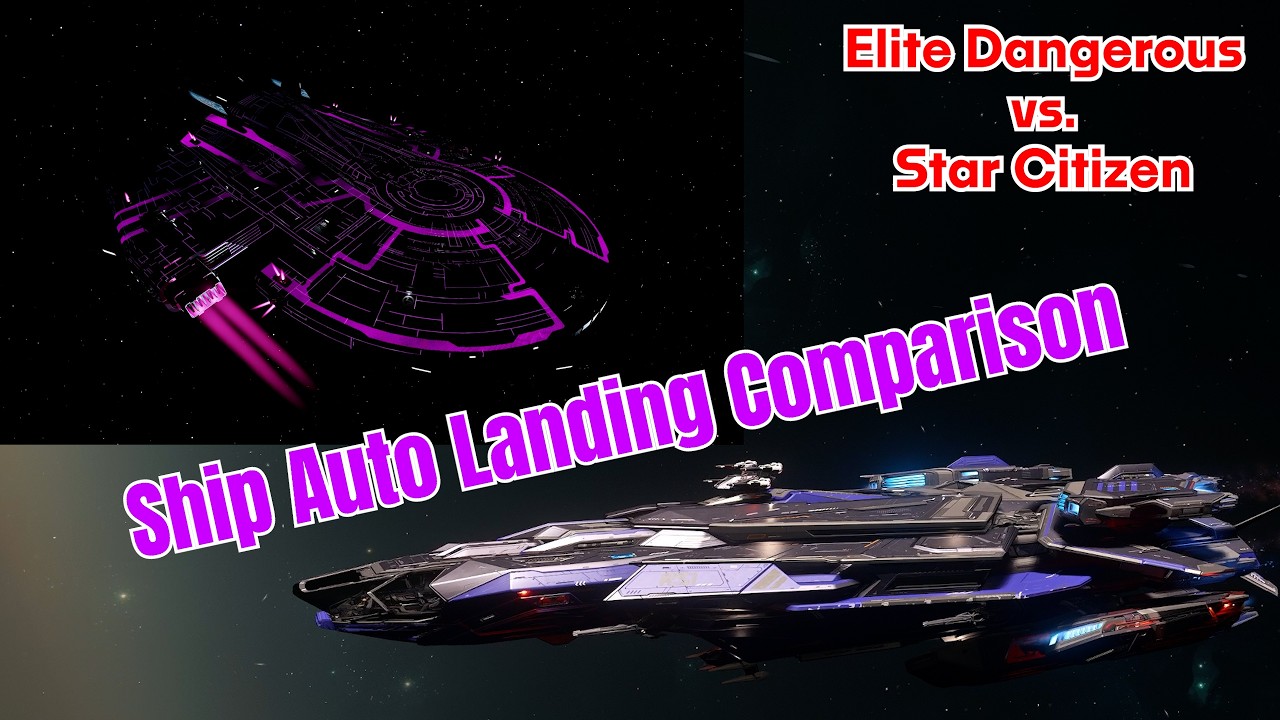
The video provides a detailed comparison of the auto landing and auto docking features in two popular space simulation games: Elite Dangerous and Star Citizen. Both games offer unique experiences with strengths and weaknesses in their respective systems. The presenter begins with Elite Dangerous, explaining that auto docking requires an advanced docking computer module. This module facilitates auto launching from fleet carriers and auto landing on various locations such as space stations, asteroid bases, mega ship carriers, and planetary outposts. The auto landing process is visually appealing, allowing players to relax and enjoy the surroundings while their ship docks or lands automatically.
In Elite Dangerous, players can also perform auto landings on moons and flat ground surfaces, though the system requires the terrain to be suitable for landing, which sometimes makes the process challenging. The game’s auto landing system is praised for its smooth animations and the ability to switch to different camera views during the process. Additionally, players can disembark, launch vehicles, or engage in combat after landing. The presenter highlights the variety of landing environments available in Elite Dangerous, from space stations to comet bases, enhancing the immersion and enjoyment of the auto landing feature.
The discussion then shifts to Star Citizen, where auto docking and landing are more manual compared to Elite Dangerous. Players must manually fly their ships close to hangars or landing pads and then hold a keybind to initiate auto landing. Although the auto landing process itself is automatic once started, the approach requires player skill and control. Star Citizen allows landing on space stations, ground stations, moons, and even rough terrain without restrictions on landing spots. The presenter also demonstrates managing ship emergencies, such as fires, which can be resolved by landing and repairing the ship, adding a layer of realism to the gameplay.
For capital ships in Star Citizen, auto docking involves a docking collar system where players manually align their ship before the automated docking procedure takes over. This feature has improved over time, becoming more reliable and less frustrating for players. Star Citizen also features ship-to-ship docking, particularly for the Constellation series, which includes a snubfighter bay. Players can launch and dock these smaller ships manually, with the process now smoother than in earlier versions. This system contrasts with Elite Dangerous, where ship-to-ship docking requires specific ship modules to carry and deploy smaller vessels.
Overall, the video highlights that while Elite Dangerous offers a more automated and visually polished experience for landing and docking, Star Citizen emphasizes manual control and realism, with a wider range of landing possibilities and complex ship management. Both games have their unique approaches to these features, catering to different player preferences. The presenter concludes by appreciating the strengths of each game’s system and encourages viewers to enjoy the distinct experiences offered by both space simulations.