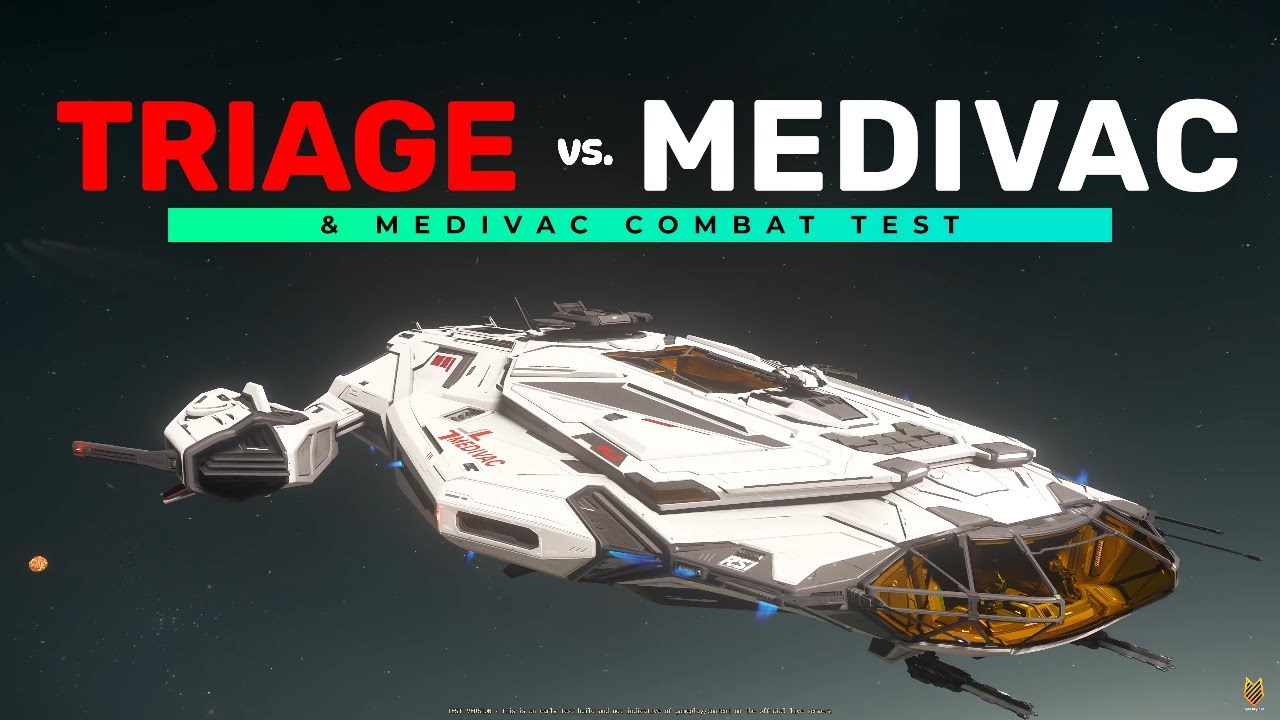
The video provides a detailed comparison between the Apollo Triage and the Apollo Medivac, two dedicated medical ships, focusing on their combat capabilities. Both ships are size five, sharing identical dimensions and weight, but the Medivac has slightly higher hull and vital part hit points, making it marginally more survivable. The Medivac also has a slight speed advantage in standard combat mode (SCM) but is slower in forward boost and maximum navigation speeds compared to the Triage. Maneuverability differs as well, with the Medivac having better pitch but worse yaw control, which affects combat handling.
Fuel capacities for both ships are similar, with the Medivac having a minor increase in quantum fuel. Insurance claim times and costs are slightly higher for the Medivac. Both ships have identical cross-section signatures and components, including power plants, coolers, quantum drives, radars, and shields. Weapon hardpoints are the same, featuring two size four and two size three guns, with the latter controlled by the pilot if no co-pilot is present. The key difference lies in missile capacity: the Medivac carries double the number of size two missiles compared to the Triage.
The video demonstrates the modularity of the ships’ components and weapons, showing that shields, power plants, coolers, and quantum drives can be detached and reattached. The turret on top offers a 360-degree firing arc and can be controlled remotely by the co-pilot. However, both ships suffer from a relatively low weapon capacitor of 68 rounds, which is a drawback compared to other ships with higher capacities, limiting sustained firepower during combat.
During combat testing, the Medivac performed well against light and medium fighters, quickly dispatching targets like the Avenger Titan and Hornet. The pilot leveraged the ship’s superior pitch maneuverability to gain an advantage. However, the low weapon capacitor required frequent recharging, which proved problematic in prolonged fights. Missile effectiveness was limited due to their small quantity and high rearm cost, making them less practical in large-scale engagements.
When facing heavier ships like the Vanguard, equipped with powerful size five ballistic cannons, the Medivac struggled significantly. Multiple heavy hits penetrated shields and quickly destroyed the ship, highlighting its vulnerability in intense combat scenarios. The video concludes that while the Apollo Medivac can defend itself against lighter threats and in moderate combat situations, it is not designed as a dedicated combat vessel. Its primary role remains medical support, with combat capabilities serving as a secondary, self-defense function.