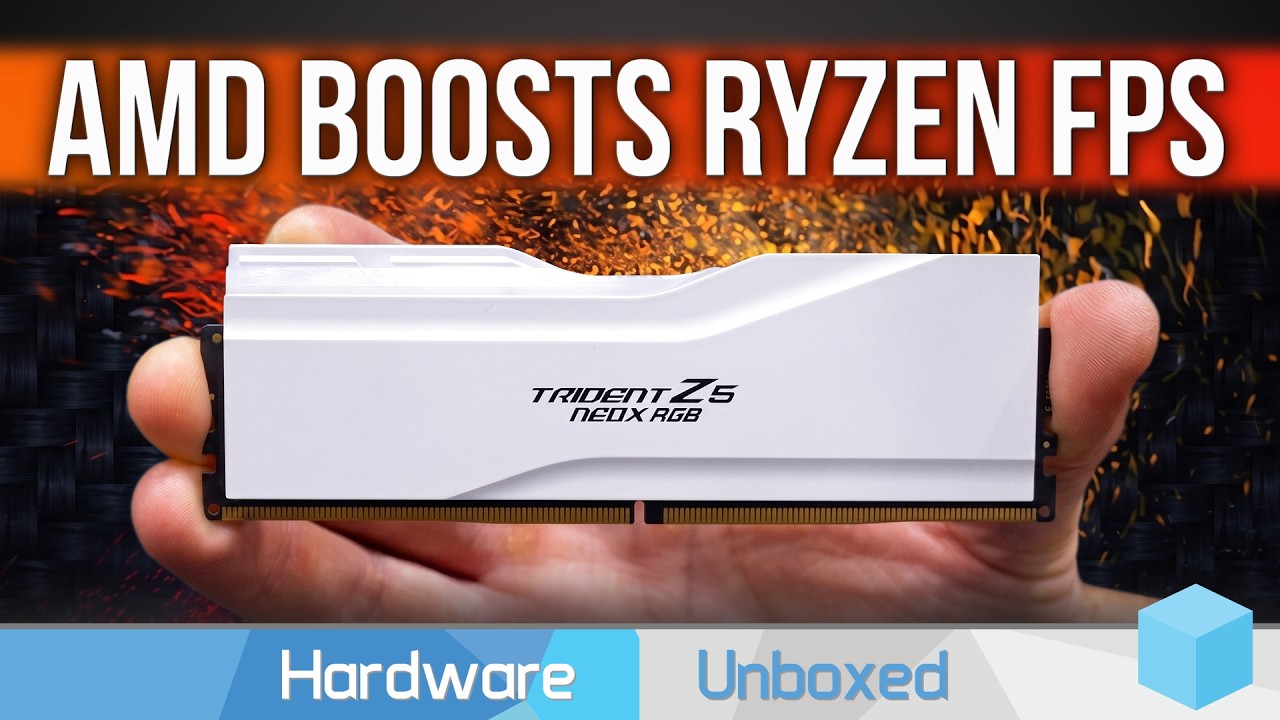
In this Hardware Unboxed coverage from the G.Skill booth at Computex 2026, several new memory products related to Ryzen platforms were showcased, focusing on DDR5 advancements. G.Skill has updated their Neo XRGB memory modules, moving away from the vibrant colors seen last year to more subdued matte finishes in white and black, which better complement RGB lighting effects. Alongside these, G.Skill introduced actively cooled DDR5 memory developed in collaboration with Cooler Master, designed to address the heat issues common with DDR5 overclocking. However, the current active cooling solution requires a 4-DIMM motherboard and supports only two modules, limiting compatibility with typical overclocking motherboards, though a low-profile version is in development.
A significant announcement from AMD at Computex was the introduction of EXPO Ultra Low Latency (ULL) memory profiles, an update to the existing EXPO standard that allows tighter memory timings and improved performance on Ryzen systems. G.Skill has four DDR5 6000 kits featuring these ULL profiles with improved secondary and tertiary timings. The key improvements involve adjustments to sub-timings such as tRFI (refresh interval), tWR (write recovery time), and tRRDS (RAS-to-RAS delay short), plus a locked VDDP voltage to maintain system stability. These changes reduce memory latency by 5 to 7 nanoseconds at Ryzen’s optimal frequency range, enhancing gaming performance.
AMD claims that EXPO ULL can deliver around a 4% gaming performance boost over previous EXPO profiles for non-X3D Ryzen CPUs like the 7900X, while X3D CPUs see minimal gains due to their memory insensitivity. Contrary to some exaggerated claims of 10-15% improvements, the real-world gains are more modest and depend on the specific memory kits and motherboard compatibility. G.Skill’s current ULL kits prioritize broad compatibility over extreme performance, and users will need a BIOS update with AGESA 1.3.0.1 or later to enable the new profiles.
Beyond the latency-focused kits, G.Skill also demonstrated extremely high-frequency and large-capacity DDR5 memory solutions. They showed a DDR5 10,933 MHz kit running on Intel’s Core Ultra 5 250K Plus platform with 48 GB capacity, though this ultra-high frequency offers limited gaming performance due to increased latency. Additionally, they highlighted massive 128 GB modules and a 256 GB dual-stick setup, as well as an Intel Xeon system equipped with a staggering 768 GB of DDR5 8800 memory, showcasing the extremes of current memory technology for professional and enthusiast use.
Overall, the event highlighted G.Skill’s continued innovation in DDR5 memory, particularly with AMD’s new EXPO ULL profiles aimed at reducing latency and boosting Ryzen gaming performance. The collaboration with Cooler Master on actively cooled memory addresses thermal challenges in DDR5 overclocking, albeit with some compatibility limitations. Enthusiasts can look forward to these new memory modules becoming available as DDR5 pricing potentially improves, and Hardware Unboxed plans to further test the ultra low latency memory to evaluate its real-world benefits.