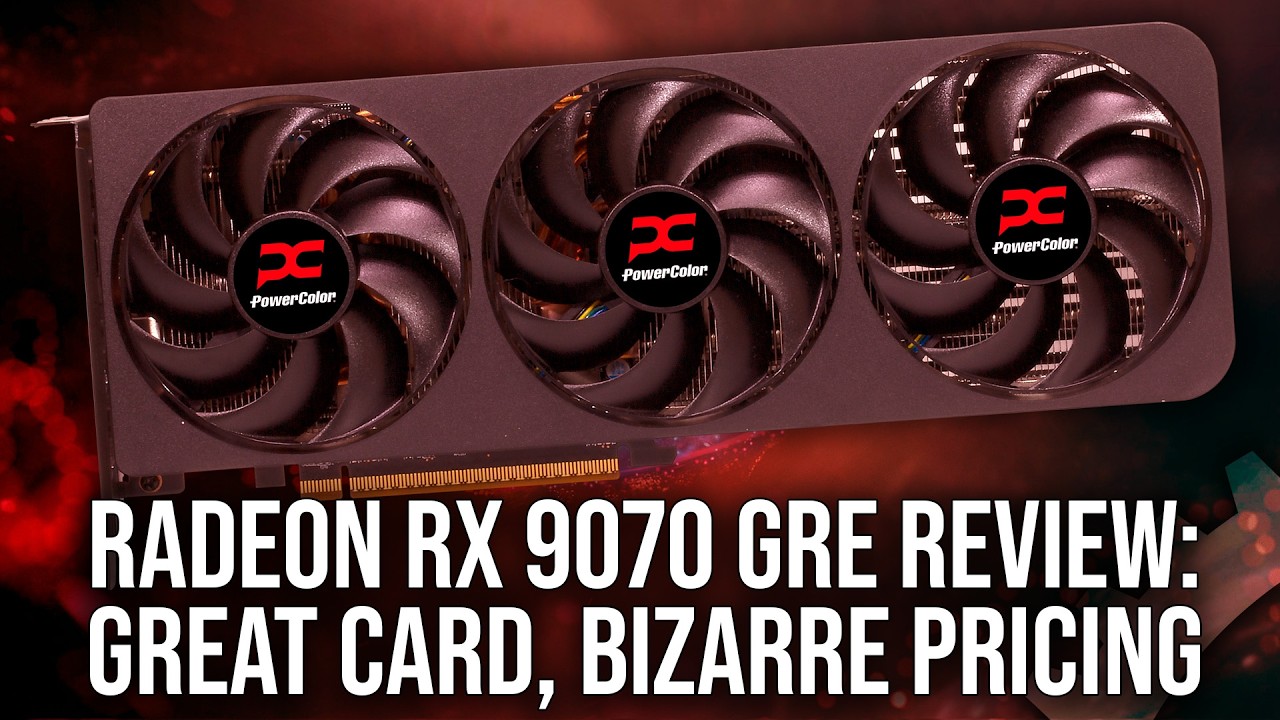
The AMD Radeon RX 9070 GRE is a somewhat familiar addition to the GPU market, having been available in China for some time but only recently gaining wider attention. Positioned between the RX 1960 XT and RX 1970 in AMD’s RDNA4 lineup, the GRE offers 12 GB of memory, which seems practical amid the ongoing AI-driven memory shortage. However, the card’s suggested price of $550 is puzzling because for just $50 more, consumers can purchase the full RX 9070, which provides better performance and more VRAM. AMD appears to have priced the GRE to avoid undercutting the inflated pricing of the 1960 XT 16 GB, but this strategy results in a confusing value proposition that fails to compete effectively with both AMD’s own higher-tier cards and Nvidia’s offerings.
From a technical standpoint, the 9070 GRE is based on the Navi 48 GPU but with reduced compute units—about 14% fewer than the RX 1970 non-XT and 25% fewer than the 1970 XT. Its memory interface is also scaled back, dropping from a 256-bit bus to 192 bits and reducing memory speed and bandwidth accordingly. The review unit, a PowerColor Reaper model, performed adequately with quiet operation and a typical triple-fan design. Benchmarking across various demanding games at 1440p revealed that while the GRE generally outperforms Nvidia’s RTX 5060 Ti 16 GB, it consistently trails behind the RX 9070 and RX 9070 XT, which provide significantly better price-to-performance ratios despite their slightly higher cost.
Performance testing showed mixed results depending on the game and settings, but the overall narrative remained consistent: the RX 9070 GRE does not offer compelling value compared to its AMD siblings or Nvidia competitors. For instance, in Cyberpunk 2077 and other titles, the GRE lagged behind the RX 9070 by around 20-25% in performance, while only saving $50 in price. Even with ray tracing enabled or using upscaling technologies like FSR4 and DLSS, the GRE could not justify its price point. The RX 9070 XT and RX 1970 emerged as the better value leaders within AMD’s RDNA4 lineup, with the GRE’s pricing failing to reflect its relative performance deficits.
The reviewer also highlighted the experience of using the GRE in real-world gaming scenarios at 1440p with optimized settings and upscaling. While the card performs well enough for QHD gaming and would be a solid choice in isolation, the presence of better-performing and similarly priced alternatives makes the GRE a less attractive option. The reviewer expressed hope that market forces might adjust the GRE’s price to a more reasonable level, as the card itself is a good product but simply not priced competitively. There was also concern that the GRE’s existence might signal a potential discontinuation of the RX 9070, which currently offers more compelling value.
In conclusion, the AMD Radeon RX 9070 GRE occupies an awkward position in the current GPU market. It offers decent performance and a respectable 12 GB of VRAM, but its pricing strategy undermines its appeal. Consumers seeking AMD GPUs in this segment would be better off investing slightly more in the RX 9070 or RX 9070 XT, which deliver superior performance and value. Meanwhile, Nvidia’s RTX 5070 also remains a competitive alternative. The GRE’s future depends on price adjustments, and until then, it remains a niche option rather than a market leader. The review ends with a call to support Digital Foundry for more in-depth hardware analysis and updates.