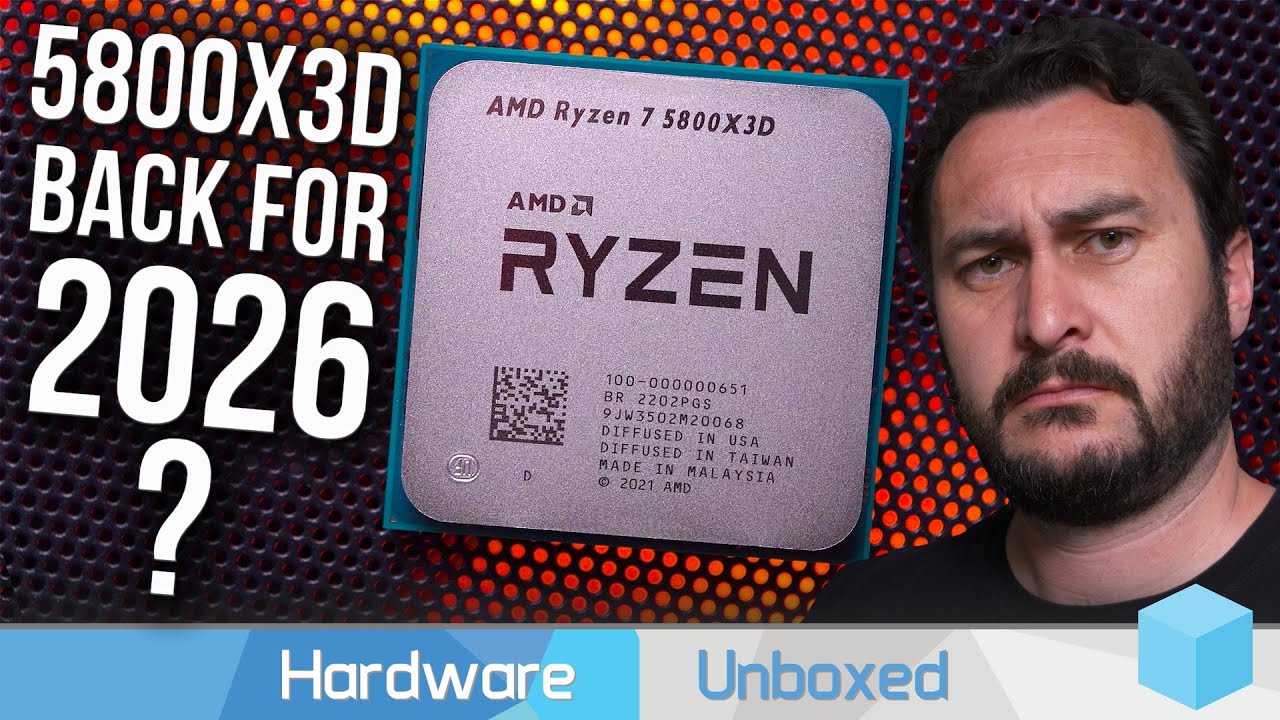
In this video, Steve revisits the gaming performance of AMD’s Ryzen 7 5800X3D and 5700X3D processors in 2026, highlighting their continued relevance despite having reached the end of their production runs. He notes that these chips are currently unavailable for purchase new, which is why previous benchmarks focused on still-available AM4 processors like the 5600X, 5700X, and 5800XT. However, there is some hope for a potential return of AM4 processors, as AMD has expressed interest in reviving the AM4 ecosystem to meet gamers’ upgrade demands without requiring full system rebuilds. This would likely involve parts similar to the 5800X3D, though nothing is confirmed yet.
Steve provides detailed gaming benchmark updates across 14 games, comparing the 5800X3D and 5700X3D against modern processors like Intel’s Core i5-14600K, 9600X, and AMD’s own 9800X3D. The 5800X3D consistently outperforms its non-3D counterparts, showing an average 29% performance improvement over the 5800XT in medium settings. In many titles, it matches or slightly edges out newer mid-range processors, proving that the 3D V-Cache technology remains highly effective for gaming even years after release. The 5700X3D trails the 5800X3D by about 5% but still delivers solid performance, often beating budget Intel CPUs.
The video also highlights how the 5800X3D ages well, particularly thanks to Windows 11 24H2 updates that improved Ryzen processor performance by about 10%. This update helped close the performance gap with newer Intel CPUs, making the 5800X3D competitive in modern gaming scenarios. Steve dispels earlier concerns that the 3D V-Cache would lose effectiveness over time or in larger, newer games, showing that the performance uplift compared to the 5800XT has actually increased slightly since launch. The 5800X3D remains a strong gaming CPU, especially when paired with DDR4 memory.
Steve discusses specific game performance, noting that titles sensitive to memory bandwidth show some limitations due to the AM4 platform’s DDR4 support. However, in cache-sensitive games like Assetto Corsa Competizione and Baldur’s Gate 3, the 3D V-Cache processors excel, often outperforming newer CPUs. Even in demanding games like Cyberpunk 2077 and Space Marine 2, the 5800X3D remains competitive, frequently matching or coming close to the latest mid-range processors. Overall, the benchmarks confirm that the 5800X3D is still a highly capable gaming CPU in 2026.
In conclusion, Steve praises the 5800X3D for its longevity and gaming prowess, calling it a “king” of gaming CPUs at launch and still very relevant today. He hopes AMD might bring back the AM4 platform and the 3D V-Cache processors to satisfy gamers who want significant upgrades without full system overhauls, though he remains cautious about the likelihood. The video ends with an encouragement to like, subscribe, and engage with the channel for more content, including potential further AM4 processor testing.