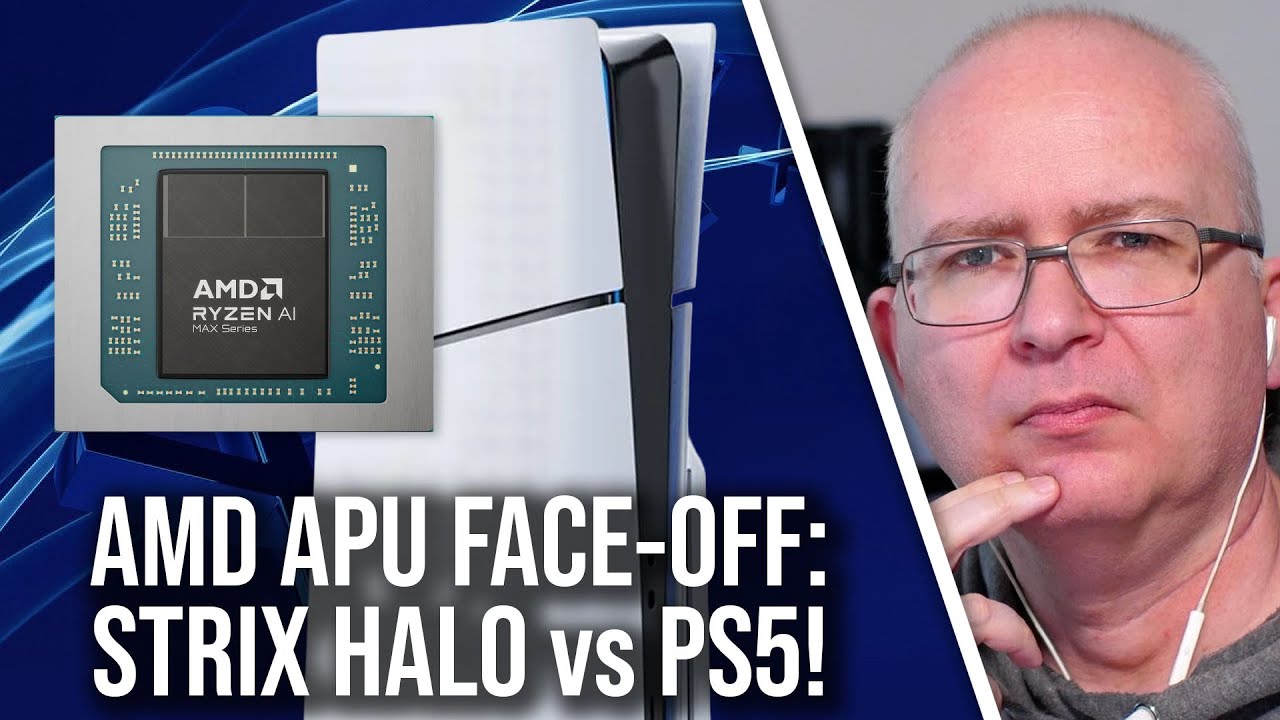
The video reviews the GMK Tech Evo X2 mini PC, which features AMD’s most powerful APU to date, the Ryzen AI Max Plus 395, codenamed Strix Halo. This mini PC is compared directly against Sony’s PlayStation 5, effectively pitting APU against APU. Strix Halo boasts significant hardware advantages, including 16 Zen 5 CPU cores versus the PS5’s 8 Zen 2 cores, and a more advanced GPU architecture with 40 RDNA 3.5 compute units compared to the console’s 36 RDNA2 units. The chip is built on a more advanced 4nm process versus the PS5’s 6nm or 7nm, but the console retains advantages in power draw and notably superior memory bandwidth, with 458 GB/s versus 256 GB/s on the mini PC.
In gaming benchmarks across several multiplatform titles, Strix Halo holds its own against the PS5 despite the console’s memory bandwidth advantage. In Alan Wake 2, both systems deliver very similar performance at 4K with FSR2 balance mode and medium settings, with Strix Halo slightly ahead by less than 1%. At an 85W power mode, the mini PC also edges out the PS5 by 2% in Alan Wake 2’s 1440p performance mode. Hitman: World of Assassination shows mixed results, with the PS5 slightly faster in some areas and Strix Halo outperforming in others by nearly 10%. Black Myth Wukong also sees comparable frame rates between the two, with Strix Halo gaining a 5% advantage in a GPU-limited scenario.
When examining CPU performance, the expected dominance of Strix Halo’s Zen 5 cores over the PS5’s Zen 2 is somewhat muted. In the CPU-heavy Act 3 of Baldur’s Gate 3, Strix Halo achieves a 25% performance improvement but still struggles to reach 60fps, likely due to shared memory bandwidth constraints. Cyberpunk 2077 highlights a CPU bottleneck during fast movement, where the PS5 actually holds a slight 3.7% edge over Strix Halo. These results indicate that while Strix Halo’s CPU is more advanced, real-world performance gains can be limited by system architecture and memory bandwidth.
Power consumption is also analyzed, showing that the GMK Tech Evo X2 mini PC consumes less power overall compared to the PS5 Slim, despite running at similar performance levels. At 85W TDP, the mini PC draws about 131W from the wall, while the PS5 Slim draws roughly 216W. Even at a higher 120W TDP, the mini PC remains more power efficient. This efficiency is notable given the mini PC’s lower memory bandwidth and smaller fabrication process. However, cooling challenges in the mini PC result in louder fan noise, and battery life for potential handheld implementations of Strix Halo is expected to be limited to about an hour at full performance.
In conclusion, the AMD Ryzen AI Max Plus 395 Strix Halo APU delivers impressive performance for a mobile-oriented chip, rivaling the PS5 in many gaming scenarios while consuming less power. The GMK Tech Evo X2 mini PC showcases what this APU can do, though with some thermal and noise trade-offs. AMD positions Strix Halo as a mobile Threadripper-class chip with unprecedented performance for its segment, and its future in handhelds and tablets looks promising. While it may not fully match the PS5 in all situations, especially due to memory bandwidth constraints, it represents perhaps the closest portable equivalent to a PlayStation 5, with the potential for further optimization on lower-wattage devices.