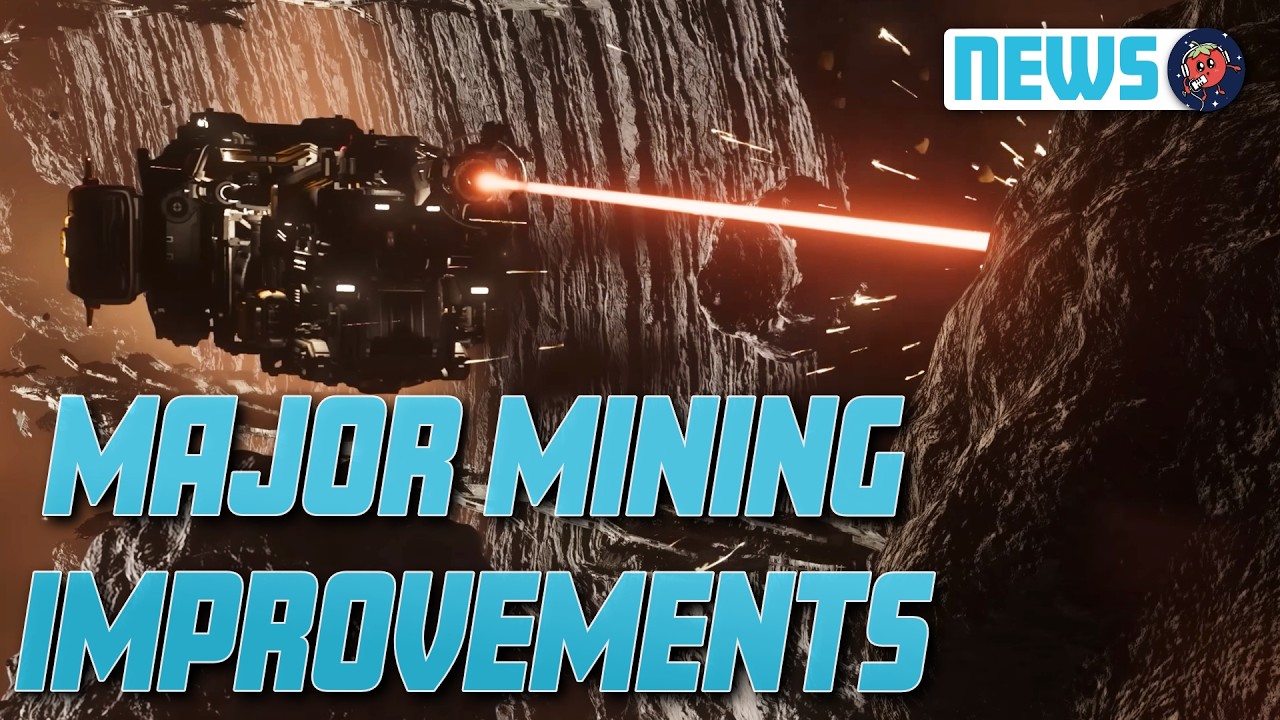
The video discusses recent updates in Star Citizen’s Alpha 4.9 patch, focusing on improvements in exploration and mining gameplay. A key change is the enhanced scanning system, where players can now perform focused scans by simply pinging rocks, automatically identifying their composition without needing to fly close or manually scan each fragment. This quality-of-life improvement significantly speeds up prospecting and mining by providing immediate resource information, reducing the tediousness of scanning multiple rock fragments individually. Additionally, the update allows scanning from different ship seats, potentially benefiting multi-crew mining operations and encouraging the use of ships with varied radar capabilities.
The presenter emphasizes that while these scanning improvements aid mining, they also hint at broader implications for exploration gameplay. Currently, exploration involves prospecting—discovering and identifying resources—which this update streamlines. However, the long-term vision for exploration in Star Citizen goes beyond this, involving more complex mechanics like data collection, mapping, and sharing. The video references CitizenCon 2023, where developers showcased features such as incremental radar mapping, saving environmental data to a databank, and placing customizable markers that can be shared or sold, pointing to a future where exploration becomes a distinct profession involving data gathering and trading.
A significant portion of the discussion reflects on the distinction between short-range prospecting and long-distance exploration. Long-distance exploration, as described by former developer Dan Truffin in 2021, involves deploying probes to scan entire star systems, triangulating signals to locate points of interest like mining fields or derelict stations. Players would analyze unique signatures of discovered objects, comparing them to a library of known data to decide whether to investigate further or avoid risk. This system would add depth and skill to exploration, requiring players to interpret data rather than instantly knowing what they’ve found, contrasting with the more immediate scanning updates introduced in 4.9.
The video also debates the balance between player skill and game accessibility. Some players prefer a more challenging experience where understanding and memorizing scan signatures provide a competitive edge, while others favor streamlined mechanics that reduce complexity and frustration. The recent scanning improvements lean towards accessibility, offering instant information to all players. The presenter acknowledges this tension and suggests that future designs might integrate both approaches, perhaps by displaying signature data on dashboards to maintain depth without overwhelming newcomers.
Finally, the presenter notes that game development decisions are fluid and subject to change, as highlighted by a quote from a developer explaining that many gameplay systems evolve over time with new team members and ideas. Therefore, while the 2021 vision for long-distance exploration provides insight, it may not fully represent the current or final design. Overall, the 4.9 scanning updates mark a positive step toward more engaging exploration and mining, but the full realization of exploration as a distinct, skill-based profession in Star Citizen remains a work in progress.