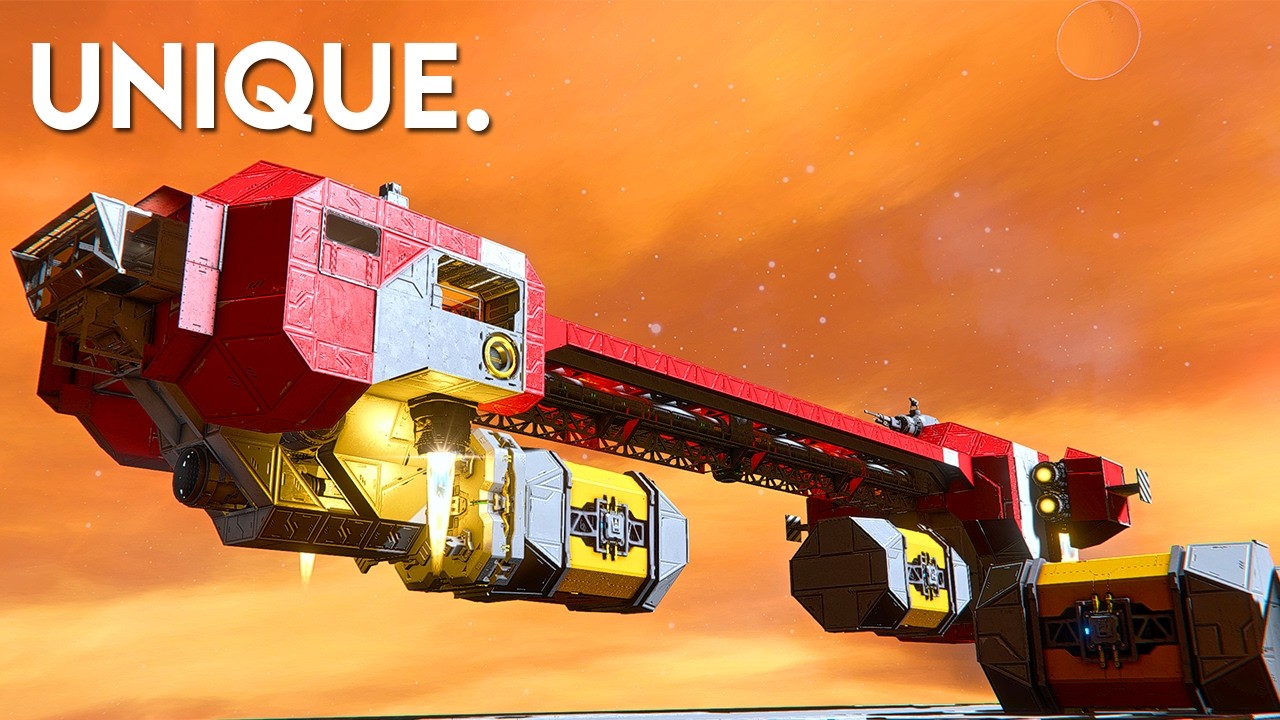
The video provides an in-depth analysis of the Heavy Module Freighter, a unique and specialized ship introduced in the Economy 2 update of Space Engineers. This vessel is designed primarily for towing standardized cargo modules between stations, featuring dual jump drives and strong forward acceleration to facilitate long-distance modular logistics. It is the longest purchasable ship in the game, powered by hydrogen, and equipped to carry custom cargo loads using dual large magnetic plates. Priced at around 70 million space credits, it is a large grid ship available from space economy stations.
The design of the Heavy Module Freighter shares notable similarities with the classic “blue ship” from the game, suggesting they may come from the same shipyard, possibly representing a civilian variant of a hauler. Both ships feature a long, slender midsection with beam blocks, walkways, conveyor systems underneath, and similarly positioned bridges and rear sections. The Heavy Module Freighter comes equipped with a modest arsenal and systems, including one small reactor, five batteries, hydrogen tanks, gyroscopes, a gatling turret, an interior turret, survival kit, jump drives, thrusters, and magnetic plates, but lacks production blocks and oxygen/hydrogen generators.
The ship’s interior is compact but functional, with unpressurized sections in the bow, including access to the gatling turret and airlock, a survival kit, and a bridge with extensive viewing angles. The living quarters are small but sufficient, featuring basic amenities like a toilet, cryopod, and sink. Narrow corridors lead to the rear engineering space housing the reactor, gyroscopes, batteries, and cargo access. The Heavy Module Freighter measures 93.75 meters long, 32.5 meters wide, and 21.25 meters tall, weighing 456 tons and utilizing 4,149 PCU. It performs well on various planetary bodies, capable of carrying significant payloads, especially on low-gravity moons.
Performance-wise, the ship excels in forward acceleration and jump capabilities but has limited maneuverability due to minimal gyro control. It is designed as a specialist vessel focused on hauling large cargo modules over long distances rather than serving as a cargo ship, warship, or survival vessel. Its lack of onboard production and refueling capabilities means it relies on external stations for resources. Despite these limitations, the ship is praised for fulfilling its intended role efficiently and reliably.
Finally, the video explores modification ideas for the Heavy Module Freighter, showcasing its versatility. One modification replaces the magnetic plates with large cargo containers for traditional freight use, albeit limiting planetary flight capabilities. Another converts it into a drop carrier for fighters, adding turrets and refueling tanks for enhanced combat support. A more radical modification involves shortening the ship to create a stubby freighter variant with a large cargo container. Overall, the Heavy Module Freighter is highlighted as a specialist ship with a large central area ripe for customization, making it a valuable asset for players focusing on modular cargo transport in survival runs or economic gameplay.