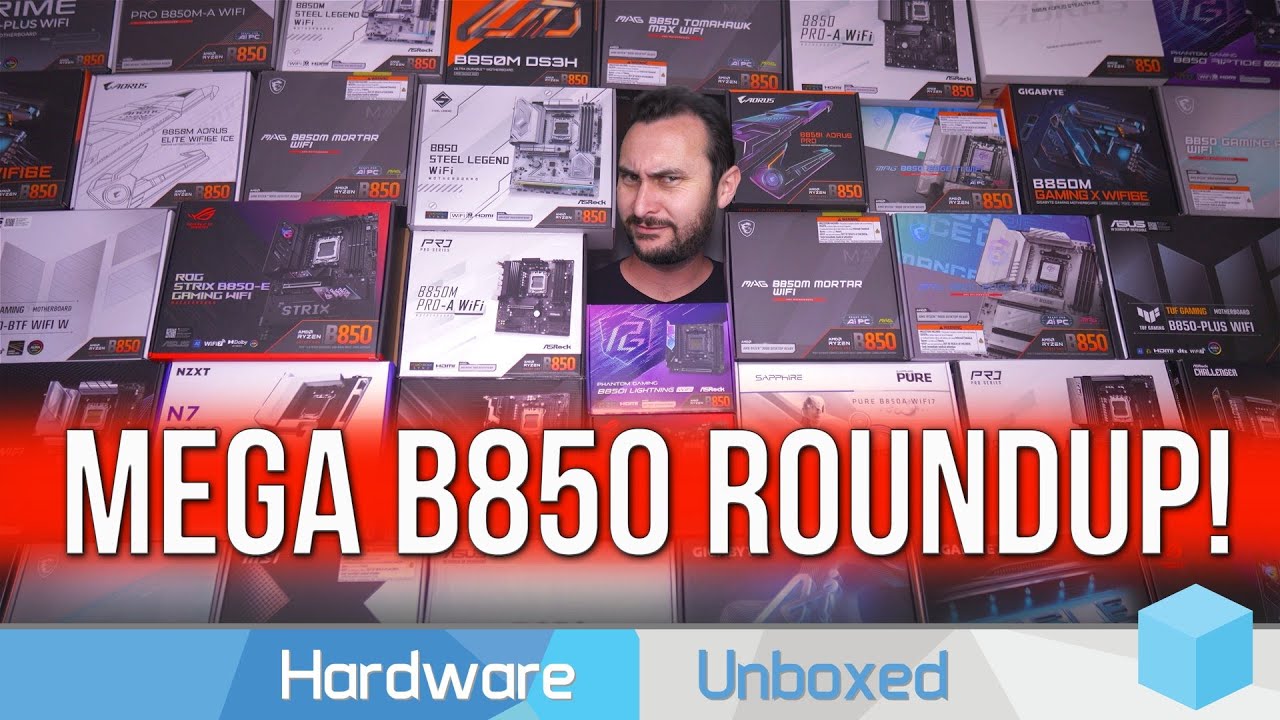
The video presents an extensive review of 47 unique AMD B850 motherboards, covering a broad spectrum from budget to high-end models. The host begins by acknowledging the extensive work involved in testing these boards over nearly a year and introduces the sponsorship by MSI QD OLED gaming monitors. The review is split into two parts, with the first focusing on sub-$200 US models and the second covering mostly boards priced above $200. The video dives into detailed specifications and features of motherboards from major manufacturers including ASRock, ASUS, Gigabyte, MSI, Sapphire, and NZXT, highlighting their VRM configurations, connectivity options, and unique design elements.
ASRock’s range is noted for offering good value, particularly with models like the Steel Legend and the Challenger Wi-Fi, which come with solid power delivery and connectivity features. ASUS boards, while generally well-equipped, show some variability in VRM quality, with some models using less efficient discrete MOSFETs, leading to higher temperatures. The ROG Strix series offers premium options with advanced VRMs and multiple M.2 slots, but some high-end models are criticized for their steep pricing. Gigabyte’s offerings include strong contenders like the B850 Orus Elite Wi-Fi 7 ICE and the AI Top, the latter standing out for its extreme VRM and dual 10 Gb LAN ports, making it a unique high-end choice.
MSI’s lineup is diverse, ranging from budget to flagship models like the Tomahawk Max Wi-Fi and the Edge TI Wi-Fi, which compete well in features and VRM performance. However, some MSI models suffer from power delivery limitations or poor design choices, such as an ineffective M.2 heatsink with a fan that doesn’t contact the SSD. Sapphire and NZXT offer more modest options, with Sapphire’s Pulse and Pure series aimed at budget and mid-range buyers, and NZXT’s N7 B850 praised for its unique aesthetic but criticized for thermal design flaws due to plastic shrouds covering heat-sensitive components.
The testing methodology involved stress testing the motherboards using an AMD Ryzen 9 9950X at 170W TDP with Cinebench 2024, measuring VRM temperatures over an hour to assess thermal performance and power delivery capabilities. Most boards passed the test with VRM temperatures well below critical levels, but a handful failed due to power limits or poor thermal management, notably some budget models from Sapphire, MSI, and Gigabyte that imposed hard power limits restricting full CPU performance. The host emphasizes that for CPUs with lower power requirements (120W or less), almost all boards provide adequate performance.
In conclusion, the host recommends several standout motherboards depending on budget and form factor. ASRock’s B850M Pro RS is highlighted as the best value option, while MSI’s Tomahawk Max Wi-Fi offers a strong feature set around $210. For mini-ITX builds, the ASRock B850i Lightning Wi-Fi and MSI MPG B850i Edge TI Wi-Fi are top contenders. The video also cautions about ongoing issues with ASRock boards and X3D CPUs, advising careful consideration before purchase. High-end B850 boards like the Gigabyte AI Top provide unique features but at prices where X870 chipset boards become viable alternatives. The host wraps up by inviting viewers to subscribe for upcoming content on X870 boards and thanks them for their support.