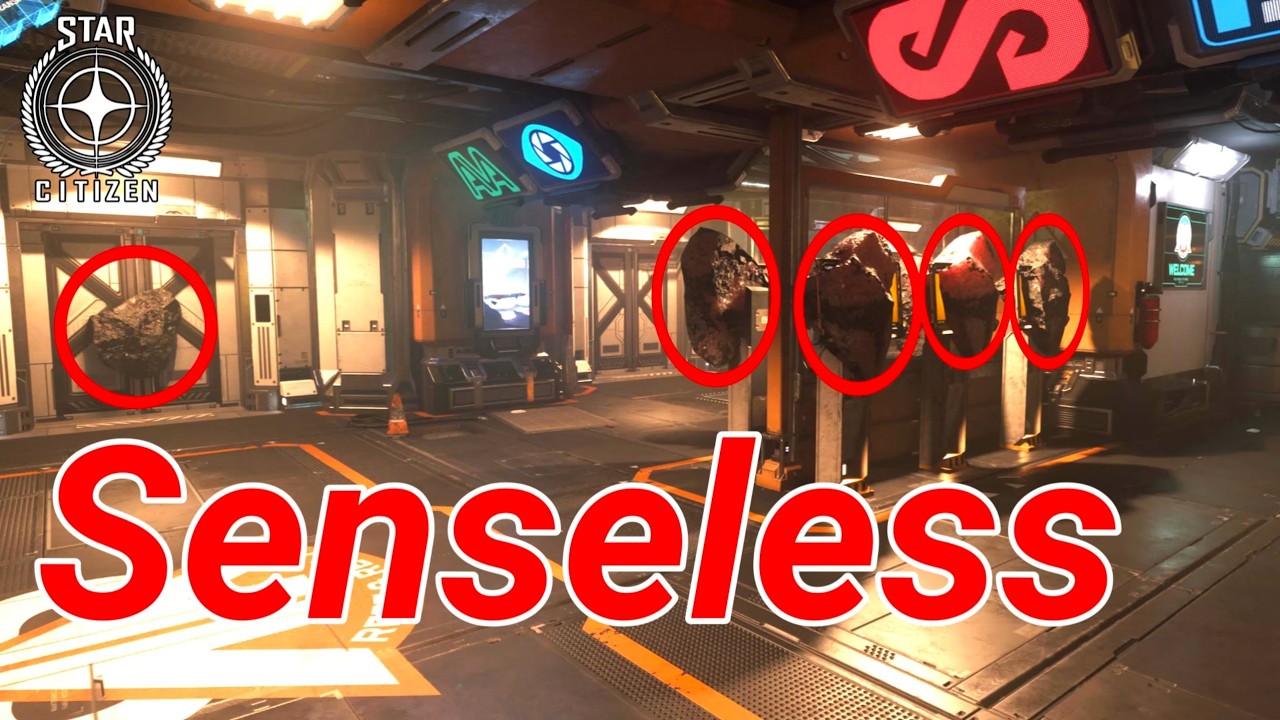
The video discusses a recent incident where players blocked the ASOP vehicle retrieval system in Star Citizen using stones, highlighting a significant flaw in the game’s design and management. The creator, Chad C42001, points out that someone deliberately spent hours placing objects to prevent others from calling ships, an act of griefing facilitated by the game’s poor internal tools. The lack of effective moderation tools and in-game support for removing such obstructions is criticized, with calls for permanent bans for offenders and faster cleanup of persistent objects within the game world.
A major focus of the critique is on Star Citizen’s implementation of Persistent Entity Streaming (PS), a system designed to maintain the state of the game universe, including items left in the environment, over long periods. While the concept aims to enhance immersion by remembering objects like discarded Coke cans in forests, the video argues that PS imposes a heavy burden on CIG’s servers and databases. Unlike other online games, Star Citizen struggles with performance issues due to this system, which also leads to persistent clutter such as abandoned “brick ships” that consume resources without any viable way for players to remove or interact with them.
The video further explains that the problems have worsened over time with increased player caps and new features like static server meshing and engineering mechanics, which add more data for the servers to handle. The game’s aging engine, originally not designed for MMO-scale operations, combined with subpar netcode and server infrastructure, exacerbates these issues. This results in a gameplay environment where griefing and technical limitations severely impact player experience, and where CIG’s current technology and policies fail to adequately address these challenges.
Additionally, the video criticizes the leadership at CIG, particularly Chris Roberts, suggesting that the primary focus of the Star Citizen Persistent Universe (PU) is financial rather than community-driven. It claims that Chris prioritizes funding for high-end art, studios, and the Squadron 42 single-player campaign over improving the multiplayer experience. This perspective implies that the PU serves more as a revenue source than a fully supported MMO, contributing to the neglect of critical gameplay and technical problems like those demonstrated by the ASOP blocking incident.
In conclusion, the video calls for better management of persistent objects, more robust moderation tools, and a re-evaluation of the PS system to reduce server strain and improve gameplay. While acknowledging the creativity and effort behind the griefing act, it emphasizes that such exploits are possible only because of fundamental flaws in the game’s code and infrastructure. The presenter invites viewers to continue the discussion on social media platforms, highlighting ongoing community frustration with Star Citizen’s current state and the need for substantial improvements.