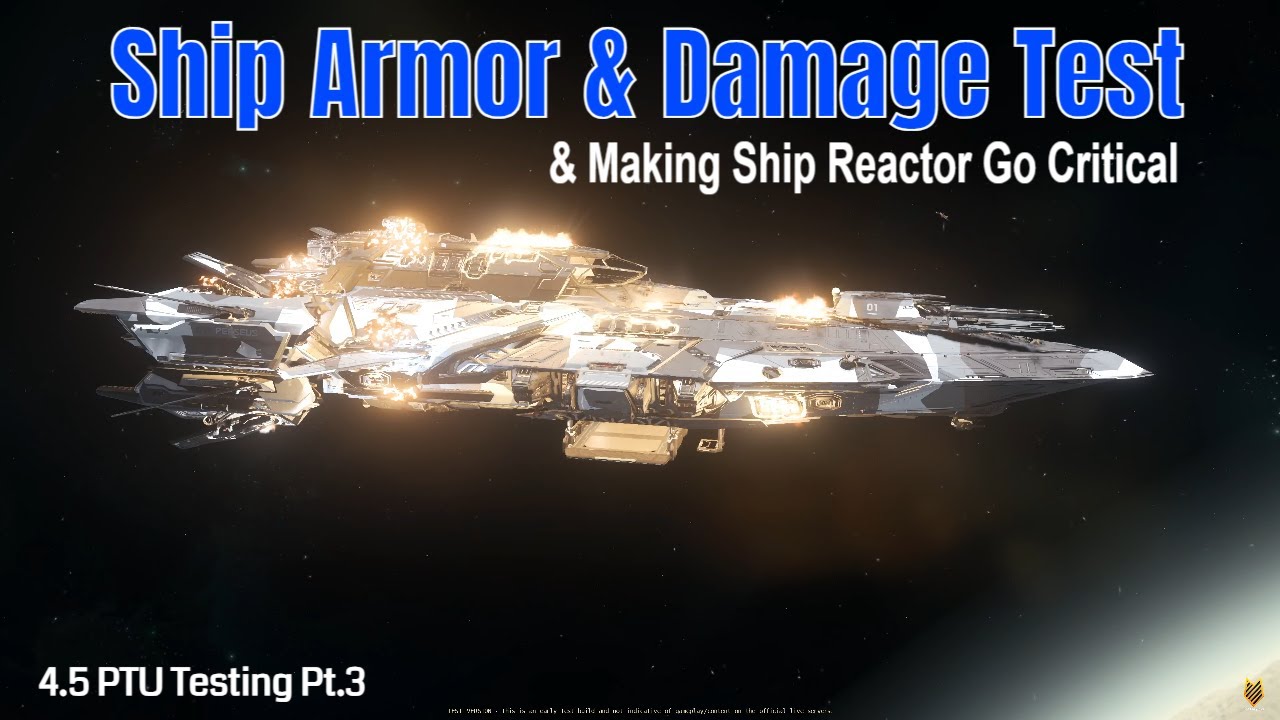
In this video, the creator conducts an in-depth armor and damage test on various ships in Star Citizen Alpha 4.5 PTU, focusing on how ship armor works and how ships can be made to go critical and explode. The test begins with light fighters like the Wolf 21 and Gladius, demonstrating that shields have been significantly nerfed, making them deplete quickly under fire. Once shields are down, components such as power plants and weapons take damage rapidly, and although limited repairs can be done through the diagnostic system, they only restore a small portion of health. The video highlights that when critical components like the power plant are destroyed, the ship’s reactor can go critical, leading to an inevitable explosion.
The creator then moves on to test other ships, including the Firebird and Wolf, showing similar patterns where shields drop quickly and component damage follows. A notable discovery is that shooting the nose of the ship, which is a vital part, can trigger a reactor critical state regardless of whether the power plant is fully destroyed. This pattern holds true across multiple ships tested, indicating an intentional game mechanic where the nose acts as a critical weak point. Attempts to repair components mid-combat offer limited success, and once the ship is in a critical state, the explosion countdown begins, giving players only seconds to escape.
Testing extends to heavier fighters like the Super Hornet Mark 2 and the Mir Guardian, which have more armor and health but still succumb to the critical nose damage mechanic. The Mir Guardian’s engineering terminal provides detailed component health data, showing armor mitigating most damage until the hull and vital parts are compromised. Fires and reactor overload warnings appear as the ship nears destruction, emphasizing the danger of sustained hits to critical areas. The video also demonstrates the dramatic visual effects of ships breaking apart and exploding once they go critical, adding to the immersive experience.
Larger ships such as the Anvil Paladin and Perseus are also examined, revealing their substantial armor pools and component health. Despite their tankiness, the same vulnerability to nose damage applies, with the ship eventually going critical and exploding after sustained fire. The Perseus, with its advanced engineering terminal, shows that while shields protect components effectively, once down, components take damage slowly but steadily. Even with repairs attempted during the critical phase, the ship’s destruction seems unavoidable once vital parts are compromised, reinforcing the importance of armor and shield management.
In conclusion, the video provides a comprehensive overview of the new armor and damage mechanics in Star Citizen Alpha 4.5 PTU. The key takeaway is that the nose of the ship is a critical weak point, and depleting its health leads to reactor critical and explosion, regardless of repairs. Shields have been nerfed significantly, making component damage more impactful, especially in light fighters. While limited repairs are possible, they cannot prevent a ship from exploding once it reaches a critical state. The creator invites viewers to suggest other ships for future damage testing, emphasizing ongoing exploration of the evolving combat mechanics.