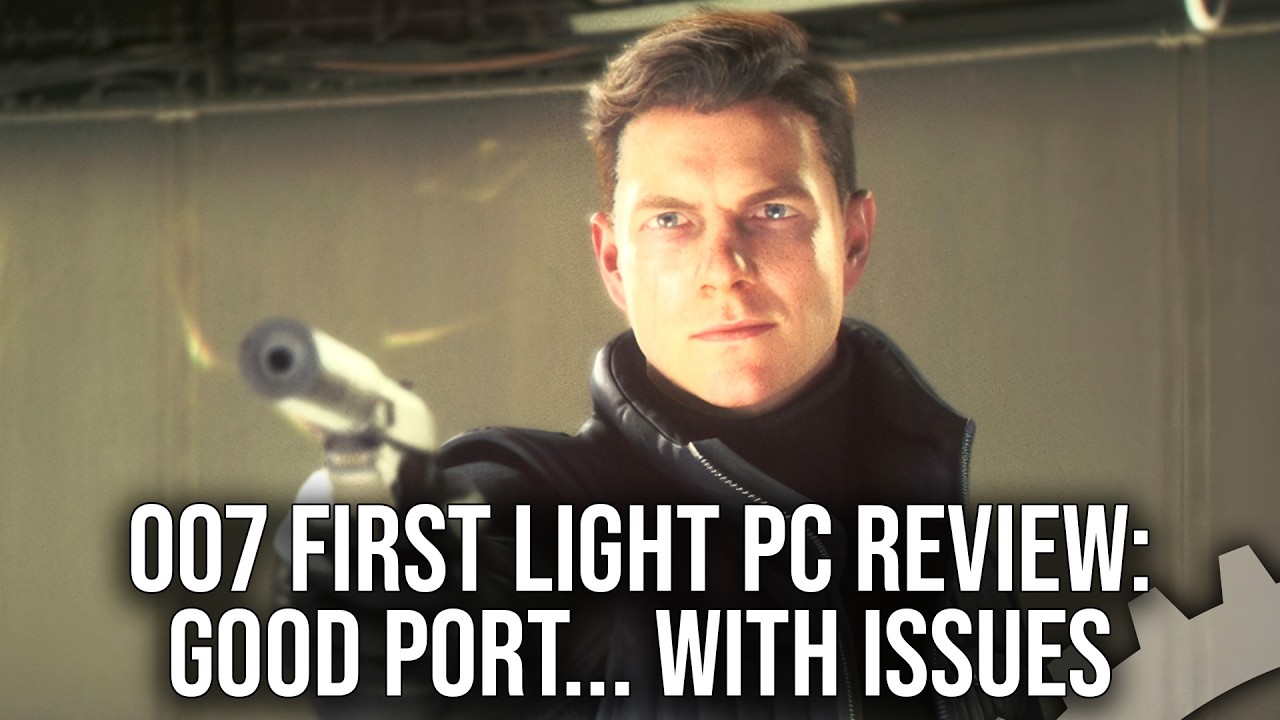
The review of 007 First Light on PC highlights significant developments since earlier impressions, particularly focusing on the recent patch 1.05 that finally fixes the previously broken DLSS upscaling feature. This fix makes the game more accessible for players with lower-end RTX graphics cards, addressing a major performance bottleneck. Despite this improvement, the game still lacks support for other popular upscaling technologies like FSR 4 and XeSS, and frame generation remains limited to Nvidia hardware, leaving AMD and Intel users without equivalent options. The review also notes some puzzling CPU overhead issues with FSR 3 in CPU-bound scenarios.
Testing was conducted on a range of hardware, from modest Ryzen 5 5600 systems to high-end setups like the Alienware Area-51 with Ryzen 9 7950X3D and RTX 5090 GPUs. The game is shown to be quite demanding on CPU resources, especially in scenes with many NPCs or heavy streaming, where mid-range processors struggle to maintain steady 60 FPS. The high-end processors deliver significantly better performance, emphasizing the game’s scaling with CPU power. DLSS now performs as expected, providing the kind of performance uplift typical of the technology, which is crucial for high refresh rate gaming.
Graphical settings were analyzed in detail, revealing that some of the game’s most demanding features, such as volumetric effects and fog quality, offer only subtle visual improvements when set to ultra but can cause significant performance drops. For example, volumetric effects quality can reduce frame rates noticeably without a dramatic change in visual fidelity, making high settings hard to justify. Other settings like texture quality, level of detail, shadow quality, and reflections scale more predictably, with clear visual and performance trade-offs that allow players to optimize based on their hardware and preferences.
The review also compares the PC settings to the console-equivalent presets provided by IO Interactive, finding them to be well-balanced and close to what the reviewer would recommend for most players. Pushing all settings to ultra results in an 18% performance hit, but the visual gains are incremental rather than transformative. This underscores the absence of the promised path tracing update, which is anticipated to bring a more significant visual leap when it arrives. The reviewer expresses eagerness to see how path tracing will enhance the game’s graphics in future updates.
Overall, the PC port of 007 First Light is described as decent but with room for improvement, especially regarding broader upscaling support and the inclusion of more advanced rendering features like path tracing. IO Interactive’s decision to use a static FSR library for development commonality with consoles is understandable but limits the PC version’s potential. The reviewer hopes for expanded support of all major upscaling technologies, including Intel’s XeSS, to provide a more inclusive and optimized experience across different hardware. The review concludes with a positive note on the game’s progress and anticipation for future enhancements.