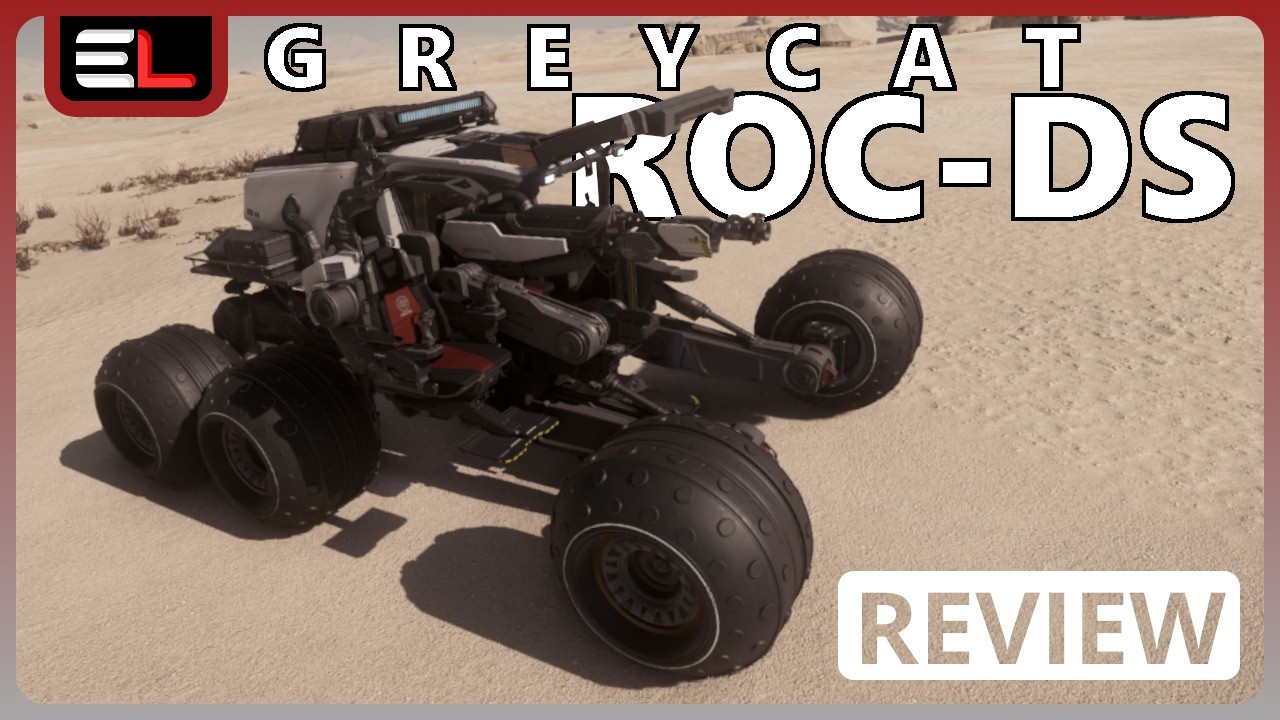
In this Star Citizen ship review, Even Lee takes an in-depth look at the Graycat ROC DS, a ground mining vehicle that has sparked some controversy among players. Initially met with skepticism, especially after comments from Star Citizen developers expressing dislike for the ROC DS, Even Lee approaches the review with an open mind and shares his findings after extensive testing. The ROC DS is priced at $75 on the pledge store or 141,750 AUC in-game, and it offers a larger cargo capacity of 3.4 SCU compared to the original ROC’s 1.2 SCU, making it a strong contender for solo mining operations.
The review highlights the ROC DS’s mining capabilities, focusing on its one-man mining arm equipped with a size zero hosted mining laser. This laser boasts impressive stats such as a minus 40% resistance, plus 30% laser instability, plus 40% optimal charge size, and plus 20% optimal charge rate, outperforming the original ROC’s laser. The vehicle also features two radars and decent armor and HP for a ground vehicle, though it lacks shields. Its speed and climbing ability are commendable, but it requires a larger transport vehicle like the Freelancer Max, limiting its portability compared to the ROC.
Even Lee’s team conducted efficiency tests comparing the ROC DS to the Greycat Geo and the original ROC. The ROC DS excelled by mining 144 gems from 16 Apherite rocks in 5 minutes and 30 seconds, outperforming the Geo’s best time and the ROC’s currently bugged-out state. The ROC DS’s larger cargo capacity and longer laser range allow players to mine continuously without frequent storage interruptions, making it highly efficient for solo players. This contrasts with the Geo, which requires players to frequently exit the vehicle to unload mined materials, increasing downtime and risk.
The review also discusses practical considerations for multiplayer mining. While the ROC DS is excellent for solo miners, players with two or more people might prefer using multiple Geos or ROCs for simultaneous mining. The ROC DS’s design encourages less physical movement between storage and mining, enhancing efficiency but potentially complicating coordination when more crew members are involved. Even Lee suggests that a fleet of ROC DS vehicles could revolutionize large mining operations by minimizing downtime and maximizing output.
Overall, Even Lee gives the Graycat ROC DS a surprisingly high rating of 85 out of 100. Despite initial reservations and the vehicle’s lack of weapons and smaller transport options, its mining efficiency, cargo capacity, and ease of use make it a compelling choice for solo miners. The review closes with a positive note on the vehicle’s sound design and encourages viewers to try the ROC DS themselves. Even Lee’s balanced perspective offers new insights into a vehicle many had written off, recommending it as a valuable tool in the Star Citizen mining arsenal.