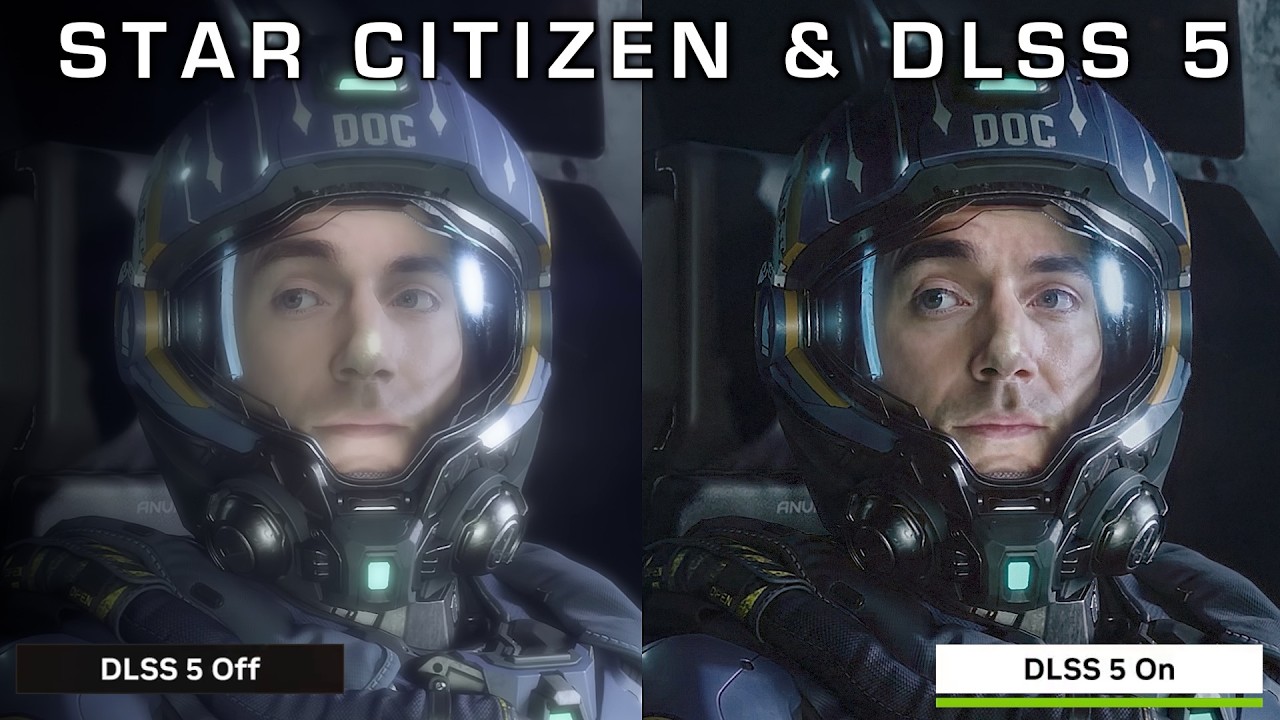
The video discusses the recently leaked DLSS 5 technology from Nvidia, focusing on its implications for games like Star Citizen and Squadron 42. The presenter shares initial skepticism about generative AI and DLSS 5, especially given its controversial reception. DLSS 5 is an advanced upscaling technology that improves graphics by enhancing detail based on actual rendered data, unlike previous versions that either upscaled images or interpolated frames to increase FPS but with drawbacks like increased input latency. However, DLSS 5 is currently incompatible with Star Citizen due to anti-cheat restrictions, so the presenter demonstrates its effects using other games first.
DLSS 5 introduces neural rendering, which applies a clarity filter that enhances lighting and detail without adding artificial or hallucinated elements. While the effect can sometimes look overdone or artificial, the presenter notes that it is adjustable and, in many cases, improves the visual quality by adding realistic lighting effects such as subsurface scattering and reflections based on the game’s rendered data. Despite initial concerns about a generic “AI beautification” effect, the technology maintains consistency with the original character appearances and does not create unrealistic or uniform faces.
The presenter highlights that DLSS 5 is currently trained only for photorealistic graphics, which explains why it performs poorly with stylized games like Final Fantasy. Star Citizen, aiming for photorealism, could potentially benefit from DLSS 5, especially for improving the appearance of crowd NPC faces that are less detailed. However, the presenter emphasizes that main hero characters should remain handcrafted for uniqueness and recognizability. For Star Citizen, which is an MMO, facial detail is less critical, but Squadron 42, being a story-driven single-player game, relies heavily on high-quality, relatable characters, making DLSS 5 potentially more valuable there.
Ray tracing is also mentioned as a complementary technology that has matured significantly and could enhance visual fidelity in Star Citizen and Squadron 42. The presenter notes that while ray tracing was once considered too performance-heavy for fast-paced games, recent titles have demonstrated its feasibility and visual benefits. Star Citizen has been working on ray tracing integration for years, and Squadron 42 is expected to support it at launch, though the stability and quality of implementation remain to be seen.
In conclusion, while the presenter personally dislikes the idea of relying on generative AI filters like DLSS 5, they acknowledge its technological achievements and potential benefits. They express concern over the possibility of developers using such technology to mask mediocre game design but believe that true craftsmanship and passion in game development will always attract players. Despite mixed feelings, the presenter recognizes that DLSS 5 and similar AI-driven technologies are likely here to stay, shaping the future of game graphics whether artists and gamers like it or not.