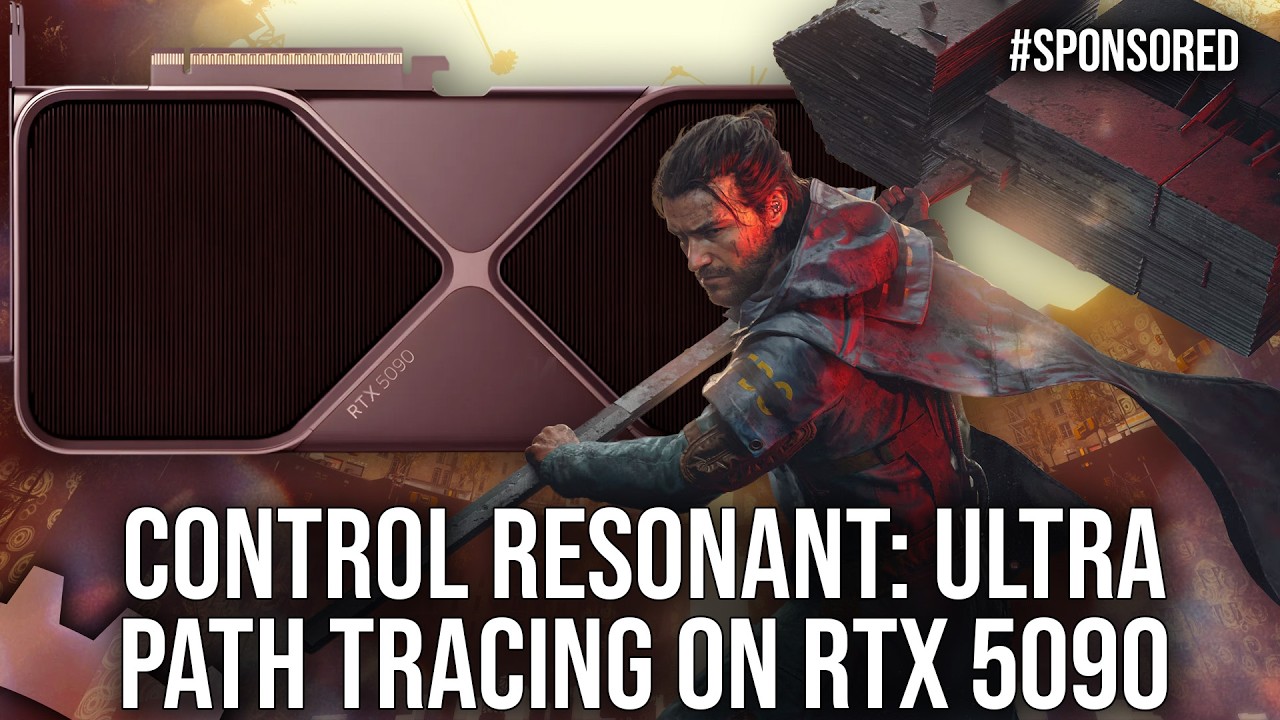
Control Resonant, Remedy Entertainment’s expansive open-world sequel to Control, leverages advanced ray tracing and path tracing technologies on Nvidia’s RTX 5090 to deliver stunningly realistic lighting, reflections, and environmental interactions within a dense Manhattan sandbox. Utilizing Nvidia’s DLSS 4.5 and ray reconstruction, the game achieves smooth 60 FPS gameplay at 4K ultra settings, showcasing a major technical leap in real-time rendering and visual fidelity.
Control Resonant is Remedy Entertainment’s ambitious sequel to the 2019 action RPG Control, expanding its cryptic world into a vast open-world Manhattan sandbox. Departing from the original’s confined “Oldest House” setting, the game introduces a dynamic urban playground where players can leap across rooftops, glide, and engage in agile melee combat against otherworldly creatures. Built on Remedy’s Northlight Engine, the game represents over a decade of technical evolution, blending Remedy’s signature atmospheric storytelling with a fresh open-world design and a new combat system focused on melee rather than shooting.
A major technical highlight of Control Resonant is its integration of advanced ray tracing and path tracing technologies, showcased here running on Nvidia’s top-tier RTX 5090 GPU at 4K resolution with max settings. The Northlight Engine now supports a new world-building editor that enables seamless streaming of around two million entities across the map, creating a dense and richly detailed urban environment. The game’s lighting system benefits greatly from hardware-accelerated ray tracing, which enhances direct and indirect lighting, shadows, reflections, and transparent surfaces, delivering a visually stunning and immersive experience both indoors and outdoors.
The video details how different ray tracing settings impact the game’s visuals, from direct lighting that sharpens shadows and material definition, to indirect lighting that enables multiple light bounces for realistic global illumination and specular reflections. Ray traced transparencies further improve the clarity and realism of glass and reflective surfaces. Additionally, the game features physics-based destruction that adds satisfying environmental interactions, with debris and objects reacting persistently to player actions, further enhancing immersion.
Nvidia’s DLSS (Deep Learning Super Sampling) 4.5 and ray reconstruction technologies play a crucial role in making path tracing feasible at high frame rates. DLSS ray reconstruction uses AI to denoise ray-traced images more effectively than the engine’s built-in denoiser, reducing artifacts like ghosting and flickering while improving performance. This allows Control Resonant to maintain smooth gameplay at 60 frames per second on the RTX 5090, even with ultra ray tracing settings enabled. Additional Nvidia features like frame generation further boost frame rates, offering up to six times the base frame rate and delivering ultra-fluid motion suitable for high-refresh displays.
In summary, Control Resonant represents a significant technical and creative leap for Remedy Entertainment, combining their Northlight Engine’s capabilities with Nvidia’s cutting-edge RTX hardware and software. The result is a richly detailed open-world game that leverages path tracing to deliver unparalleled lighting realism and environmental fidelity. Nvidia’s suite of tools not only enhances visual quality but also ensures high performance, making this a showcase title for next-generation PC gaming. The collaboration between Remedy and Nvidia culminates in a visually spectacular and technically impressive experience that pushes the boundaries of what is possible in real-time rendering today.