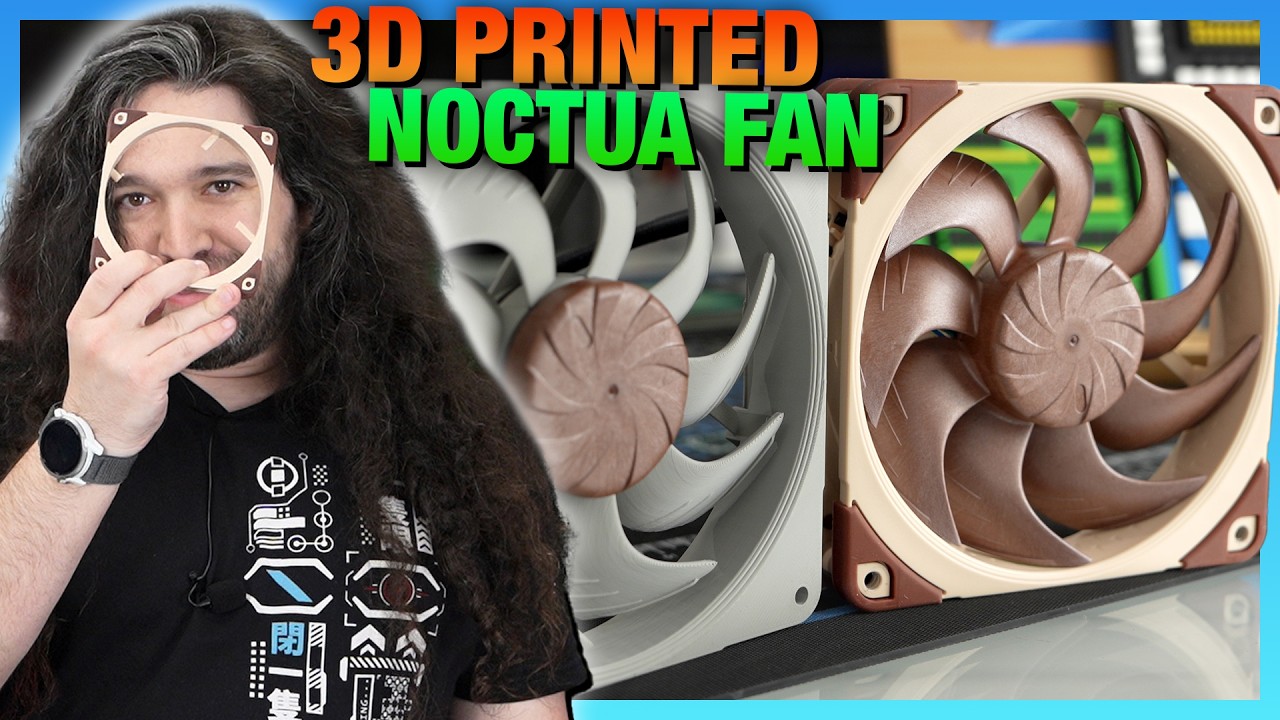
The video explores the ambitious project of 3D printing a Noctua NF-A12 G2 computer fan using the official CAD files released by Noctua. While Noctua provides these files for mechanical design and spacing purposes, they explicitly advise against using them for 3D printing. Despite this, the creators accepted the challenge to print a fully functional fan by salvaging the motor from an actual Noctua fan and printing the rest of the components themselves. This project marks their first serious foray into 3D printing, and they document the entire process, from printing the impeller to assembling and testing the fan.
The team encountered several challenges along the way, including modifying the CAD files to accommodate the motor, dealing with printing supports, and optimizing print settings like layer height to improve print quality. They used PLA filament for ease of printing, though they acknowledged that stiffer materials might yield better results. After several test prints and adjustments, they successfully produced a functional impeller and frame, carefully designing the frame to be 3D printing-friendly while preserving airflow characteristics. The motor was carefully extracted from a genuine Noctua fan, ensuring the printed parts fit snugly onto it.
For performance evaluation, the video details their meticulous testing setup using a fan tester and a Hemi anechoic chamber to measure airflow, pressure, and acoustics. The original Noctua fan outperformed the 3D printed version significantly, with higher static pressure and airflow rates. However, the 3D printed fan still performed reasonably well, comparable to a low-end case fan, and produced similar noise levels, albeit with a slightly different acoustic profile. They also experimented with different filament colors and wood-infused PLA, concluding that the iconic Noctua brown and beige colors do not influence fan performance.
The acoustic analysis revealed that while both fans shared similar frequency spikes, the 3D printed fan exhibited higher noise in lower frequency ranges and a less smooth noise spectrum overall. Despite these differences, the noise levels were comparable at full speed. The video emphasizes that Noctua’s original fans benefit from precise manufacturing, balancing, and advanced materials like liquid crystal polymer, which are not replicable with consumer 3D printing. The creators acknowledge that while their 3D printed fan is a fun and impressive achievement, it cannot match the performance and quality of the factory-made product.
In conclusion, the project demonstrates that it is possible to 3D print a fan closely resembling a Noctua NF-A12 G2 using official CAD files and a salvaged motor, but with noticeably reduced performance. The team spent significant time and resources, including purchasing multiple Noctua fans to harvest motors, and their testing confirms that the factory fans remain superior in all key metrics. The video encourages viewers to experiment with 3D printing but to temper expectations regarding performance. It also highlights the value of Noctua’s design and manufacturing expertise, ultimately affirming the company’s dominance in high-quality PC cooling fans.